AL Circle analysis: How do Germany’s 32.8% automotive aluminium share, 40% Diet Coke can price rise & 3.54Mt North American extrusion demand matter?
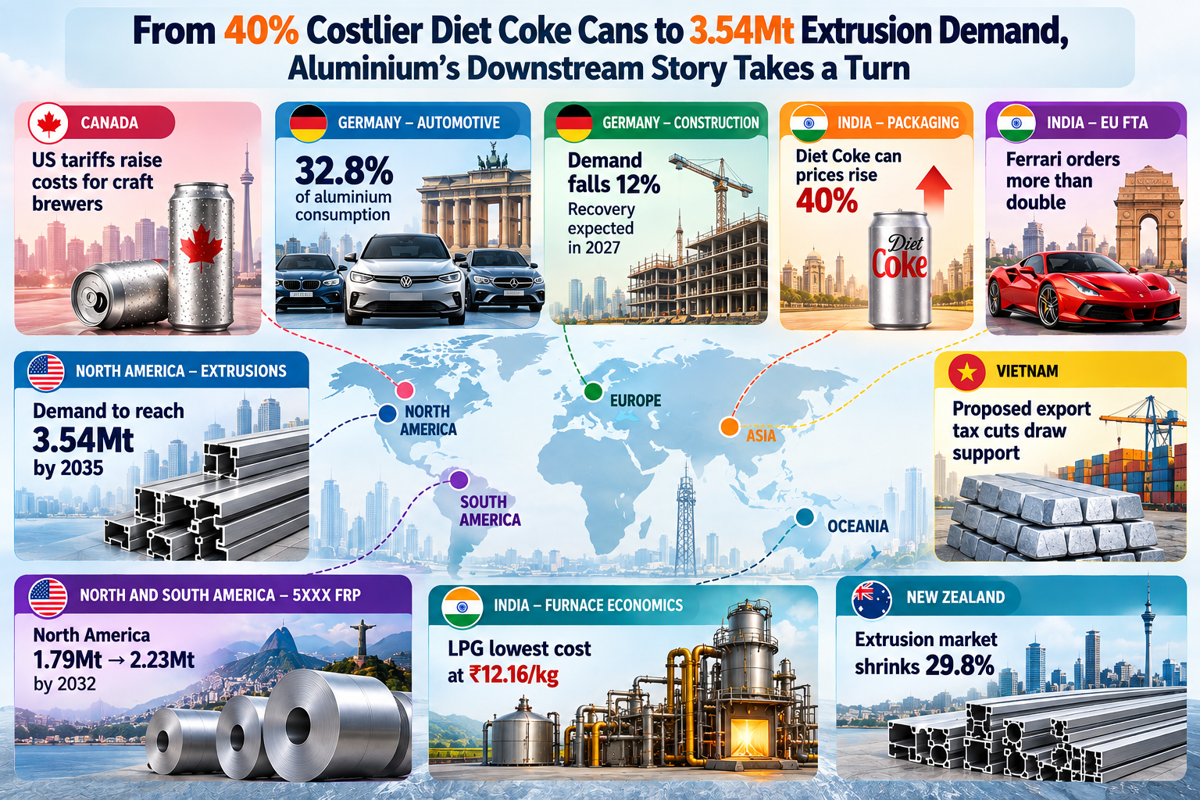
The image used in this article is generated with an AI tool and does not depict any real-time moment
Aluminium’s downstream and end-user world is having one of those fortnights where a beer can, a luxury sports car, a German construction site and an Indian furnace all end up in the same conversation. The metal may begin its life far upstream, but its real fuss is playing out in cans, cars, extrusions, buildings and factories, where tariffs, trade policy, energy costs and demand cycles decide who wins.
This fortnight highlights that aluminium demand is moving towards electric vehicles, lightweight transport and long-life infrastructure, even as packaging and construction feel the pinch of cost and weak activity. Meanwhile, producers from Vietnam to New Zealand are arguing over the oldest question in the business of how much protection, taxation or openness does a downstream industry need to stay competitive?
To know the global production, demand and consumption forecasts of aluminium extrusions, explore our report "The World of Aluminium Extrusions to 2035"
When the can becomes a cost story
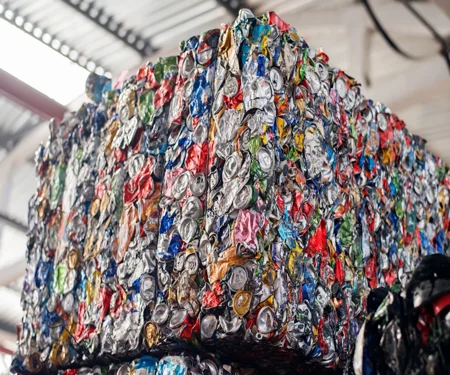
Start with something deceptively ordinary — a can of Diet Coke in India. Its price has risen by 40 per cent amid higher aluminium costs, reminding us that the metal’s price journey does not stop at the smelter or the rolling mill. It travels all the way to the supermarket shelf, where consumers eventually meet it as a small but very noticeable increase in their beverage bill.
The same cost logic is now troubling Canadian craft brewers. With 75 per cent of beer in Ontario sold in cans, United States aluminium tariffs are pushing up costs for breweries that depend on cans as their default packaging format. For small brewers, this is not an abstract trade-policy debate; it is a squeeze on margins in a category where packaging is central to distribution, shelf life and brand appeal.
- Key takeaways
- Watch where tariff costs settle: The real question is whether brewers absorb lower margins, pass costs to consumers, or shift packaging formats.
- Treat cans as a price-sensitive category: Packaging-led price increases may test consumer tolerance, especially in everyday beverage segments.
- Reassess sourcing resilience: Can-dependent businesses should examine supplier geography, contract terms and inventory strategies before costs escalate further.
Europe including Germany: cars up, construction down
While beverage makers worry about can costs, Ferrari is enjoying a very different kind of aluminium-linked momentum. The India-EU Free Trade Agreement has put the Italian marque “in the fast lane”, with orders more than doubling.
Germany offers perhaps the clearest snapshot of aluminium’s split personality. The country’s automotive industry accounts for 32.8 per cent of aluminium consumption, and electric vehicle production has risen by 23 per cent, led by Volkswagen, BMW and Mercedes-Benz.
That is good news for aluminium. EVs give the metal another reason to be indispensable, wherein battery enclosures, body structures, chassis components and thermal-management systems all reward lightweight materials. With Germany’s major automakers pushing EV production higher, automotive remains a powerful anchor for aluminium demand.
But construction tells the opposite story. German construction aluminium demand has fallen by 12 per cent, although a 2027 recovery and recycling offer fresh growth prospects.
- Key takeaways
- Trade access can unlock demand faster than price cuts: Ferrari’s order surge shows that reduced trade friction may matter more than product-cycle timing in premium segments.
- Look beyond volumes: Luxury-car demand is small in tonnage but influential in setting expectations for lightweight, high-performance aluminium applications.
- Track policy-driven demand pockets: Exporters and component suppliers should identify markets where FTAs are changing competitive access.
- Recycling may decide the recovery’s quality: A 2027 construction rebound will favour players with credible recycled-aluminium supply and lower-carbon product propositions.
- Plan for uneven regional demand: Downstream producers should avoid treating Europe as a single market when automotive and construction cycles diverge.
Extrusions: North America climbs, New Zealand stumbles
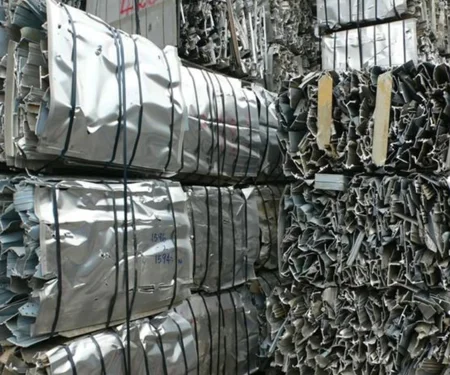
Extrusion is where aluminium becomes profiles, frames, rails, heat sinks, curtain walls and countless industrial components. And the market’s geography is looking uneven.
North America’s aluminium extrusion demand is set to reach 3.54 million tonnes by 2035, with end-use sectors driving the climb. The forecast points to a market where construction, transport, renewable energy infrastructure and industrial applications continue to pull material through the value chain. For extruders, the opportunity lies in serving sectors that need engineered profiles rather than simply commodity metal.
New Zealand, however, is dealing with a sharper problem. Its aluminium extrusion market has shrunk by 29.8 per cent after the country rejected import protection.
- Key takeaways
Import protection can shield local producers from competitive pressure, but rejecting it leaves the market open to imported material. The result, in New Zealand’s case, has been a substantial contraction in the domestic extrusion market.
- Export competitiveness is becoming a policy tool: Vietnam’s proposal signals that governments may use tax relief, rather than import barriers, to support downstream industries.
- Watch for supply-chain reallocation: Wider 0% export taxes could influence where regional buyers source semi-fabricated and downstream products.
- Assess the trade-off: Lower export taxes may support producers, but policymakers will need to balance export incentives with domestic value addition.
And beyond extrusions: The Americas look to specialised demand
Beyond standard extrusions, North and South America’s 5xxx aluminium FRP consumption is drawing attention for its growth drivers and market challenges through 2032.
The 5xxx series, known for its strength and corrosion resistance, is particularly relevant in demanding applications. Its use in fibre-reinforced plastic-related and specialised industrial contexts points to a market where performance requirements, durability and application-specific engineering matter as much as headline volume.
Read our latest magazine “ALuminium’s Frontline: OEM Edition 2026” and learn how OEMs are transforming critical aluminium applications across end-use sectors.
Vietnam bets on lower export taxes
Vietnam is approaching the problem from the policy side. The country’s proposed aluminium export tax cuts have drawn support from VCCI, with a call for wider zero per cent rates.
Lower export taxes can make Vietnamese aluminium products more competitive in overseas markets. For a country seeking to strengthen its position in regional and global supply chains, export-tax relief is a way to support downstream producers without necessarily building walls around the domestic market.
It also contrasts neatly with New Zealand’s rejection of import protection. Vietnam is looking outward, using tax policy to encourage exports; New Zealand has chosen openness at home, even as its extrusion market contracts. Different markets, different starting points—but both show that policy choices can have immediate consequences for downstream aluminium businesses.
India’s furnace economics: where downstream margins are made
Finally, back to India and to a less glamorous but crucial question of how an aluminium tower furnace should be powered.
A should-cost analysis of an aluminium tower furnace in India compares the economics of LPG, PNG and electric energy sources. It is the kind of analysis that rarely makes headlines, yet it sits at the heart of downstream competitiveness. Energy choice affects cost per tonne, emissions intensity, operational reliability and ultimately the ability of Indian processors to compete.
- Key takeaways
- Energy choice is now a competitiveness decision: The LPG-PNG-electricity comparison shows that fuel strategy can shape cost structures as much as metal procurement.
- Electrification depends on power economics: Electric furnaces will gain ground only where reliable, competitively priced and increasingly clean power is available.
- Cost modelling should precede capacity decisions: Indian downstream players should use should-cost analysis to identify the most viable energy pathway before investing.
The winners will be those who can read the downstream and end-user evolution early by securing competitive energy, adapting to trade rules, serving lightweighting-led automotive demand, and positioning for the eventual construction recovery. Aluminium’s next chapter will not be written only in mines and smelters. It will be written in cans, cars, extrusion presses, buildings and furnaces — precisely where the metal meets the market.

Note: This is exclusive coverage by AL Circle and may not be reproduced, republished or shared without prior permission.
Grow with
AL Circle