North America’s aluminum extrusion demand set to reach 3.54Mt by 2035: The end-use sectors behind the climb
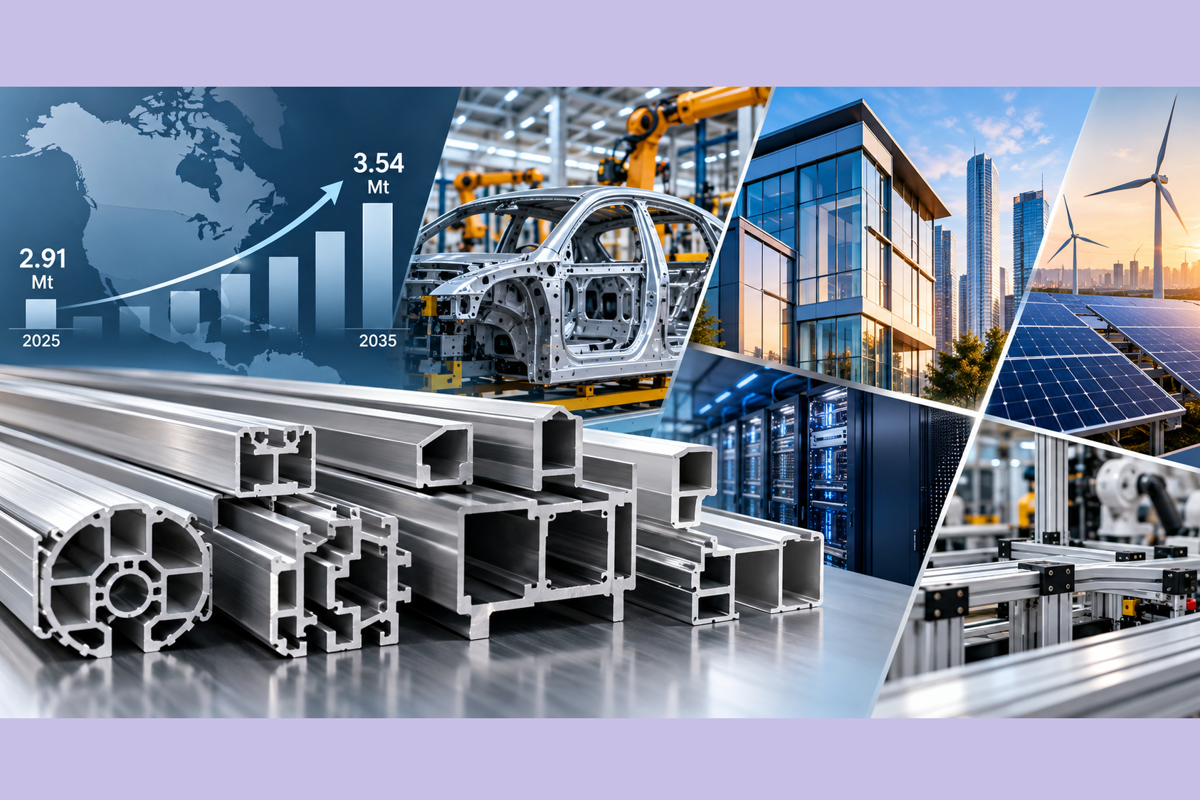
The image used in this article is generated with an AI tool and does not depict any real-time moment
After a soft 2025 and a near-flat 2026, North American aluminum extrusion demand is forecast to climb from 2.91 million tons in 2025 to 3.54 million tons by 2035. The lift is expected to come less from construction volume and more from transportation, data centers, grid and solar, and engineered industrial profiles.
North America’s aluminum extrusion forecast: 630 thousand tons of new demand by 2035
North America is one of the most mature aluminum extrusion markets in the world, and its forecast reflects that. Usage is projected to rise from 2.91 million tons in 2025 to 3.54 million tons in 2035, an addition of about 0.63 million tons and a compound annual growth rate (CAGR) of roughly 1.99%. That is slightly below the 2.29% CAGR expected for global extrusion demand, which is set to grow from 35.25 million tons to 44.22 million tons over the same period. North America accounts for roughly 8% of world extrusion usage at both ends of the forecast.
|
Year |
North America extrusion usage (million tons) |
|---|---|
|
2025 |
2.91 |
|
2026 (forecast) |
2.92 |
|
2032 (forecast) |
3.32 |
|
2035 (forecast) |
3.54 |
The shape of the curve matters as much as the end point. Demand is essentially flat between 2025 and 2026, so almost all of the 0.63 million tons arrives later in the decade, as reshoring, grid investment, lightweighting and data center construction work through the market. The mix of end-use sectors behind that growth is where the story gets interesting.
To know the global production, demand and consumption forecasts of aluminium extrusions, explore our report "The World of Aluminium Extrusions to 2035"
A soft start: demand dipped 2% in 2025 and is expected to grow only about 1% in 2026
The near-term picture is cautious. North American extrusion demand was estimated to have declined 2% in 2025, with CRU expecting roughly 1% growth in 2026. The weakness has been linked to muted industrial activity, weaker-than-expected electric vehicle (EV) production and lower commercial truck and trailer build rates.
US trade policy added volatility. Aluminum bars, rods and profiles (HS 7604) and tubes and pipes (HS 7608) were brought under Section 232 measures in March 2025, with duty levels revised in mid-2025. According to S&P Global Energy, the aluminum tariff rose from 10% to 25% in March 2025 and to 50% in early June 2025. Demand surged in the first half of 2025 on expectations of onshoring, then faded by June as higher all-in aluminum prices began to curb orders.
The result has been an uneven market. Aluminum Association data cited by S&P Global showed new orders for extruded products up 5.1% for January–November 2025 versus 2024, while shipments were down 1.4% through September. By sector, solar, data centers, EV charging stations and some pockets of the automotive industry were growing. Truck trailers were described by one larger extruder as “dismal,” and building and construction was flat for one company but sharply down for others.
Transportation: lightweighting in light trucks and commercial EVs is a core growth driver
Transportation is one of the sectors where North American extrusion growth is expected to be built. The regional outlook points to ongoing lightweighting in light trucks and commercial EVs as one of the main supports for growth, and the region is rated positively for automotive and EV extrusion demand through 2035.
The underlying logic is well established. EV platforms can consume up to two to three times more extrusions than internal combustion vehicles, particularly in battery trays, spaceframes and structural rockers that call for high-strength 6xxx-series alloys. Automakers are also adopting larger, integrated extruded components to simplify vehicle architecture, reduce welding and improve crash performance.
The near term is less smooth. EV-related demand is developing more slowly than expected, and commercial transportation remains weak, so the outlook advises that investment timing account for EV-cycle volatility. Even so, EV structures, battery components and thermal-management profiles remain long-term opportunities. Globally, transportation extrusion usage is forecast to grow from 6.51 million tons in 2025 to 9.26 million tons in 2035, a 3.58% CAGR that is the fastest of any major end-use sector, lifting its share of world demand from 18.5% to 20.9%. Mexico, meanwhile, continues to attract automotive and industrial extrusion investment on the back of nearshoring, and Canadian producers are focusing on value-added products for integrated automotive supply chains.
Building and construction: a mature volume base, with value moving to complex systems
Construction remains the largest single outlet for aluminum extrusions worldwide, accounting for 19.31 million tons, or about 54.8% of global usage, in 2025. Its global CAGR through 2035 is only 1.24%, well below the 2.29% market average, so its share is forecast to slip to 49.4% by 2035. The regional comparison for North America treats construction demand as broadly steady rather than growing, consistent with a mature market.
Rather than being a story of decline, windows, doors, facades, curtain walls, roofing and partitions keep aluminum deeply embedded in buildings, and durability and recyclability support its use. The near-term picture is nonetheless mixed as S&P Global reported building and construction flat for one US extruder and sharply down for others during 2025.
Sustainability is also becoming a differentiator, with Environmental Product Declarations (EPDs), green building certifications and low-carbon specifications increasingly influencing project approvals and supplier selection.
Explore Solar Extrusion, Solar-grade Aluminium Extrusion, Solar Mounting Extrusion Solar Panel Frame Extrusion, PV Mounting Structures, Solar Racking Aluminium, Renewable Energy Extrusion, Solar Module Frames from our comprehensive list of AL Biz
Data centers, grid, electrical and solar: the new demand engines
Grid modernization and data centers are named alongside reshoring and vehicle lightweighting as the forces expected to power North American growth. Data centers are shifting from a general commercial building subsegment into a distinct, high-margin growth vector for extruders, and North America is one of the regions where suppliers of precision 6000-series structural shapes and high-purity thermal profiles are best placed to win premium share.
Inside the facility, rising AI and high-performance computing loads are pushing rack power density from 5-10 kW to 40-100+ kW, and engineering is moving from legacy steel and copper toward extruded aluminum:
- Thermal management: profiles with micro-fin geometries, liquid-cooling channels and cold plates.
- Racks and frames: 6061, 6063 and 6082 structural profiles for modular, rigid enclosures.
- Power distribution: extruded aluminum busways in place of copper busbars; aluminum has roughly 61% of copper’s conductivity, but lower density and cost make it attractive at scale.
- Aisle containment: light, modular frames for ceiling panels, doors and containment walls.
The indirect effect reaches beyond the building. Hyperscalers are contractually driving gigawatt-scale solar installations through power purchase agreements, and solar frames and mounting systems rely heavily on extruded aluminum. Connecting multi-megawatt to gigawatt campuses also requires substation and transmission upgrades, adding demand for structural profiles and high-voltage extruded busbars.
The market is already showing it. S&P Global named solar, data centers and EV charging stations among the growing segments of US extrusion demand in 2025, and the regional comparison rates North American solar demand as rising. Globally, electrical and electronics extrusion usage is forecast to grow from 4.20 million tons to 6.38 million tons by 2035, a 4.26% CAGR, lifting its share of world demand from about 11.9% to 14.4%.
Industrial and specialty profiles: investment is shifting to harder-to-make shapes
Recent North American investment has emphasized technically demanding, large-scale and industrial extrusion rather than simply adding commodity architectural capacity. Aerospace, defense, industrial machinery, and electrical and transportation applications offer opportunities for larger, more technically demanding profiles that can earn better margins than standard architectural shapes. Heavy structural and ultra-wide profiles could become attractive niches where domestic supply is limited.
Industrial applications span machinery, automation, robotics, linear-motion systems, hydraulic tubing, heat management and industrial frames. Because one extruded profile can integrate several functions, it can cut assembly, weight and machining. Globally, industrial extrusion usage is projected to rise from 2.04 million tons in 2025 to 2.68 million tons in 2035, a 2.76% CAGR, and the North American regional comparison rates industrial demand as rising.
Read our latest magazine “ALuminium’s Frontline: OEM Edition 2026” and learn how OEMs are transforming critical aluminium applications across end-use sectors.
Policy, plant closures and low-carbon aluminum are reshaping supply
The demand outlook is unfolding alongside a restructuring of supply. Higher import costs under Section 232 are encouraging U.S. buyers to favor domestic or regional sourcing, supporting utilization at U.S. extruders and the localization of downstream manufacturing in automotive, construction and industrial sectors. US antidumping and countervailing duty investigations in 2023–2024 covered extrusions from a wide range of origins, including China, India, Mexico, Turkey and Vietnam. Under USMCA, qualifying products from Canada and Mexico enjoy preferential access, though exports to the U.S. remain subject to applicable Section 232 measures; S&P Global flagged the USMCA renegotiation as a watch item for 2026.
Plant rationalization is the other side of the coin. Hydro announced it will close its California and Louisiana extrusion plants, citing low-capacity utilization and the significant investment needed to bring the sites up to standard. City of Industry operations are due to end on January 1, 2027, and Delhi on April 1, 2027, affecting about 350 employees, with production moving to other North American sites. Hydro is also ceasing production at its Burlington, North Carolina, plant by the end of the third quarter of 2026 because the site’s primary customer announced its closure, leaving too little demand for its specialized products. Hydro has said it is optimizing its North American footprint rather than leaving the market.
Recycling is a structural advantage. North America’s established recycling infrastructure gives extruders access to secondary aluminum as customers seek lower-carbon products, and the regional comparison rates recycling opportunity as very high. Recycled-content billet could become a key differentiator in automotive, construction and industrial extrusion by 2035.
Note: This is exclusive coverage by AL Circle and may not be reproduced, republished or shared without prior permission.
Grow with
AL Circle