The science behind a better drill: Researchers optimise AA7075-T6 machining
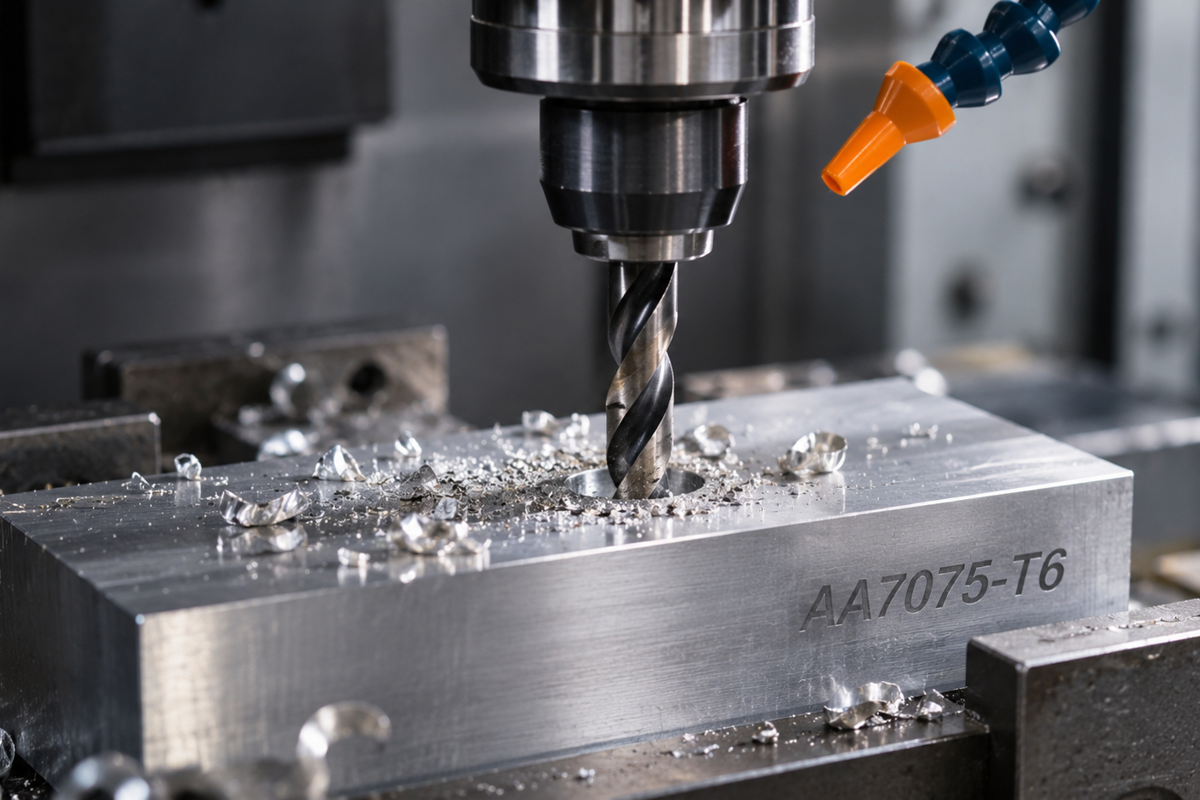
The image used in this article is generated with an AI tool and does not depict any real-time moment
Getting a clean, smooth finish while removing material quickly is not always easy when machining high-strength aluminium alloys. A new study on AA7075-T6 aluminium alloy has explored this challenge, identifying two different sets of drilling conditions to improve surface quality and maximise machining productivity.
The research examined how cutting speed, feed rate and drill depth influence conventional drilling performance. Using response surface methodology and a central composite design, the researchers developed predictive models to determine how changes in these parameters affect the machining process.
The models showed a strong level of accuracy, with coefficients of determination (R²) reaching 0.9731 for surface roughness and 0.9359 for material removal rate. Further confirmation experiments also showed close agreement between the predicted and observed results.
To know the global production, demand and consumption forecasts of aluminium extrusions, explore our report "The World of Aluminium Extrusions to 2035"
Two approaches to better aluminium drilling
One of the study's key findings was that achieving the smoothest surface and removing material at the highest possible rate required different operating conditions.
For minimum surface roughness, the researchers identified a drill depth of 15 mm, a feed rate of 0.20 mm/rev and a cutting speed of 45 m/min as the optimal combination. This produced a surface roughness of 3.66 μm.
However, manufacturers prioritising faster material removal would need to adjust those settings. The study identified a drill depth of 18.04 mm, a feed rate of 0.23 mm/rev and a cutting speed of 53.92 m/min as the most effective combination for this objective. Under these conditions, the material removal rate reached 417.28 mm³/s.
The findings highlight an important trade-off in machining: the conditions that deliver a smoother finish are not necessarily those that maximise productivity. Manufacturers may therefore need to select drilling parameters according to the requirements of each operation.
Read our latest magazine “ALuminium’s Frontline: OEM Edition 2026” and learn how OEMs are transforming critical aluminium applications across end-use sectors.
Implications for structural and aerospace applications
The study also found that cutting speed and feed rate were the most influential parameters affecting material removal rate. Understanding how these variables interact can help refine drilling procedures when working with demanding aluminium alloys.
AA7075-T6 is a high-strength, lightweight alloy, making machining precision an important consideration in applications where material performance and dimensional accuracy matter.
According to the researchers, the experimental findings offer practical guidance for improving conventional drilling processes, particularly in structural and aerospace engineering, where both surface quality and manufacturing efficiency are important.
Explore downstream aluminium products from our comprehensive list on AL Biz.
Kazakhstan tightens EAEU trade, restricts aluminium foil exports till 2030
Next articleSaudi Arabia’s Maadaniyah cancels aluminium foundry project with IGL Group
Grow with
AL Circle













_md.webp)








