15% of Europe’s recycling furnace capacity is idle: Dr Martin Iffert on the scrap shortage limiting aluminium production (Part 2)
_md.webp)
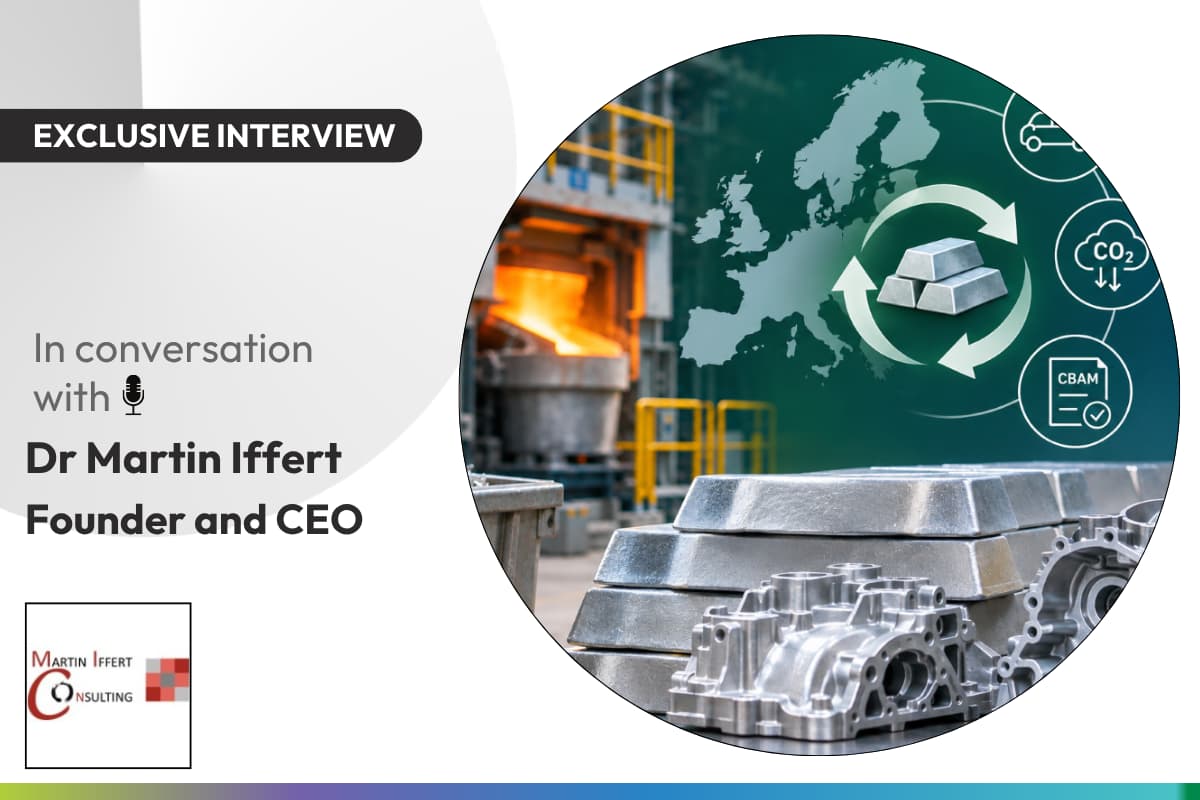
Germany’s aluminium die-casting and recycling industries are navigating a changing landscape, with energy costs, the transition to electric vehicles and evolving carbon regulations influencing production economics and investment decisions. Meanwhile, Europe faces a reported 2-million-tonne gap between aluminium recycling capacity and output, highlighting the growing importance of scrap availability and processing efficiency.
In the second part of this exclusive interview with AL Circle, Dr Martin Iffert, Founder and CEO of Martin Iffert Consulting, discusses the cost pressures facing German die-casters, the implications of CBAM for downstream producers and the technologies that could drive aluminium decarbonisation. He also examines Europe’s scrap shortage, idle recycling capacity and the challenges of strengthening the region’s recycling industry.
AL Circle: German aluminium die-casters face energy costs associated with melting and holding metal, operating casting machines, maintaining dies and running auxiliary equipment. What is the energy cost per tonne of finished castings, what share does it represent of total manufacturing costs, and how have these figures changed since 2023?
Dr Martin Iffert: The price of an automotive die-casting can be divided into three components: metal, tooling and manufacturing. Energy is included in manufacturing costs, alongside labour, equipment, maintenance and other operating expenses. Its share depends on the component, production route and the scope of the cost calculation.
Energy consumption should be measured per tonne of saleable castings. Internal returns, re jects and rework increase the energy and processing effort required for each tonne delivered. As an illustration, a plant using 2 MWh of gas and 1 MWh of electricity per tonne of saleable castings would incur around EUR 200 per tonne at structural prices of EUR 40/MWh for gas and EUR 120/MWh for delivered electricity. Capacity utilisation is equally important because it determines how fixed manufacturing costs are distributed across production volumes.
German automotive manufacturers and their suppliers face a particularly demanding transformation. In my assessment, the policy-driven timetable for electrification initially moved faster than the alignment of vehicle affordability, charging infrastructure and customer acceptance. This contributed to uncertainty in demand and investment planning.
The transition also changes the industry’s cost structure. Established combustion-engine programmes can benefit from mature processes and substantially depreciated development expenditure and production assets. Electric vehicles require new development, equipment and production facilities. These overlapping commitments put pressure on margins, particularly before new facilities reach their intended utilisation.
New vehicle generations offer grounds for greater confidence as their capabilities become better aligned with customer requirements. I am making this transition myself: later this year, I will replace my diesel-powered BMW 520d xDrive with an all-electric BMW iX3 50 xDrive. I see the latest generation of battery-electric vehicles (BEVs) from established German premium manufacturers becoming attractive to German business owners and executives. I am convinced that this will lead to a broader recovery in demand, which will help manufacturers and suppliers improve utilisation and earn returns on their investments.
For die-casters, profitability therefore depends strongly on stable production volumes and consistently producing conforming parts without rework or rejects. Metal-price indexation does not automatically recover increases in energy or other manufacturing costs; these require separate contractual provisions or negotiations.
A comparison with 2023 must consequently consider procurement prices, energy consumption, utilisation, quality and cost recovery together. Successful investment in the new product generation can establish a competitive long-term position, but the transition places substantial demands on current margins and cash flow.
AL Circle: How could CBAM and its proposed extension to downstream aluminium products affect Europe’s competitiveness, particularly Germany, a major hub for automotive suppliers and die casters competing with manufacturers in China and Türkiye? How might producers adapt their sourcing, pricing and trade strategies, and what could this mean for cross-border trade, downstream investment and global competition?
Dr Martin Iffert: CBAM was designed to complement the European ETS, prevent carbon leakage and establish comparable carbon-cost treatment for European production and imports. However, its design risks creating additional economic costs and environmental inefficiencies where compliance changes material flows without reducing global emissions.
One concern is the development of recycling facilities alongside primary smelters outside Europe. Producers respond rationally to European carbon rules and OEM recycled-content requirements by finding the most economical way to qualify their products for the European market. This can increase competition for scrap and redirect recycled metal towards customers requiring a particular carbon footprint or recycled content, while primary aluminium serves other markets.
Such changes do not necessarily decarbonise primary production. If existing scrap is simply diverted from one application to another, the result may be a redistribution of primary and recycled aluminium rather than an increase in global recycling or a reduction in emissions. Additional transport and processing can further weaken the environmental benefit.
The relevant test is therefore whether the rules stimulate additional scrap recovery, improve metal yields or reduce overall emissions. Compliance and recycled-content claims alone are insufficient measures of progress. The Council and Parliament positions on CBAM anti-circumvention already address “resource shuffling”, which confirms that this concern is recognised.
For German processors, charging carbon costs on metal while leaving competing imported components outside the scope can weaken competitiveness. Producers therefore need verified emissions data, sourcing comparisons based on delivered costs and contractual provisions for carbon-cost changes. Predictable downstream coverage is important for investment, while export competitiveness requires separate attention.
AL Circle: Beyond renewable electricity, which pathway offers the most credible route to decarbonising European primary aluminium production by 2035: inert anodes, carbon capture, green hydrogen for downstream thermal processes, or flexible renewable-powered smelting? What are the main barriers to commercial deployment?
Dr Martin Iffert: I would not make inert anodes the foundation of Europe’s aluminium decarbonisation strategy for 2035. After decades of development and substantial investment, sustained, economically competitive deployment across commercial potlines remains to be demonstrated. Recent industrial-scale trials are progressing, but they do not yet establish a broadly deployable solution.
My assessment also reflects the scale of the potential contribution. Bill Gates’s book How to Avoid a Climate Disaster describes an investment criterion of technologies capable of avoiding at least 500 million tonnes of emissions annually at full deployment. I find this emphasis on scale useful when setting research and investment priorities.
The aluminium value chain generates approximately 1.1 billion tonnes of CO₂-equivalent emissions annually. Most of this comes from fossil-fuel electricity used for electrolysis, which makes low-carbon power the main lever. Direct CO₂ emissions from carbon-anode consumption are of the order of 100 million tonnes. Inert anodes could address these emissions, with further benefits in anode production, but their contribution to the overall challenge remains limited. I therefore see them as a potential supplementary technology rather than the principal route to decarbonisation.
In my view, success will depend primarily on other technologies. Carbon capture has applications across aluminium production and the wider industrial economy. CCS, and CCU where it delivers demonstrable lifecycle benefits, can draw on infrastructure and technology development extending well beyond our sector. Sustainably sourced bio-based materials and fuels may provide further substitution opportunities.
Flexibility is essential for integrating renewable electricity. Smelters can adjust consumption to electricity availability, while heat recovery and electrification can reduce fossil-fuel use elsewhere in the aluminium value chain.
Plasma burners provide one route to electrifying high-temperature processes. They use electricity to generate a high-temperature plasma jet that transfers heat to the furnace, potentially replacing natural-gas burners in suitable applications. Hydro’s development programme at Sunndal illustrates this approach for aluminium casthouses.
High-temperature thermal energy storage can complement electrification. Electricity can be converted into stored heat when solar or wind generation is abundant, then delivered to industrial processes when required. This separates the timing of electricity procurement from heat consumption and can support continuous production despite variable renewable supply.
The appropriate combination depends on temperature, heat-transfer requirements, storage losses, equipment durability and delivered energy costs. Plasma heating and thermal storage address different technical needs, but both offer opportunities extending beyond aluminium. Their ability to replace fossil-fired industrial heat deserves greater attention alongside carbon capture, sustainable bio-based materials and other electrification technologies.
Green hydrogen may serve selected thermal applications, but should be compared with direct electrification, plasma heating and thermal storage on delivered heat cost, efficiency and process suitability.
The deployment barriers are industrial reliability, energy requirements, capital costs, infrastructure and an adequate return on investment. These must be addressed through site-specific engineering and predictable commercial conditions.
AL Circle: European Aluminium estimated a gap of approximately 2 million tonnes between European recycling capacity and production in March 2025. Scrap exports rose by 53 per cent between 2019 and 2024, while domestic scrap intake grew by just 7 per cent. How much recycling capacity is underused because of feedstock shortages, and how much additional annual output could be unlocked by closing this gap?
Dr Martin Iffert: European Aluminium’s figures indicate a substantial feedstock constraint. Its March 2025 paper identified a gap of approximately 2 million tonnes between recycling capacity and production. In August 2025, the association estimated that around 15 per cent of European recycling furnace capacity was idle because of insufficient scrap availability. These are industry estimates rather than a plant-by-plant assessment of recoverable output.
The 2-million-tonne figure describes the scale of the reported production gap, rather than a forecast of additional annual output. Closing it requires suitable scrap, competitive processing costs and customer demand for the resulting alloys.
Scrap quality is increasingly important. The transition from combustion engines to electric vehicles weakens some traditional outlets for mixed secondary casting alloys. Better sorting, decontamination and pretreatment can qualify suitable scrap for wrought alloys and demanding foundry applications, reducing the primary metal required for dilution.
However, upgrading scrap adds cost. Equipment, labour, energy, emissions control and residue treatment must be financed. Processing difficult scrap under high environmental and occupational standards can be substantially more expensive than using routes with less demanding requirements. The additional value of the recovered metal does not always cover this difference.
The Commission has now replaced the export duty it originally considered with planned restrictions on shipments to non-OECD countries, expected from 2027. In my view, a well-designed export measure, whether a duty or a restriction, could help address that imbalance. It could improve European recyclers’ ability to compete for feedstock against overseas processors operating under less demanding environmental and labour requirements. Effective coverage of major destinations and safeguards against circumvention would be essential. The measure should also preserve incentives for collection, sorting and advanced processing. Retaining scrap alone does not increase global recycling. The case for export measures rests on better recovery, emissions control and residue treatment under European standards, not on shifting carbon footprints between markets. Such measures should therefore support investment in technology, automation and responsible processing.
The opportunity is substantial, but the output unlocked will depend on matching scrap quality, plant capability and customer demand under economically viable conditions.
AL Circle: CBAM currently excludes aluminium scrap under customs code CN 7602, while policymakers are debating the treatment of pre-consumer and post-consumer scrap. How does the current framework affect investment in European recycling capacity and competition with overseas markets? What changes to the rules would best support European recyclers without discouraging recycling?
Dr Martin Iffert: The debate over scrap exposes a fundamental dilemma in CBAM: a lower carbon footprint for European imports does not necessarily mean lower global emissions.
Consider an overseas producer using three equal input streams: locally produced primary aluminium, pre-consumer scrap and post-consumer scrap. Suppose one-third of its output is sold to Europe. Rather than supplying every market with the same material mix, the producer has an incentive to direct post-consumer scrap-based production towards European customers and primary-metal-based production towards other markets. Where the production arrangements and applicable accounting rules permit this differentiation, European imports can show a substantially lower footprint without any reduction in the producer’s overall emissions. Scrap may carry no inherited primary-production emissions under the relevant methodology, although remelting and processing still generate emissions. OEM recycled-content requirements can reinforce this redistribution and increase competition for scrap.
The same tension already exists in voluntary carbon accounting, outside CBAM, which for aluminium covers only direct emissions. The GHG Protocol allows market-based reporting of electricity emissions using contractual instruments, but it is a recommendation rather than a legal requirement, and how such claims are allocated to individual products remains open. One example is a smelter that obtains a percentage of its electricity from photovoltaics and allocates
that electricity to a corresponding volume of aluminium. Such an allocation may be an accounting exercise rather than a separate physical production process. The renewable electricity is real, but allocating its benefit to selected products might create ambiguity for its customers.
The same distinction applies to scrap: a lower declared footprint for a selected shipment does not demonstrate an additional reduction in global emissions. Policy should reward additional recovery and actual decarbonisation, rather than merely the redistribution of existing environmental attributes.
In my view, resetting the inherited carbon footprint of post-consumer scrap to zero can function consistently only within an integrated market operating under comparable carbon-pricing, monitoring and verification rules. I would therefore not apply that principle to material entering from third countries outside this framework. Otherwise, Europe risks recognising an accounting benefit without a corresponding reduction in global emissions. This is broadly consistent with the European Parliament’s position, which would count all aluminium scrap used in imported products, including post-consumer scrap, as carrying embedded emissions. The same treatment must follow the metal into semi-finished and downstream products. If not, the advantage simply moves from ingot to profile, sheet or component.
For European recyclers, the consequences are commercial as well as environmental. Greater competition for feedstock can weaken utilisation and investment returns, particularly where responsible sorting, decontamination and residue treatment carry costs that competing overseas processors do not face.
CBAM rules should therefore be considered alongside recycling policy and scrap-export measures. In my view, a well-designed export measure could help address unequal processing conditions while preserving incentives for collection and sorting. The objective should be additional recovery, better metal yields and economically viable production of the alloy qualities customers require.

