Secondary Aluminium
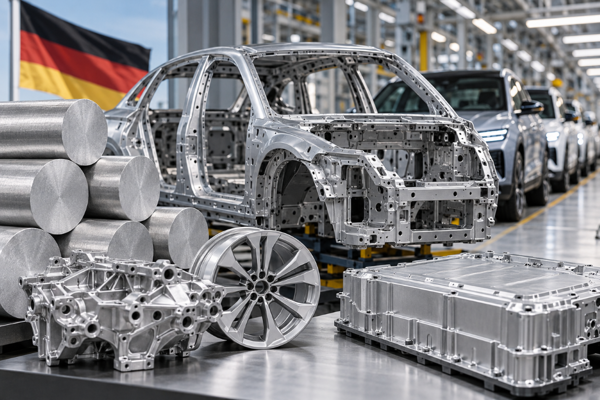
Germany’s automotive industry drives 32.8% of aluminium consumption as EV production rises 23%, led by Volkswagen, BMW & Mercedes-Benz
Germany’s automobile industry is a major part of the country’s aluminium story, with the metal used in everything from vehicle body panels and chassis components to battery enclosures and electric-drive systems. As automakers develop lighter vehicles and expand their electric models, aluminium has become an important material across the manufacturing process. Germany’s automotive industry consumes around 950,000 tonnes of aluminium annually, accounting for a substantial share of the wider transport sector’s demand. In 2025, Germany’s total aluminium consumption stood at approximately 2.9 million tonnes, with the transport sector accounting for 1.35 million tonnes, representing 46 per cent of the total. This extensive use of aluminium in transport mirrors its importance to the global...
Rate hike expectations disrupt, coupled with post-holiday inventory buildup; Aluminium prices consolidate on a subdued note in the short term
The most-traded SHFE aluminium contract opened at RMB 23,255per tonne in the night session on Oct 8, hit a high of RMB 23,365 per tonne and a low of RMB 23,195 per tonne, and closed at RMB 23,220 per tonne, down RMB 165 per tonne or 0.71 from the previous close. Futures quickly dipped and weakened, with prices falling below all cyclical moving averages of 5/10/20/40/60. All moving averages turned downward to form resistance, highlighting a bearish pattern. Trading volume during the session was 74,115 lots, with open interest at 269,000 lots, down 819 lots, mainly driven by bulls cutting positions and exiting. On the technical front, the 4-hour MACD death cross continued, with DIFF well below DEA. Green bars expanded significantly, and bearish momentum continued to be released. The LME...
Grow with
AL Circle
Price
→Events

Business Cards
A report that reveals where the aluminium casting industry is heading and how businesses can act.
LEARN MORE
A report that reveals where the aluminium casting industry is heading and how businesses can act.
LEARN MOREEurope’s recycled aluminium production: Germany, Italy and the UK anchor a competitive market
Global EV sales to hit 35.4 million by 2030, with aluminium usage forecast to rise 38% in North America & 79% in China
AL Circle analysis: How do Germany’s 32.8% automotive aluminium share, 40% Diet Coke can price rise & 3.54Mt North American extrusion demand matter?
AL Circle Analysis: Guinea’s 150Mt bauxite cap, China’s import swings, US tariffs draw aluminium Q4’26
EU approves Germany’s power relief instrument: Could aluminium producers save €459m annually?
News
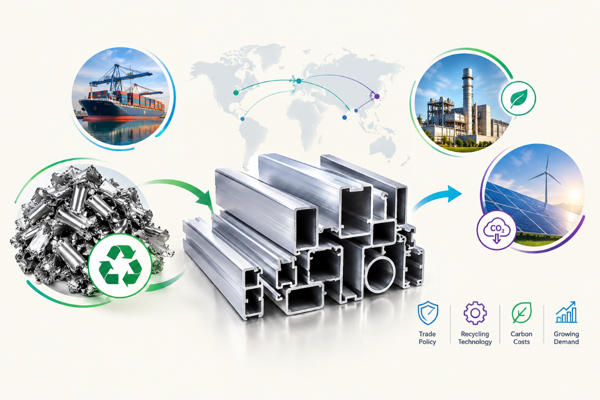
AL Circle Analysis: Aluminium’s recycling economics, trade walls and carbon rules converge
The story of the aluminium industry is starting a chapter wherein scrap availability, recycling technology, trade policy, carbon costs and demand growth are becoming increasingly interconnected. From the US and Canada to Europe, India, New Zealand and China, recent developments show that the global aluminium supply chain is being reshaped on several fronts at once. These developments point to a changing aluminium business model: access to metal alone may no longer be enough. Quality of recycled feedstock, domestic processing capacity, carbon intensity, trade exposure and the ability to meet increasingly specific customer requirements could become equally important competitive factors. Join the fourth edition of the webinar “Hedging for recyclers - Become an expert in 6 hours” by Jorge...

ADC12 consolidates on a strong note as costs rise and orders see marginal improvement
Aluminium scrap: This week, China's aluminium scrap market price centre edged up alongside primary aluminium. As of September 10, SMM A00 aluminium prices closed at RMB 24,560 per tonne, up RMB 210 per tonne from RMB 24,350 per tonne last Thursday. Domestic aluminium scrap prices followed with relatively limited gains, but supported by raw material scarcity and selling activity at some yards, mainstream grades such as shredded aluminium tense scrap and bare bright aluminium wire were quoted on a consolidate on a strong note basis, with traders in some regions slightly raising purchase prices in tandem. In terms of price spreads, on September 10, the price difference between A00 aluminium and mixed aluminium extrusion scrap free of paint in Foshan was about RMB 2,436 per tonne, and the...

Weak domestic markets are holding back aluminium scrap sorting investments, WBCSD study finds
A WBCSD study says advanced sorting technology is available, but stronger demand for grade-specific secondary aluminium is needed to unlock investment. Technology for sorting mixed aluminium scrap has advanced significantly, but weak domestic markets for some recovered grades are limiting investment in automated sorting infrastructure, according to a study by the World Business Council for Sustainable Development (WBCSD). The study, conducted through WBCSD's North America Aluminum Initiative, examined whether technologies such as X-ray transmission (XRT) and laser-induced breakdown spectroscopy (LIBS) could help transform mixed aluminium scrap into higher-quality, grade-specific secondary metal for domestic use. Its conclusion is that technology is only part of the equation. Recyclers...

AL Circle Analysis: How are scrap, CBAM, EVs, energy rewiring the aluminium industry?
The aluminium industry stands at a juncture material quality, recycling capacity, cross-border cooperation, carbon compliance and energy security are falling into a network of interconnectivity. The aluminium supply chain is evolving from simply securing enough metal to securing the right quality, the right carbon profile, the right technology and the right energy at the right cost. For businesses, this means supply-chain decisions are increasingly becoming strategic rather than purely transactional. From secondary aluminium trust to a recycling ecosystem India’s secondary aluminium market is expanding, but buyers need stronger checks before committing to suppliers, as trust has to accompany volume. As Indian buyers increase their participation in secondary aluminium, supplier...

Buying Indian secondary aluminium? Start with these seven verifications
Secondary aluminium is increasingly central to Europe’s decarbonisation plans. It is used in automotive castings, construction profiles, packaging and consumer goods and is valued because it can deliver similar mechanical properties to primary metal while requiring a fraction of the energy and emitting far less carbon dioxide. The European Union’s Emissions Trading System (ETS) and the Carbon Border Adjustment Mechanism (CBAM) have made low-carbon aluminium a strategic priority. As India’s scrap aluminium imports have continued to rise, from 0.88 million tonnes in CY15 to nearly 2 million tonnes in CY25, with a long-term CAGR of about 8.6 per cent, stronger traceability and licensing requirements are becoming increasingly important across the secondary aluminium supply chain. For this...

Why aluminium scrap grade matters when buying secondary aluminium in India
India’s aluminium recycling sector has matured significantly over the past decade. Secondary aluminium, produced by remelting and refining scrap, now accounts for a growing share of the country’s total aluminium consumption. Recycling aluminium requires up to 95 per cent less energy than smelting primary metal from bauxite, and that energy advantage flows directly into pricing: secondary alloy ingots are consistently priced below equivalent primary material, often by a meaningful margin, without compromising performance for most industrial applications. The Indian market has a wide spread of recycled-aluminium suppliers, from fully integrated, ISO-certified recyclers operating multi-location facilities and supplying global customers, to informal remelters working from single furnaces...















Blog
LATEST POSTS




Turn marketplace visibility into more relevant buyer enquiries.
View Priority Plans
Turn marketplace visibility into more relevant buyer enquiries.
View Priority Plans
