AL Circle Analysis: Alumina prices fall 22%, Ghana advances bauxite projects & global aluminium production rises 2.1%
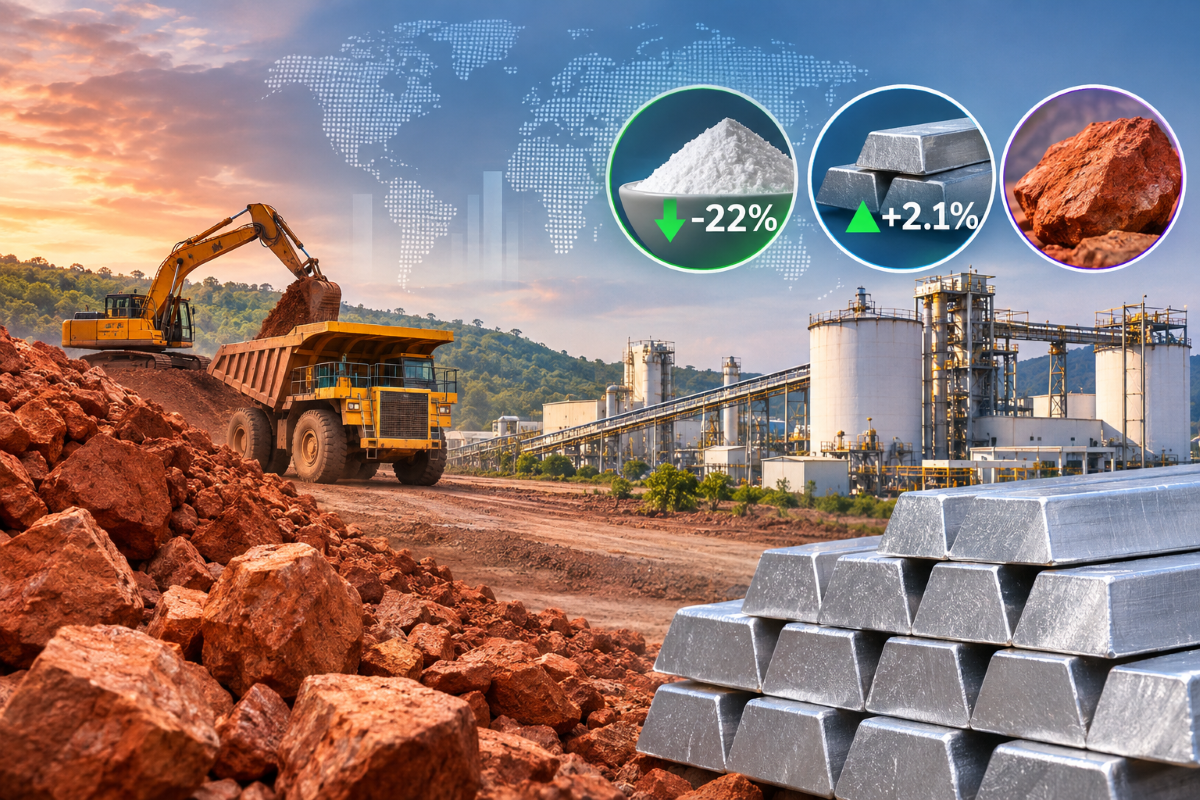
The image used in this article is generated with an AI tool and does not depict any real-time moment
The global aluminium industry is entering a new phase of competition, with access to raw materials, affordable energy and production capacity increasingly shaping the position of major producers. China is preparing a large overseas smelting expansion, Ghana is attracting investment in its bauxite reserves, and India and Vietnam are advancing new aluminium projects.
However, the expansion drive comes against a complicated market backdrop. Alumina prices have fallen sharply, energy and logistics costs remain significant, and trade policies are reshaping the economics of production and exports. Together, these developments point to a market in which securing resources is only part of the challenge; converting them into competitive aluminium will matter just as much.
Africa’s bauxite ambitions meet a power test
Africa is attracting renewed attention as aluminium producers look beyond established sources of bauxite and alumina. Ghana is among the countries seeking to turn its mineral resources into a stronger domestic aluminium industry.
Ghana’s Nyinahin bauxite deposit is estimated to be worth around USD 17.5 billion. On November 1, 2026, the Ghana Integrated Aluminium Development Corporation (GIADEC) hosted a delegation from ORG Technology, three days after Ghana reached an agreement with RUSAL. The proposed RUSAL partnership involves two joint ventures, with the Russian producer holding majority stakes. The projects could support bauxite mining of up to 5 million tonnes per year and an alumina refinery with capacity of 1.2 million tonnes per year.
The ambition extends beyond mining. Ghana’s Volta Aluminium Company (VALCO) reported a provisional profit of USD 1.3 million for the first nine months of 2026 and aims to process 1.5 million tonnes of alumina within the next decade, supported by a proposed USD 4 billion investment.
Yet Guinea offers an important reminder that mineral wealth alone cannot guarantee industrial growth. The country currently produces around 1,000 MW of power, while estimates suggest it needs an additional 5,000–10,000 MW to support its broader industrial ambitions. The electricity shortfall could delay an additional 75,000 tonnes of aluminium supply until after 2030.
Key takeaways
- Project selection: Prioritise bauxite and alumina projects with credible power and infrastructure plans.
- Supply diversification: Ghana’s partnerships could become important future sources of bauxite and alumina, but execution will determine their value.
- Investment risk: Guinea demonstrates how electricity constraints can delay downstream capacity even where raw materials are available.
China’s expansion puts future supply in focus
China’s influence on global aluminium supply is extending beyond its domestic production base. Chinese producers have announced or planned at least 15 million tonnes per year of new primary aluminium smelting capacity across Southeast Asia, the Middle East, Central Asia and Africa. If realised, this pipeline could significantly alter the global supply balance. However, regulatory scrutiny from Beijing and project profitability may limit how much capacity ultimately comes online.
Vietnam is emerging as one of the important destinations for this investment. The country’s first electrolytic aluminium project in Dak Nong has a planned capacity of 450,000 tonnes per year. Its second phase produced its first molten primary aluminium on October 31, 2026, more than four months ahead of schedule, with NFC acting as the contractor. The project has entered trial production.
Vietnam is also advancing its alumina ambitions. CHALIECO has won the EPC bid for a proposed 2.4 million-tonne-per-year alumina project. The contract is valued at CNY 5.595 billion, equivalent to approximately USD 839 million, with a planned construction period of 27 months from the effective date.
India is pursuing capacity growth through NALCO’s proposed INR 300 billion expansion at Angul. The project aims to increase aluminium production capacity from 460,000 tonnes per year to around 1 million tonnes per year, with operations targeted for 2030–31.
Meanwhile, global primary aluminium production showed a quarterly recovery. International Aluminium Institute data put Q3 2026 output at 18.377 million tonnes, up 2.1 per cent from 18.003 million tonnes in Q2. The improvement reflected capacity restoration in the Gulf Cooperation Council region and stronger operational performance in Europe, Oceania and Asia. However, production remained below Q3 levels in 2025 and 2024.
Key takeaways
- Oversupply risk: China’s overseas capacity pipeline could put pressure on prices and project returns if a large share is commissioned.
- Regional sourcing: Vietnam’s emerging production base could provide downstream consumers with additional supply options.
- Capacity discipline: Investors should assess actual commissioning, demand growth and operating economics rather than announced capacity alone.
Lower alumina prices, higher delivered costs
The decline in alumina prices is offering some relief to aluminium producers, but lower benchmark prices do not automatically translate into lower production costs.
Nanshan Aluminium International Holdings reported that overseas alumina prices averaged around USD 321 per tonne in the first nine months of 2026, down approximately 22 per cent year on year. Prices recovered in Q3 after a subdued first half, supported by new overseas smelting capacity and supply constraints at some alumina refineries.
Bauxite pricing also highlights the importance of comparing delivered costs. In August 2026, Chinese bauxite was priced at around USD 64 per dry metric tonne on a CIF basis, while Indian bauxite stood at USD 73 per tonne on an FOB basis. The USD 9 difference cannot be treated as a direct price advantage because the two benchmarks use different delivery terms.
Metro Mining shipped 2.1 million wet tonnes of bauxite in Q3 2026, up from 1.8 million tonnes in Q2 but below the 2.25 million tonnes recorded in Q3 2025. Its CIF prices increased by 6.5 per cent.
Energy security is another part of the cost equation. Chevron Australia has agreed to supply 55 petajoules of gas to South32’s Worsley Alumina refinery from January 1, 2028. The agreement builds on a longstanding relationship and supports the refinery’s future processing requirements.
Key takeaways
- Procurement: Compare bauxite and alumina suppliers using total landed costs, including freight and insurance, rather than headline prices alone.
- Cost management: Energy and logistics contracts should be assessed alongside raw material benchmarks when calculating refinery margins.
- Supply security: Long-term fuel agreements can reduce exposure to energy uncertainty and support operational continuity.
Strong earnings, changing asset portfolios
Despite pressure across parts of the supply chain, several major aluminium producers reported stronger financial performance, reflecting the importance of cost control, operational efficiency and product mix.
Aluminium Corporation of China (CHALCO) reported Q3 2026 total profit of CNY 12.50 billion, up 66.08 per cent year on year from CNY 7.53 billion. Stable aluminium margins in Yunnan and cost controls supported performance, although its alumina business continued to face pressure from bauxite and freight costs.
Yunnan Aluminium reported nine-month net income of CNY 11.6 billion, up 164 per cent year on year, while sales increased 19.4 per cent to CNY 52.61 billion. In India, NALCO reported Q2 FY2026–27 net sales of INR 53.80 billion, an increase of 26.2 per cent from a year earlier.
Vedanta also reported stronger aluminium operations, with aluminium EBITDA increasing 83 per cent and output reaching a record 649,000 tonnes. Its reported profit figures require clarification: the headline cites INR 62.02 billion, while the accompanying text gives INR 6.2 billion.
At the corporate level, South32 shareholders approved the proposed disposal of its aluminium, bauxite and alumina assets in South Africa, Australia and Brazil to Alcoa for up to USD 5.6 billion. Completion is expected within the six months ending June 2027.
Key takeaways
- Profitability: Strong group earnings can conceal weaker performance in individual segments. Track alumina, primary aluminium and downstream margins separately.
- Operational efficiency: Cost control and production performance remain central to protecting earnings in a volatile market.
- Portfolio strategy: South32’s proposed sale highlights how producers are reassessing asset ownership and geographic exposure.
Trade and carbon costs reshape competitiveness
Trade policy and carbon regulation are adding another layer to the global aluminium industry's competitive landscape.
Canada and China have extended their steel and aluminium trade arrangement through 2028. The agreement links Chinese access to Canadian agricultural products, including canola, with arrangements for Canadian access to the Chinese steel and aluminium markets. It also preserves remission measures for eligible Chinese products not manufactured in Canada, providing greater predictability for selected trade flows.
In the United States, unwrought aluminium imports reached 1.68 million tonnes in the first half of 2026, with the UAE accounting for 16.96 per cent. UAE shipments to the US totalled 285,000 tonnes, down 9.8 per cent from 316,000 tonnes in H1 2025, following a 47.66 per cent increase in H1 2025 compared with H1 2024.
In Europe, producers continue to face pressure from high energy costs, the Carbon Border Adjustment Mechanism (CBAM), rising Emissions Trading System (ETS) costs and changing trade policies. European Aluminium Director General Paul Voss described the industry as bruised but resilient, noting that buyers remain reluctant to pay premiums for low-carbon aluminium despite producers’ continued commitment to decarbonisation.
Key takeaways
- Export strategy: Diversifying destination markets can reduce dependence on individual trade partners and changing tariff conditions.
- Regulatory exposure: Exporters must assess product eligibility and trade-policy requirements before committing to contracts.
- Carbon costs: CBAM and ETS exposure should be built into investment and production decisions rather than relying on future low-carbon premiums.
Aluminium competitiveness moves beyond capacity
The latest developments show that the next phase of global aluminium competition will not be decided by production capacity alone. Ghana is seeking to convert bauxite reserves into domestic value, China is extending its smelting footprint overseas, and India and Vietnam are building capacity for future supply.
At the same time, lower alumina prices, energy constraints, changing trade arrangements and carbon costs are reshaping the economics of production. For producers and investors, the priorities are becoming clearer: secure reliable raw materials, assess total delivered costs, lock in competitive energy supplies and understand exposure to trade and carbon regulations.
Read our latest magazine “ALuminium’s Frontline: OEM Edition 2026” and learn how OEMs are transforming critical aluminium applications across end-use sectors.
Atlas Metals terminates UPSA acquisition as lithium and graphite deals take priority
Grow with
AL Circle