Global primary aluminium output rebounds 2.1% in Q3 2026 despite September slump - Is supply deficit easing?

The image used in this article is generated with an AI tool
Global primary aluminium production staged a sequential recovery in the third quarter of 2026, supported by the gradual restoration of disrupted smelting capacity in the Gulf Cooperation Council (GCC) countries, stronger operational performance in Europe and Oceania, and incremental production gains across Asia and China. Yet, beneath this quarterly improvement lies a contrasting reality – global output remained below the corresponding levels of both 2025 and 2024, signalling that the recovery in aluminium supply is still incomplete.
According to data from the International Aluminium Institute (IAI), global primary aluminium production reached 18.377 million tonnes in Q3 2026, an increase of 2.1 per cent from 18.003 million tonnes in the preceding quarter. However, compared with Q3 2025, when production totalled 18.683 million tonnes, output declined by 1.64 per cent. Production was also 0.5 per cent below the 18.467 million tonnes recorded in Q3 2024.
The contrasting trends suggest that although aluminium smelters across several regions are gradually restoring production, the additional volumes have yet to compensate fully for the supply disruptions experienced earlier in 2026. The GCC's recovery has been particularly significant, while production improvements in Europe, Oceania and Asia have provided further support.
September production falls to a two-year low, but daily output tells a different story
September has consistently recorded lower monthly primary aluminium production than August over the past three years. The pattern continued in 2026, with global output declining to 6.014 million tonnes, marking the lowest September production level since 2023.
The September 2026 volume represented a year-on-year decrease of 1.41 per cent from 6.1 million tonnes in September 2025 and a marginal decline of 0.23 per cent from 6.028 million tonnes in September 2024.
However, the month-on-month contraction was less pronounced than in the previous two years. Global output decreased by approximately 2.8 per cent in September 2026, compared with declines of 3.11 per cent in both September 2025 and September 2024.
Crucially, the recurring September decline should not automatically be interpreted as deterioration in smelter performance. September has 30 days compared with August's 31, creating a calendar effect on monthly production totals.
In fact, IAI data indicate that average daily global primary aluminium production increased marginally from approximately 199,600 tonnes in August 2026 to 200,500 tonnes in September. This suggests that the decline in September's total volume was primarily attributable to the shorter month rather than a reduction in the industry's daily production rate.
Consequently, while September's two-year low highlights the weakness in global output on an annual comparison, the improvement in daily production offers evidence of stabilising operational activity towards the end of Q3.
Q3 recovery gains momentum, but global output remains below previous years
The sequential increase in Q3 2026 continued a pattern observed in the corresponding quarters of the previous two years. In Q3 2025, global primary aluminium production increased by 1.33 per cent quarter-on-quarter to 18.683 million tonnes, while Q3 2024 registered a stronger sequential expansion of 2.3 per cent to 18.467 million tonnes.
At 2.1 per cent, the quarterly growth rate in 2026 was stronger than in 2025 but marginally below that of 2024. More importantly, the recovery came from a lower production base, reflecting the impact of supply disruptions during the first half of the year.
The regional breakdown reveals that the improvement was geographically widespread, although the scale of recovery differed considerably.
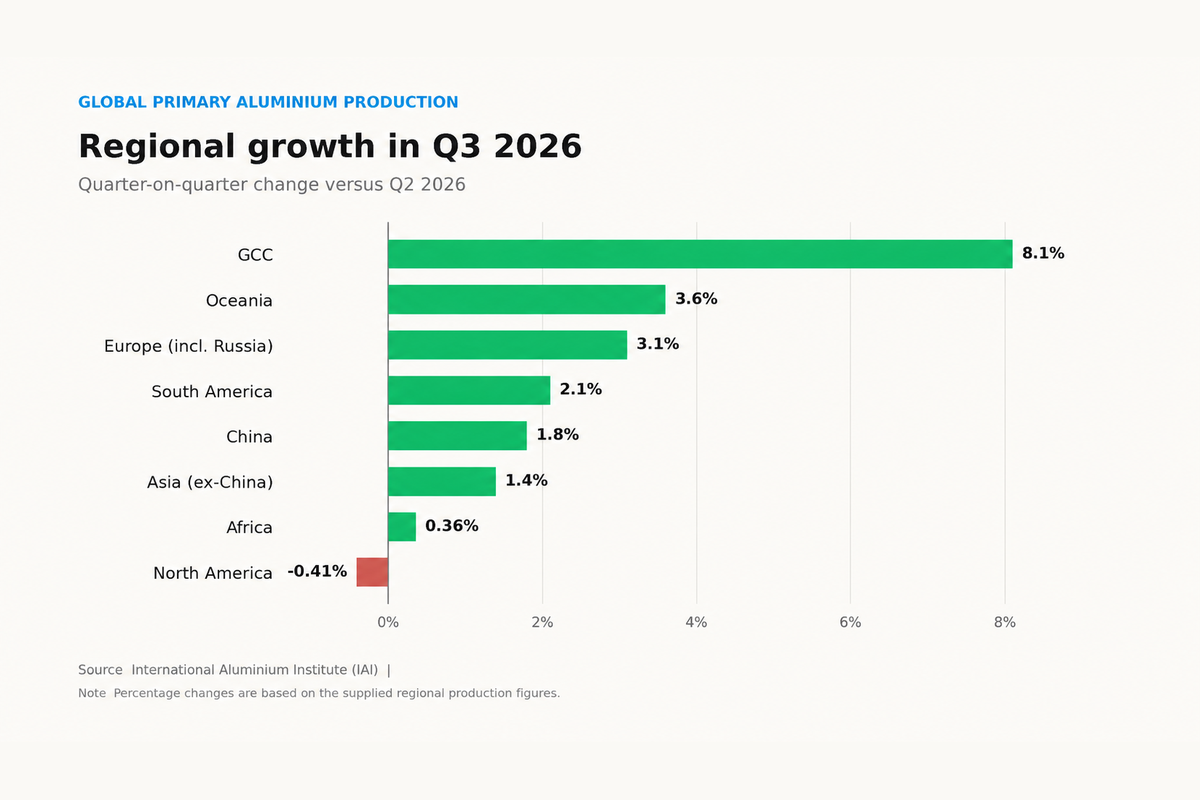
The GCC emerged as the fastest-growing region, registering an 8.1 per cent sequential increase, followed by Oceania at 3.6 per cent and Europe, including Russia, at 3.1 per cent.
South America and China recorded production growth of 2.1 per cent and 1.8 per cent, respectively, while Asia excluding China registered a comparatively modest increase of 1.4 per cent.
North America was the only region to experience a sequential contraction, with production declining by 0.41 per cent from 981,000 tonnes to 977,000 tonnes. Africa remained broadly stable, recording 276,000 tonnes against 275,000 tonnes in the preceding quarter.
The divergent regional performance underlines a central feature of the global aluminium market in 2026: production growth is increasingly being shaped by the restoration of previously disrupted capacity, rather than solely by new smelter additions.
Explore the production, demand and consumption forecasts of bauxite and alumina in our report: "Global Bauxite & Alumina Market Forecast to 2036: Supply–Demand, Trade Flows & Price Outlook"
GCC leads the recovery as EGA and Alba gradually restore disrupted capacity
The improvement in the GCC’s Q3 2026 primary aluminium production followed disruptions to aluminium production across the Gulf after the escalation of the US-Iran conflict in March 2026. Iranian attacks on Emirates Global Aluminium's (EGA) Al Taweelah smelter in Abu Dhabi and Aluminium Bahrain's (Alba) operations, together with logistical restrictions around the Strait of Hormuz, significantly affected regional production and raw material movements.
The disruption was particularly severe at Al Taweelah, where an attack on March 28 forced the smelter into an emergency shutdown. EGA began restarting reduction cells on May 26, gradually restoring production across its three potlines. As the restart progressed, GCC’s monthly production recovered, with daily average output increasing from around 9,100 tonnes to approximately 9,800 tonnes. Monthly production subsequently reached 306,000 tonnes by September, although it remained below pre-conflict levels.
Alba also made progress in restoring its production operations. By September, the company was operating at approximately 80 per cent of pre-war levels, equivalent to an annualised production rate of 1.3 million tonnes against its previous capacity of approximately 1.6 million tonnes.
EGA's 50% restart milestone could strengthen Q4 output
A more substantial improvement in GCC production could emerge during Q4 2026 as EGA advances the r,estoration of Al Taweelah. On October 21, EGA confirmed that it had restarted 631 of the smelter's 1,262 reduction cells, representing 50 per cent of the total. Since the restart of reduction cells does not immediately translate into equivalent finished-metal production and it typically takes a week to stabilise and achieve full production, the effect of the restoration is likely to be seen in the Q4 data.
Theoretically, daily production rate per reduction cell is 3.5–3.7 tonnes. So, for the 631 restarted cells, the production volume in 30 days could reach approximately 66,255–70,041 tonnes, provided all cells have stabilised and achieved the assumed operating rate. For a 31-day period, this would translate into approximately 68,463–72,376 tonnes.
Note: These estimates represent potential production at the assumed operating rate rather than confirmed output or an October production forecast. Actual volumes will depend on the timing of individual restarts, cell performance, operational stability and the continued commissioning programme.
Also read: Showcase your brand, aluminium recycling initiatives and sustainability vision in our upcoming magazine: Sustainability & Recycling: Aluminium’s Commitment 2026.
Oceania's growth reflects broader improvements in smelter performance
Oceania recorded the second-highest sequential production growth in Q3 2026, with primary aluminium output rising by approximately 3.6 per cent from 476,000 tonnes in Q2 to 492,000 tonnes. The improvement was primarily supported by higher output across several established smelters in Australia and New Zealand.
Rio Tinto's operational data reveal that production at the Boyne Island smelter increased from 125,000 tonnes in Q2 to 130,000 tonnes in Q3, while the Tomago smelter registered growth from 143,000 tonnes to 147,000 tonnes.
The Bell Bay smelter in Tasmania recorded a smaller increase from 47,000 tonnes to 48,000 tonnes, while New Zealand's Tiwai Point smelter produced approximately 84,000 tonnes, compared with 83,000 tonnes in the previous quarter.
Collectively, production across these four facilities increased from approximately 398,000 tonnes in Q2 to 409,000 tonnes in Q3, representing growth of 2.76 per cent. These smelters accounted for a substantial share of the regional production increase, highlighting the contribution of established operations to Oceania's recovery.
Additional support came from the restoration of previously curtailed capacity at Alcoa's Portland smelter in Australia, where the company completed the restart of 15,000 tonnes per annum of capacity during Q2. The restored capacity was therefore available to contribute throughout Q3.
The regional improvement was not limited to sequential growth. Oceania's primary aluminium production also increased by approximately 3.8 per cent year-on-year from 474,000 tonnes in Q3 2025.
Europe gains as Spain and Norway's smelter restarts support supply
Europe, including Russia, registered one of the strongest production performances in Q3 2026, with primary aluminium output increasing by approximately 3.1 per cent Q-o-Q to 1.91 million tonnes from 1.85 million tonnes.
More significantly, output increased by 7.3 per cent Y-o-Y, making Europe one of the notable contributors to the global production recovery.
The improvement was supported by the restoration of previously curtailed smelting capacity, particularly at Alcoa's San Ciprián smelter in Spain and its Lista facility in Norway. San Ciprián completed its restart on April 7, 2026, enabling the facility to contribute production throughout Q3. The development represented an important step towards restoring European aluminium capacity that had been affected by high energy costs and operational challenges.
Similarly, Alcoa completed the restart of a 31,000-tonne-per-year potline at the Lista smelter during Q2 2026, bringing additional production capacity back into operation ahead of the September quarter.
Norsk Hydro's operational performance provided further support as it reported record liquid-metal production across its Norwegian smelter system in Q3 2026. Together, these developments indicate that Europe's production recovery has been supported by a combination of capacity restoration and improved performance at existing smelters.
China and Asia maintain production growth, with India's BALCO providing an additional boost
Asia excluding China recorded a comparatively modest but positive increase in primary aluminium production during Q3 2026, with total volume at 1.254 million tonnes, up 1.4 per cent sequentially from around 1.24 million tonnes. The improvement was more substantial on an annual basis, increasing by 2.5 per cent from 1.223 million tonnes in Q3 2025.
India's Vedanta Aluminium contributed to this growth through higher output at Bharat Aluminium Company (BALCO). BALCO's quarterly aluminium production increased from 168,000 tonnes in the June quarter to 178,000 tonnes in the September quarter, representing a 6 per cent rise.
The company's expansion was supported by the commissioning and ramp-up of its new 525 kA smelter potline, which is part of a planned 435,000-tonne-per-year capacity expansion. By the September quarter, the commissioning of the second zone had brought the new smelter's operational capacity to approximately half of its planned expansion.
China, meanwhile, maintained its dominant position in global primary aluminium production, with output grown by 1.8 per cent to 11.481 million tonnes in Q3 2026. On an annual basis, China's production increased by 2.75 per cent from 11.174 million tonnes in Q3 2025.
South America improves sequentially, while North America remains an exception
South America's primary aluminium production increased by approximately 2.1 per cent Q-o-Q to 395,000 tonnes in Q3 2026, although the region's output remained subdued compared with the corresponding period of the previous year.
One of the supporting developments was the continued ramp-up of Alcoa's Alumar smelter in Brazil. The company confirmed that the restart of its share of the facility's 268,000-tonne-per-year capacity was completed during Q3 2026, following progressive restoration efforts over previous quarters.
North America, in contrast, recorded a marginal sequential contraction, with output declining by 0.41 per cent from 981,000 tonnes to 977,000 tonnes.
Africa's output was virtually unchanged at 276,000 tonnes against 275,000 tonnes in Q2, suggesting that the region contributed little to the global quarterly increase.
Global production down 1% in nine months: Can Q4 narrow the gap?
Despite the sequential improvement in Q3, global primary aluminium production remained under pressure on a cumulative basis. During January-September 2026, worldwide output reached 54.76 million tonnes, a decline of around 1 per cent from 55.29 million tonnes during the corresponding period of 2025.
The nine-month contraction highlights the impact of production disruptions earlier in the year, particularly in the GCC, which have not yet been fully compensated for by improvements elsewhere.
However, the final quarter of 2026 could bring additional production recovery, supported by continued smelter restarts, newly commissioned capacity and further ramp-ups across several regions.
One of the most immediate contributors could be EGA's Al Taweelah smelter, where the restoration of 50 per cent of reduction cells by October 21 creates scope for higher production as the restarted cells stabilise and additional units become operational.
In Europe, Hydro's Slovalco smelter in Slovakia represents another source of incremental supply. The facility began restarting primary aluminium production in late August 2026, with the first phase targeting an annualised production capacity of 75,000 tonnes by the end of February 2027. Consequently, its contribution could gradually increase during Q4, although the full targeted run rate will not be available this year.
Beyond Europe, fresh capacity additions in Asia could provide additional support.
In Vietnam, Phase II of the Dak Nong primary aluminium smelter project produced its first liquid aluminium on October 31, 2026, marking the beginning of trial production. The development adds another 150,000 tonnes per annum of designed capacity to the project, bringing the combined capacity of its first two phases to 300,000 tonnes per annum.
However, as the second phase has only recently entered trial production, its contribution to Q4 output will depend on how quickly its electrolytic cells are commissioned and stabilised.
Indonesia's expanding aluminium smelting industry, including the Kalimantan Aluminium Industry project, could provide a further source of incremental production as capacity ramp-ups progress. Nevertheless, the timing of new capacity additions and associated power availability remain critical factors determining actual output.
Based on the first nine months' production of 54.76 million tonnes, global primary aluminium output would need to reach approximately 19.27 million tonnes in Q4 simply to match the 74.03 million tonnes recorded in 2025. That would require a sequential increase of approximately 4.9 per cent from Q3's 18.377 million tonnes – considerably stronger than the 2.1 per cent recovery achieved during the September quarter.
A full-year production outcome of approximately 73.5–74 million tonnes therefore remains a plausible scenario, but reaching the upper end would require a sustained acceleration in global output during the final three months.
The central question for Q4 is no longer whether global primary aluminium production is recovering, but whether the pace of that recovery will be sufficient to offset the losses accumulated during the first half of 2026.
With GCC smelters still restoring disrupted capacity, European producers gradually bringing curtailed operations back online and Asian projects entering commissioning, the global supply outlook is improving. However, the full benefits of several major restarts are unlikely to materialise before 2027.
As a result, 2026 could close with global primary aluminium production broadly approaching, but still falling short of, the previous year's level – setting the stage for a more substantial supply recovery in 2027.
Unlock full access – sign up for FREE.
Key benefits
Grow with
AL Circle