What determines whether an aluminium smelter increases production or struggles to maintain its existing output? The figures for January–September 2026 point to two contrasting situations in the Americas. North America recorded a slight year-on-year decline, while South America posted marginal growth. The difference reflects the pressures on North American smelters, particularly electricity costs and limited operating capacity, compared with more stable production conditions and stronger export opportunities in South America.
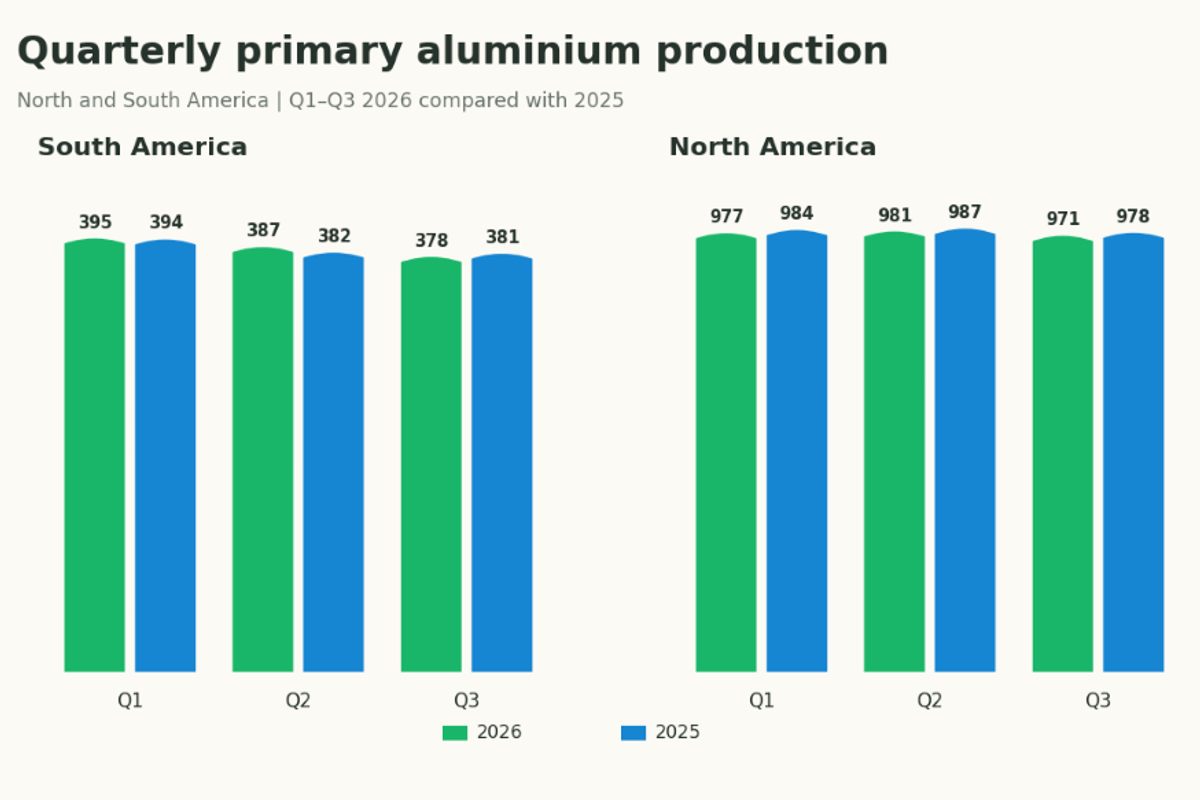
Primary aluminium production in North America totalled 2.929 million tonnes in the first nine months of 2026, down from 2.949 million tonnes in the corresponding period of 2025, a decline of 0.68 per cent. In contrast, South American production increased from 1.157 million tonnes to 1.160 million tonnes, representing growth of 0.26 per cent.
North America loses momentum as electricity costs weigh on smelters
North America's production trend remained relatively weak throughout the first nine months of 2026. Output reached 971,000 tonnes in Q1, increased to 981,000 tonnes in Q2 and then slipped to 977,000 tonnes in Q3. This represented a 1.03 per cent quarter-on-quarter increase in Q2, followed by a 0.41 per cent decline in Q3.
The year-on-year figures show that the region's production remained below 2025 levels in each quarter. Output was 978,000 tonnes in Q1 2025, 987,000 tonnes in Q2 and 984,000 tonnes in Q3, as per IAI data. The gap between the two years remained relatively consistent at around 6,000–7,000 tonnes per quarter, indicating a persistent capacity or utilisation constraint rather than a single isolated production disruption.
Electricity remains one of the biggest challenges for primary aluminium producers in North America. Smelting typically requires around 13–16 MWh of electricity per tonne of aluminium, with power accounting for approximately 40 per cent of total production costs. Industrial electricity rates in the US have reportedly exceeded USD 80 per MWh, considerably higher than the approximately USD 40 per MWh level generally considered competitive for new smelting operations under long-term power arrangements.
High energy costs have weakened the competitiveness of US producers against lower-cost suppliers, including Canada, Russia and the UAE. The Congressional Research Service has also identified elevated energy costs and international competition as factors behind the long-term decline in US primary aluminium production. Canada benefits from access to relatively low-cost hydropower, although its output can still be affected by hydrological conditions, contracted electricity supply, maintenance and market factors.
Limited smelter capacity and operational disruptions restrict North American output
The region's production constraints are also linked to the reduced number of operating smelters. The US now has around four operating primary aluminium smelters, compared with more than 20 at the beginning of the century. In 2025, only two of the six US primary smelters were operating at full capacity, while two had reduced production rates and two were offline. Reports in 2026 also indicated that two of the six smelter lines were idle, with others operating at reduced rates.
Although some capacity is being brought back, restarts take time and require significant investment. Century Aluminium's Mount Holly smelter, for example, has been associated with a restart of more than 50,000 tonnes per year, while plans have also been discussed for New Madrid. However, restarting aluminium potlines is technically complex and costly, particularly because prolonged power interruptions can cause pots to freeze.
An outage in June 2026 following a breach at a flash converting furnace added to the operational challenges. Such disruptions can affect production beyond the immediate shutdown period, as restoring smelting operations requires time and careful technical management.
Explore primary aluminium suppliers, product listings and trade opportunities on the AL Biz platform.
South America records steady quarterly production growth
South America followed a different production trajectory during the first nine months of 2026. Output increased from 378,000 tonnes in Q1 to 387,000 tonnes in Q2 and 395,000 tonnes in Q3. This represented consecutive quarter-on-quarter increases of 2.38 per cent and 2.07 per cent, respectively.
The region's production also remained slightly above the corresponding 2025 levels. Output in Q1 2025 was 381,000 tonnes, followed by 382,000 tonnes in Q2 and 394,000 tonnes in Q3. The year-on-year increase was modest, but the steady quarterly rise in 2026 indicates an improvement in production momentum.
Operational stability at major smelters has helped underpin this performance. At Alumar in São Luís, Brazil, fiscal 2026 aluminium production increased by 4 per cent to 144,000 tonnes. The improvement was supported by stabilisation across its three potlines.
In Argentina, Aluar's Puerto Madryn smelter operated at full capacity during 2026. The company produced 337,968 tonnes of aluminium in the first nine months of its fiscal year, reflecting the contribution of its established production base to regional output.
Stronger exports and lower costs support South American producers
Stronger export activity has also supported South American producers. Aluar's foreign sales increased by 27.6 per cent year on year in fiscal Q1, which ended in September 2026. More than 80 per cent of the company's annual production is exported, making international market conditions an important factor in its performance.
Higher LME aluminium prices and stronger US premiums improved revenue realisation and profitability. At the same time, lower alumina costs helped support margins, with Aluar specifically citing the reduction in alumina costs as a positive factor.
Aluar has also strengthened its access to electricity through investment in renewable energy. In August 2026, the company completed the expansion of its Puerto Madryn wind farm by 336 MW, taking the complex's total capacity to 582 MW. The additional capacity strengthens the company's access to power and supports its energy requirements.
Overall, North America's recovery depends on lower energy costs and improved smelter utilisation, while South America is better positioned to sustain growth through stable operations, stronger exports and renewable energy investments.
Unlock key insights from leading companies and experts across the aluminium ecosystem with our e-Magazine - Mine to Market: Aluminium Producers & Manufacturers 2026














_md.webp)
_md.webp)