AlCircle News Edited By "Debanjali Sengupta"

Debanjali Sengupta is a passionate content writer with 10 years of experience in Business writing, Web Content writing, Blogging, Editing and Research. She is responsible for generating and editing content for AlCircle Newsletter and other online and offline content for enhancing the brand value and its visibility among global users.
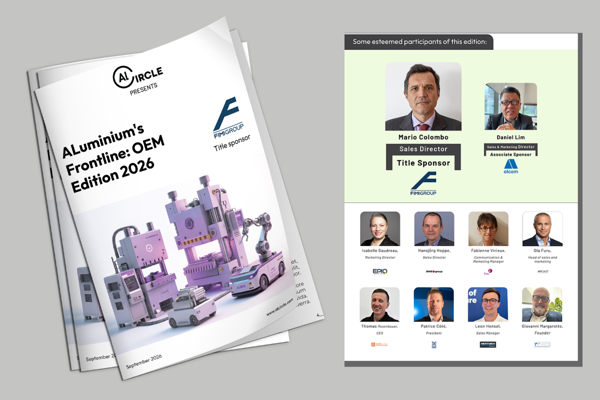
Aluminium’s Frontline: OEM Edition 2026 launched! Inside the technologies powering aluminium from mine to recycling
Much is said about aluminium’s expanding role in modern mobility, aerospace, construction, packaging, renewable energy and countless other applications. Far less is said about the technology and machinery that make this evolution possible - and the Original Equipment Manufacturers (OEMs) behind them. Yet, OEMs have long been among the forces shaping the global aluminium industry. There was a time when primary metal producers used to operate as Original Equipment Manufacturers (OEMs) themselves. Owing to the high price attached to the metal, primary producers would invent downstream products, tools, and manufacturing processes instead of selling raw ingots. Much has evolved since then. Today, an extensive ecosystem of Tier-1 and Tier-2 OEMs supports every stage of aluminium production -...

EU aluminium extrusion trade story: Exports rebound and imports retreat, yet inbound volumes remain higher
The European Union’s aluminium extrusion trade is moving in two distinct, although equally subdued, directions. Exports have remained broadly resilient despite repeated fluctuations, while imports have been declining consistently since reaching a peak in 2022, according to International Trade Administration data. As far as exports are concerned, the volumes have been fluctuating over the years now. After declining for the two consecutive years by total 10.14 per cent from 345,241.74 tonnes to 310,217.09 tonnes in 2020, the exports rose strikingly in the subsequent year and regained higher volume than in 2018 level, coming in at 356,523.94 tonnes in 2021. However, the recovery did not last beyond two years and eventually plunged to as low as 319,840 tonnes as of 2023. They subsequently...

European aluminium EPR fees vary by country, PRO, packaging and recyclability
In a recent conversation with AL Circle, Daniel Vaknine, Co-Founder of Gramta, explained the objectives and implementation of Extended Producer Responsibility (EPR) and the Packaging and Packaging Waste Regulation (PPWR). He discussed how the aluminium packaging industry can comply with these requirements and manage the associated costs. He also highlighted how Gramta helps aluminium packaging exporters meet their EPR reporting obligations through dedicated compliance solutions. Daniel Vaknine is a Co-Founder of Gramta EPR software platform helping businesses navigate packaging producer responsibility requirements across Europe. His work focuses on making multi-country EPR compliance more practical, from determining producer obligations and registration requirements to packaging data,...

Energy is the single biggest variable in aluminium cost structures, says Praveena Rai, MD & CEO of MCX
India’s aluminium pricing mechanism has gained immense prominence, and its major credit goes to the Multi Commodity Exchange of India Limited, as they are playing a central role in improving domestic price discovery. Today, AL Circle is in conversation with an eminent personality from that esteemed organisation, Ms Praveena Rai, Managing Director & CEO of MCX. Ms Rai has candidly weighed in on the ongoing price volatility, attributing it not only to the Middle East geopolitical crisis but also to other structural factors. For instance, energy contributes to about 35 per cent of production costs but is now undergoing inflation and translating it into high aluminium prices. According to her, the taker of this volatile primary aluminium price is the downstream producers who are operating...
_1788170554.903_md.webp)
Thick, hard-anodised AAO is vital for wear-resistant aluminium extrusions, says Dr Judy Runge
Dr Judy Runge when approached for her key insights into the importance of anodisation for aluminium extrusions as part of AL Circle’s exclusive campaign on “ Aluminium Extrusion Growth Markets ” , she extensively spoke about the advantages that anodisation offers to aluminium extruded products, how it can be developed further, and what sustainability measures it should take. Dr Judy Runge is a metallurgical engineer and surface scientist specialising in the surface treatment and interfacial science of aluminium and its alloys. Her career spans more than 40 years, beginning with her work in electronic materials and processes at Northrop Corporation, and culminating with the last 11 1/2 years at Apple, from where she retired in 2023. Dr. Runge is an independent consultant at her company,...

Key takeaway from Global Commodity Conclave 2026 - Oil shocks, supply risks and shrinking stocks keep aluminium prices volatile in 2026
Price volatility has emerged as one of the most pressing issues for the global aluminium industry in 2026. India, experiencing the same, is also facing the additional impact of currency movements and rising domestic costs. This is the issue being prominently featured at the three-day conference Global Commodity Conclave 2026, organised by the Multi Commodity Exchange of India (MCX). Among many key insights regarding aluminium price shocks, the most interesting takeaway was the aluminium market’s sensitivity to the surge in crude oil prices and supply disruptions arising from the Middle East conflict. According to S&P Global, the rise in oil prices due to the Middle East conflict has translated into an aluminium price increase. As per the American publicly traded corporation, LME aluminium...
_1788170554.903_md.webp)
Lithium, graphite and REEs may outpace aluminium growth due to smaller starting bases, says OLI’s Chief Sustainability Officer
In an exclusive conversation with AL Circle, Vineeth Ram, Chief Sustainability Officer of OLI Systems, shares his perspectives on rare earth processing in the United States, the country’s growing demand for REEs, and its roadmap for reducing dependence on China. While he notes that complete self-sufficiency is not a realistic near-term goal, he believes that significantly reducing dependence is achievable. Talking about the demand growth of aluminium and other critical minerals, he explains that minerals like gallium, graphite and REEs are likely to register higher percentage growth than aluminium, largely because they are starting from much smaller demand bases. At the same time, he highlights that aluminium is increasingly being recognised globally as a critical and strategic mineral...
_1788170554.903_md.webp)
Beyond construction, Australia’s aluminium extrusion demand expands across renewables, defence and automation
In this exclusive interview, AL Circle speaks with Gabriel Algar, Founder and Director of Extrut Aluminium Pty Ltd, a Western Australia-based aluminium extrusion manufacturer. The discussion explores the demand drivers of extruded aluminium products in Australia and examines the country’s competitive strengths in manufacturing quality, infrastructure and production capabilities. With a strong passion for manufacturing and innovation, Gabriel is committed to delivering high-quality aluminium extrusion solutions through advanced production technologies, sustainable practices and continuous improvement. His approach reflects the growing potential and resilience of Australia’s aluminium extrusion industry. Conducted as part of AL Circle’s exclusive campaign, “ Aluminium Extrusion Growth...

Why does a barrel of oil matter to aluminium producers? A hidden link between petroleum coke, prebaked anode and the metal itself
Oil price shocks are traditionally associated with their impact on transportation, aviation, paints and chemicals, tyres, rubber, and fertiliser industries, while the ripple effects on metallurgy often remain overlooked. The recent Middle East geopolitical crisis has renewed attention on aluminium’s strategic importance as a critical global metal supplier, but what about the impact of the oil price surge linked to the conflict on aluminium’s cost structure? Indeed, the aluminium industry does not consume crude oil directly in the smelting process. Still, it does through petroleum coke and carbon anodes used in the smelting process, which creates a significant connection between global oil markets and aluminium production costs. Between crude oil and aluminium – the petroleum coke...

The story beyond energy race: Data centres as a new-age demand driver of aluminium to over 1Mt by 2030
Aluminium demand is visibly entering another phase of transition. Until a few years ago, the demand used to be largely driven by packaging, transportation and the electrical and electronics sectors. Then came renewable energy, infrastructure, and electric vehicles, adding a fresh layer of demand for the metal. And now, data centres emerge as a new demand engine for the metal. The rapid expansion of artificial intelligence, cloud computing and digital infrastructure is creating an increasing requirement for materials that can support high-performance cooling, reliable power distribution and large-scale structural systems. Since aluminium fits into this equation because of its thermal conductivity, light weight, corrosion resistance, formability and cost advantage over several competing...

Salt slag remains one of the most difficult issues for aluminium recyclers to manage today, says Dr Zhongping Que
Europe’s aluminium recycling industry is facing a difficult question: how can increasingly mixed and contaminated scrap be transformed into high-quality alloys without adding more waste, emissions or processing costs? This is what has been addressed by Dr Zhongping Que, an expert in advanced metallurgy and sustainable aluminium recycling, in this interview. She has explained how the CLEANMAT project has brought a viable solution to this through smarter sorting, intelligent pre-treatment, advanced refining and closer control of scrap quality before melting. Her work focuses on alloy design, impurity management and recycling technologies that support a low-carbon, circular metals industry. The discussion explores how next-generation recycling strategies could improve scrap quality, reduce...

Safeguarding 1.3 Mt of aluminium scrap could enable Europe to reduce primary metal imports by a similar volume
In conversation with Jerome Lucaes regarding aluminium scrap challenges in the European domestic market. In the interview, Mr Lucaes highlighted that if Europe had not exported 1.3 million tonnes of aluminium scrap, it could have cut a similar volume of primary imports. That could reduce Europe’s aluminium carbon footprint by around 17 million tonnes of CO₂ per tonne, according to Lucaes.The conversation also covered the risk of non-inclusion of aluminium scrap within the scope of CBAM, which, according to Lucaes, might leave EU recyclers more than EUR 200 a tonne worse off by 2035. Jerome Lucaes is a senior leader with 35 years of experience, including 25 in the aluminum sector (incl Rio Tinto, RUSAL, Constellium, Arctial), Jerome is an independent advisor driving business...

China’s rare earth export control exposes global supply-chain vulnerability, pushes G7 to confront single-source dependence
Rare earth elements were formed billions of years ago through cosmic processes, but their importance has never been more immediate. Once treated as a niche mineral group, rare earths now sit at the centre of the global contest for its strategic value in developing technology, clean energy, defence capability, and industrial security. And in this contest, the winner is not who owns the maximum reserves, but who is efficient in processing, refining, and turning into usable industrial inputs. And this is where China holds its strongest advantage China has the world’s highest identified rare earth reserves, estimated at around 44 million tonnes. But there are also the countries like Vietnam, Brazil, Canada, Russia, India, Australia, and the United States who have notable reserves of 22...
_1788170560.178_md.webp)
The European aluminium recycling market is currently going through an exciting yet challenging phase with rising demand and scrap outflow
In this interview, as part of the “ Europe Aluminium Recycling Market” , Karl Hoffman, Global Sales Director Metal Recycling of STEINERT, has explained the critical role of sorting and separation in determining the quality of recycled aluminium. According to him, this, in turn, may lead to increased recycling rates of aluminium in Europe. Karl Hoffmann has collected more than 30 years of experience in different positions within the environmental technology industry. Since 2010, Karl has worked for Steinert in Cologne/Germany in different positions. After he joined as Sales Manager, he became Global Key Account Manager and Product Manager for Separation and Sorting Solutions in Metal Recycling. Since the beginning of 2018, he has been responsible for Steinert’s global sales activities in...

Solar may be growing, but hydropower remains the backbone of “Green ALuminium” – here’s to it!
“Green Aluminium” is relatively a modern term referred to the metal produced with significantly lower carbon footprint. This is mainly achieved through recycling or using recycled metal as input, deploying breakthrough technologies such as inert anodes and carbon capture and storage, or through the use of renewable energy sources like hydropower, solar, wind or geothermal electricity. While there is no particular global standard, but usually, aluminium with up to 4 tonnes of CO2e per tonne of metal is commonly used across the industry as a low-carbon reference. This is a cradle-to-gate measurement equivalent to GHG Protocol of Scope 1, Scope 2 and relevant upstream Scope 3 emissions from bauxite mining, alumina refining, and high energy-intensive smelting process. Recycled and Renewable –...

Luyou equipment fits Europe, where aluminium scrap availability is limited and recycling rate requirements are high
In an exclusive interview with AL Circle, Shandong Luyou explained the fundamental difference between aluminium scrap recycling and steel scrap recycling, pointing to aluminium’s low melting point and high ductility compared to steel. Published as part of the platform’s latest initiative, “European Aluminium Recycling Market,” the interview highlights how aluminium scrap derived from different end-user products, such as cans, automotive components, or architectural bridges, requires a unique processing approach.Luyou shares that technological advancements have helped them achieve high recovery rates, and they claim their equipment is suitable for the European market, where scrap availability is limited but recycling rate requirements are high. AL Circle: Shandong Luyou has built a strong...

Aluminium scrap leakage is also often driven by information asymmetry and inefficient market matching
In an exclusive interview with AL Circle as part of the latest initiative, “European Aluminium Recycling Market” , Ivan Mayorov of CANCOM Austria AG outlined the company’s role in building the digital infrastructure for RecAL, a Horizon Europe project designed to improve Europe’s aluminium supply chain and metals marketplace, enabling them to address long-standing challenges such as data sovereignty, traceability and transparency. Ivan believes information asymmetry and inefficient market matching often leads to scrap leakage. So, in his view, a transparent yet sovereign data exchange is important to create a more efficient internal European market for scrap. Ivan Mayorov at CANCOM Austria AG is a Manager of Digital Sovereignty Team, co-created & now guides a dedicated, business...

Double pressure for Europe with risen ETS costs for aluminium recyclers while valuable scrap moves to higher-paying international markets
As part of AL Circle’s latest initiative, “European Aluminium Recycling Market” , an exclusive interview between AL Circle and Emanuele Manigrassi, Director Climate & Energy at European Aluminium, addressed the loopholes of the updated EU Emissions Trading System benchmarks for 2026-2030, particularly for the recycled aluminium industry. According to Mr Manigrassi, production costs may rise for recyclers due to fewer free allowances under the revised ETS benchmarks. He also pointed to a precarious structure in which EU recyclers remain exposed to ETS and CBAM-related costs, while aluminium scrap and recycled aluminium are not properly covered under CBAM. This comprehensive interview draws attention to the detailed structure of the ETS and CBAM and how they may put the European recycled...

