AlCircle News Edited By "Debanjali Sengupta"

Debanjali Sengupta is a passionate content writer with 10 years of experience in Business writing, Web Content writing, Blogging, Editing and Research. She is responsible for generating and editing content for AlCircle Newsletter and other online and offline content for enhancing the brand value and its visibility among global users.

Solar may be growing, but hydropower remains the backbone of “Green ALuminium” – here’s to it!
“Green Aluminium” is relatively a modern term referred to the metal produced with significantly lower carbon footprint. This is mainly achieved through recycling or using recycled metal as input, deploying breakthrough technologies such as inert anodes and carbon capture and storage, or through the use of renewable energy sources like hydropower, solar, wind or geothermal electricity. While there is no particular global standard, but usually, aluminium with up to 4 tonnes of CO2e per tonne of metal is commonly used across the industry as a low-carbon reference. This is a cradle-to-gate measurement equivalent to GHG Protocol of Scope 1, Scope 2 and relevant upstream Scope 3 emissions from bauxite mining, alumina refining, and high energy-intensive smelting process. Recycled and Renewable –...

Luyou equipment fits Europe, where aluminium scrap availability is limited and recycling rate requirements are high
In an exclusive interview with AL Circle, Shandong Luyou explained the fundamental difference between aluminium scrap recycling and steel scrap recycling, pointing to aluminium’s low melting point and high ductility compared to steel. Published as part of the platform’s latest initiative, “European Aluminium Recycling Market,” the interview highlights how aluminium scrap derived from different end-user products, such as cans, automotive components, or architectural bridges, requires a unique processing approach.Luyou shares that technological advancements have helped them achieve high recovery rates, and they claim their equipment is suitable for the European market, where scrap availability is limited but recycling rate requirements are high. AL Circle: Shandong Luyou has built a strong...

Aluminium scrap leakage is also often driven by information asymmetry and inefficient market matching
In an exclusive interview with AL Circle as part of the latest initiative, “European Aluminium Recycling Market” , Ivan Mayorov of CANCOM Austria AG outlined the company’s role in building the digital infrastructure for RecAL, a Horizon Europe project designed to improve Europe’s aluminium supply chain and metals marketplace, enabling them to address long-standing challenges such as data sovereignty, traceability and transparency. Ivan believes information asymmetry and inefficient market matching often leads to scrap leakage. So, in his view, a transparent yet sovereign data exchange is important to create a more efficient internal European market for scrap. Ivan Mayorov at CANCOM Austria AG is a Manager of Digital Sovereignty Team, co-created & now guides a dedicated, business...

Double pressure for Europe with risen ETS costs for aluminium recyclers while valuable scrap moves to higher-paying international markets
As part of AL Circle’s latest initiative, “European Aluminium Recycling Market” , an exclusive interview between AL Circle and Emanuele Manigrassi, Director Climate & Energy at European Aluminium, addressed the loopholes of the updated EU Emissions Trading System benchmarks for 2026-2030, particularly for the recycled aluminium industry. According to Mr Manigrassi, production costs may rise for recyclers due to fewer free allowances under the revised ETS benchmarks. He also pointed to a precarious structure in which EU recyclers remain exposed to ETS and CBAM-related costs, while aluminium scrap and recycled aluminium are not properly covered under CBAM. This comprehensive interview draws attention to the detailed structure of the ETS and CBAM and how they may put the European recycled...
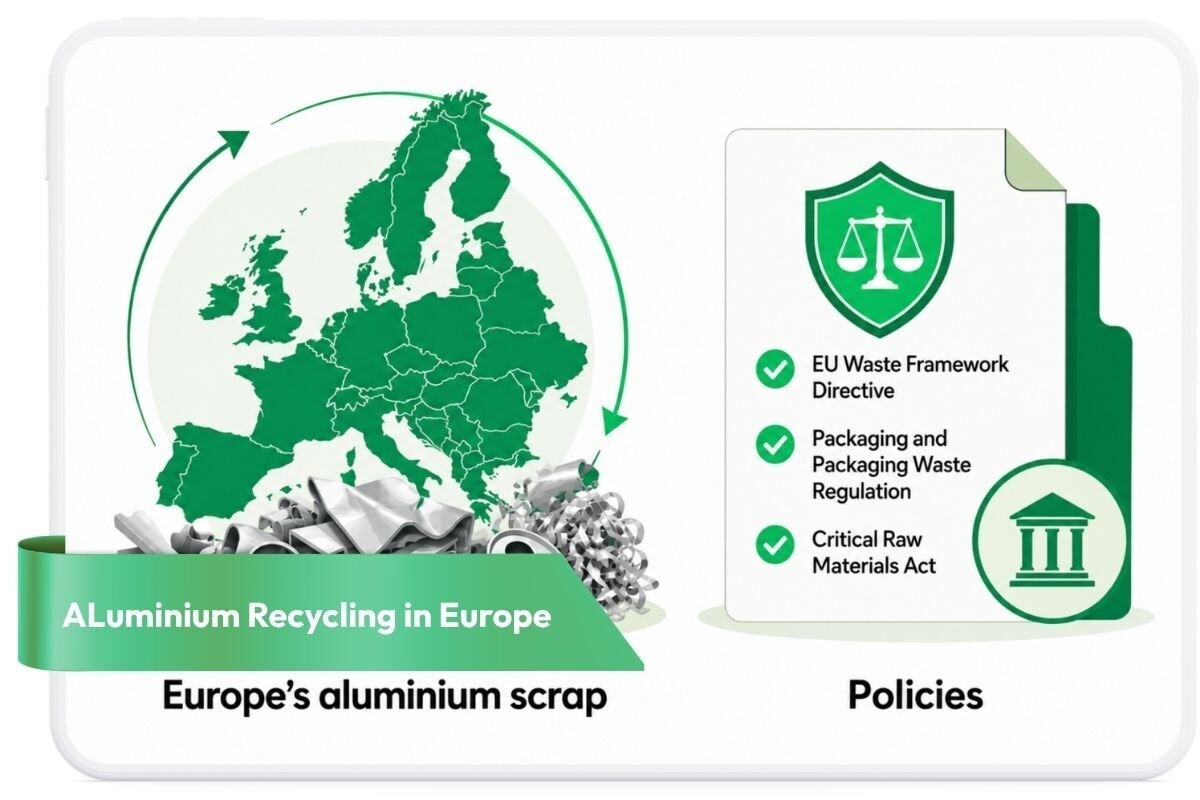
Europe’s aluminium scrap policies: Strengthen recycling but leave export challenge unresolved
As the world is accelerating its shift from primary to recycled aluminium, Europe is finding itself at a difficult crossroads. Strong demand, advanced recycling technologies and clear sustainability ambitions are one part of the story, while tightened scrap availability is another part. More than a Europe-wide problem in equal measure, the pressure is most visible in the European Union, where scrap leakage, as what they call, has become a serious challenge due to the increased overseas exports to India, China, and Thailand. Scrap leakage becomes a risk As mentioned by Mario Conserva, Secretary General of FACE, in an exclusive interview with AL Circle , the current leakage of aluminium scrap is leading to 1.2 million tonnes of such strategic resource flowing out to third countries...

There are over 30 Mt of red mud or bauxite residue on the grounds of the Atlantic Alumina (Alcoa) plant in Gramercy, shows LSU reporting
In a conversation with Harvey Kaye, Executive Chairman of U.S. Critical Materials Corp., AL Circle discussed the United States’ growing push to strengthen its domestic critical minerals supply chain and the company’s role in supporting this strategic objective. During the interaction, Harvey said U.S. Critical Materials Corp. is advancing plans to become the first new rare earths mine in the United States to begin supplying heavy rare earth elements within the next two years. Referring to LSU reporting from March 2026, he noted that more than 30 million tonnes of red mud, or bauxite residue, remain on the grounds of the Atlantic Alumina, formerly Alcoa, plant in Gramercy. He further confirmed that Sheep Creek is currently the only economically viable source of virgin ore gallium in the...

Aluminium moves beyond automotive into humanoid robotics, autonomous vehicles, and similar technologies
Part 2 of the interview with John Stokes, General Manager of IDRA Group, moves from identifying industry challenges to exploring practical solutions. While in Part 1 , Mr Stokes pointed to two major concerns of the European aluminium die casting industry, such as scrap leakage and weak data analysis, in this part, he focuses on the role of data crunching and data mining as a critical enabler for the sector’s next phase of growth. Mr Stokes stresses the need to make die casting data more accessible and usable, including for third-party service providers. This, he explains, would allow major software companies to feed valuable insights back into the die casting industry and enable seamless data exchange in and out of die casting machines. Highlighting the demand for aluminium die cast...

Scrap leakage and weak data analysis - two major challenges Europe’s aluminium die casting is navigating
Here we present Part 1 of the exclusive interview with John Stokes, General Manager of IDRA Group. Mr Stokes is a well-known Mechanical and Production Engineer with over 37 years of experience in the die casting industry. The conversation was detailed, candid, and insightful to fit into one piece. So, we are bringing it to you in two parts. The first part highlights our talk about how Industry 4.0 is transforming manufacturing processes, including die casting. Here, Mr Stokes has pointed out that digitalisation and automation are ramping up operations and doing it quite effectively, but he feels the missing area is analysis, where human minds come into play. Mr Stokes’ concern is that the industry is generating more data than ever, but not putting enough into understanding what those data...

The rising need for red mud that contain gallium and scandium motivates the use of existing red mud as a resource
Dr Greeshma Gadikota, Professor at Columbia University, has explained in this interview the growing importance of advanced recovery technologies for extracting critical metals such as gallium and scandium from red mud. She noted new technologies that are more energy and material-efficient are needed for the recovery of critical metals from red mud because its critical feature is in its co-presence in an iron-rich mineral matrix. Already some of the leading universities in the United States have developed technologies for the separation of nickel, cobalt, and manganese from spent battery materials under the leadership of Dr Greeshma. Dr Greeshma Gadikota is the Lenfest Earth Institute Chair and Professor in the Department of Earth and Environmental Engineering and Columbia Climate School...

Aluminium industry accounts for 40% of 4.8Mt of global silicon consumption
In an exclusive conversation with Jan Coetzee, Vice President Commercial Americas at Ferroglobe and Bill Hightower, Vice President of US Corporate Affairs, on the vital synergy between silicon and aluminium industry. They both acknowledge that both silicon and aluminium have strategic importance for the energy transition, advanced manufacturing, and defence. They are complementary to each other. Not only silicon serves as a crucial alloying element in aluminium production, aluminium significantly drives silicon demand. About 40 per cent of silicon consumption worldwide is driven by the aluminium industry. To know more such interesting facts, read the full interview. AL Circle: Like aluminium, silicon is recognised as a critical mineral in both the US and Canada due to its strategic role...

US' declining bauxite imports in 2025: A critical overview
The United States has long been a net importer of bauxite, owing to the small domestic reserves located in Arkansas, Alabama, and Georgia. This trend has not changed much except the numbers going up or down in 2025. Jamaica and Turkey, the only two primary exporters of bauxite to the US, have remained firm, albeit the amount dropped year-on-year, leading to the decline in the United States’ total bauxite imports. Factors driving the decline in the US bauxite imports The erosion of alumina refining capacity in the domestic market from 5 million tonnes in 2000 to nearly 600,000 tonnes today has practically reduced the demand for bauxite in the United States. At present, only one refinery - Atlantic Alumina’s Gramercy plant in Louisiana is running but at its one-third capacity, producing...

Critical role of long-duration energy storage in India's energy transition, especially for electricity-intensive sectors like aluminium
India’s progress towards the ambitious goal of achieving 500 GW of non-fossil capacity by 2030, on one hand, indicates the country’s strong commitment to sustainability, while on the other hand, it brings into question the robustness of the country’s energy storage infrastructure, which is vital for ensuring the reliability of renewable energy sources. Press Information Bureau shows India’s total installed generation capacity as of December 31, 2025, stood at 5,13,730 MW, of which non-fossil sources were comprised of 266.788 GW (51.93 per cent), exceeding the share of fossil-fuel capacity at 48.07 per cent. Given that the sources of non-fossil fuel energy are consisted of solar, wind, and hydro, which are largely dependent on the weather condition, the biggest question that looms is...

With renewable energy set to power 45% of global electricity, led by China, Europe, US, India, where do aluminium industries stand?
Renewable energy is moving from supportive to strategic role as it is set to account for 45 per cent of the global electricity generation. This marks a structural shift in how industries will be powered. China, Europe, the United States, and India are at the centre of this transformation, driven by rapid additions in solar, wind, and hydropower capacity. While these regions lead the clean energy buildout, they also represent some of the world’s most significant aluminium production hubs, where electricity remains the single most critical input cost. So, this calls for an evaluation that how far the clean power surge in these regions is translating into lower-carbon aluminium production across these major regions. Before that assessment, the scale of the renewable buildout itself deserves...

Double blow from the Middle East – aluminium supply disruptions and export challenges for the automobile industry
The ongoing geo-political conflict in West Asia has put many end-user sectors under strain in several parts of the world. From packaging to building and construction, all have been whining over raw material crisis, especially aluminium, since Gulf countries contribute a substantial portion of the metal used in these manufacturing sectors. Not only large economies like Europe, the United States, or India are grappling with crisis, but also countries like Sri Lanka, which consumes only 28,000 tonnes of aluminium in the construction sector , yet under pressure. That’s because out of 14,941 tonnes of unwrought aluminium sourced in the country, 5,235.73 tonnes come from Bahrain. Now, coming to the automobile industry, for which the problem is more nuanced because the industry is largely...

ALuminium LeaderSpeak 2026 – All about how industry leaders are reading the aluminium market today
If you had to pin down the aluminium industry today in just a few words, what would they be? At AL Circle, we call it critical, agile, sensitive, and resilient – not because it makes for a tidy line but because it describes the present condition of the metal. Critical because the metal is now almost indispensable for the modern world's infrastructure. Strip it out, and you cripple EVs, defence systems, aerospace engineering, data infrastructure, and renewable energy push. We call it agile because the industry has evolved at a pace that most legacy sectors can’t keep up with. New technologies, process efficiencies, digital integration, sustainability mandates – you name it, and aluminium has adapted to it all. Well, the market is sensitive too because it has been responding and reacting...

CEM’s Thor Project positions itself as a multi-metal asset built around a clear mine-to-metal strategy
Welcome to the interview with Christopher H. Hopkins, President and Chief Executive Officer of Canadian Energy Metals Corp., where he has outlined the true scope of the Thor Project as a multi-metal asset. He has emphasised that the immediate priority is advancing the Pre-Feasibility Study (PFS), which is expected to cover CGA, HPA, and Smelter Grade Alumina (SGA), with the potential to include additional metals. Christopher H. Hopkins is a Canadian energy executive and entrepreneur with over 40 years of experience building and leading companies in oil sands, oil shale, and critical minerals. A pioneer in unconventional resource development, his work has evolved from traditional fossil fuels to the emerging critical metals driving the global energy transition. His career experience brings...

LME aluminium prices drop after record surge but still hover above $3600/t
After a record growth rate the previous day, aluminium prices on the London Metal Exchange contracted overnight on Tuesday, April 14, albeit still standing above USD 3,600 per tonne. While the LME aluminium bid price shed off USD 41 per tonne, amounting to USD 3,624 per tonne, the LME aluminium cash offer price experienced a loss of USD 40.5 per tonne, amounting to USD 3,625 per tonne. LME aluminium 3-month bid price as well as offer price also decreased, but at a slower rate. Both prices dropped by USD 5 per tonne to stand at USD 3,565 per tonne and USD 3,566 per tonne, respectively. Dec-27 bid and offer prices closed at USD 3,017 per tonne and USD 3,022 per tonne as of April 14, which signalled an increase of 1 per cent. Don't miss out- Buyers are looking for your products on our B2B...

Carbon emissions from Australian aluminium industry represent 7% of national emissions
Welcome to Part 2 of the interview with Rachel Howard from Mission Possible Partnership. In this edition, we delve into the decarbonisation journey of the Australian aluminium industry. Ms Howard offers insights into the energy transition strategies of major players like Alcoa, Rio Tinto, and South32, and also highlights a couple of projects are even aiming for 100 per cent renewable. Aluminium recycling rate in Australia is 70 per cent and plays a pivotal role to attend decarbonisation. The first part of the interview discussed aluminium's role as a strategic, though not officially recognised, critical metal in Australia, with demand primarily driven by the construction and infrastructure sectors, accounting for around 30-40 per cent. To read the full conversation on this topic, refer to...

