Why does a barrel of oil matter to aluminium producers? A hidden link between petroleum coke, prebaked anode and the metal itself
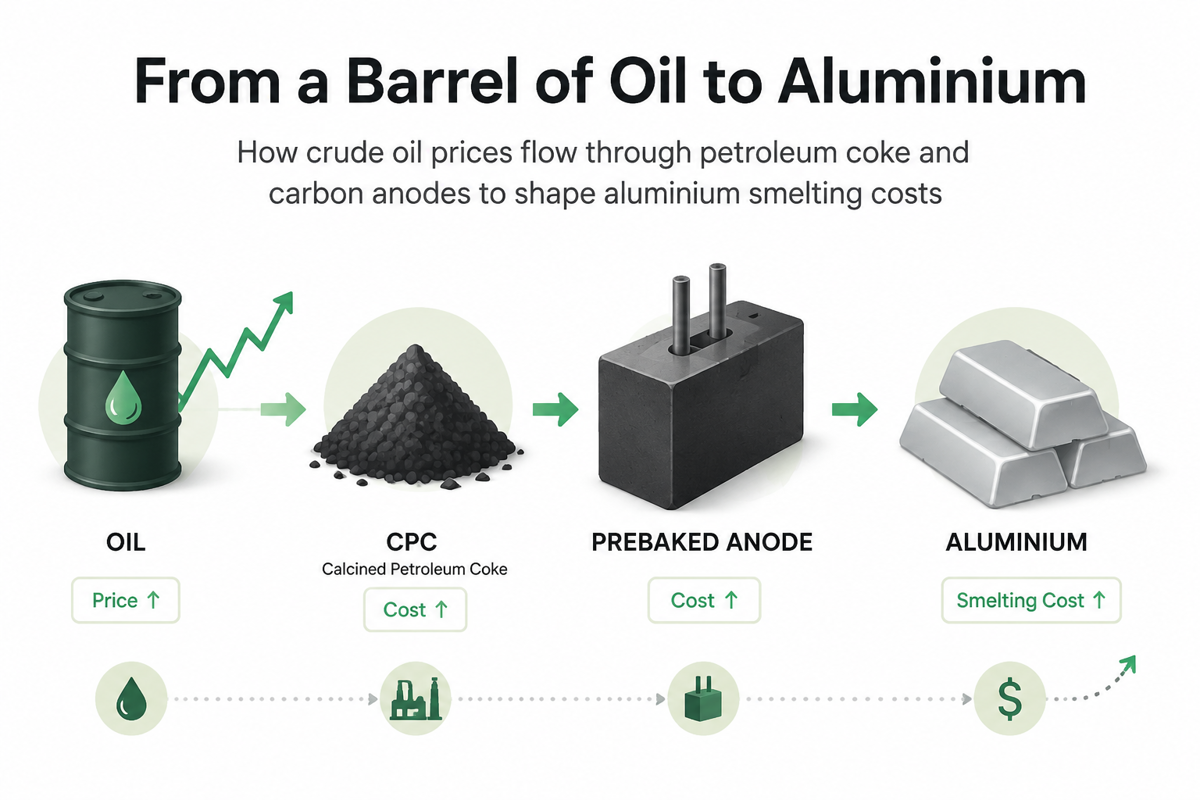
The image used in this article is generated with an AI tool and does not depict any real-time moment
Oil price shocks are traditionally associated with their impact on transportation, aviation, paints and chemicals, tyres, rubber, and fertiliser industries, while the ripple effects on metallurgy often remain overlooked. The recent Middle East geopolitical crisis has renewed attention on aluminium’s strategic importance as a critical global metal supplier, but what about the impact of the oil price surge linked to the conflict on aluminium’s cost structure?
Indeed, the aluminium industry does not consume crude oil directly in the smelting process. Still, it does through petroleum coke and carbon anodes used in the smelting process, which creates a significant connection between global oil markets and aluminium production costs.
Between crude oil and aluminium – the petroleum coke connection
Green petroleum coke, also called raw petroleum coke, is produced as a byproduct during the delayed coking process in oil refineries. It is further processed at high temperatures of around 1,200°C to 1,300°C to produce calcined petroleum coke (CPC), a key raw material for manufacturing carbon anodes.
These carbon anodes are essential in the electrolytic reduction process that converts alumina into primary aluminium.
For producing 1 short tonne of petroleum coke, 5 barrels of heavy crude oil are required. On a weight basis, typical medium crude oil yields about 8 per cent of its mass as petroleum coke, while heavier crudes (such as those from Venezuela or oil sands) can yield 15 per cent to 20 per cent or more.
Since petroleum coke is a byproduct of oil refining, pet coke prices are directly related to the costs of crude oil. The higher the prices of crude oil more are the margins of refinery, and therefore, the increased prices of pet coke, which further ripples down to anode costs, given that calcined petroleum coke is the primary raw material of carbon anodes, accounting for 60 to 75 per cent of anode composition. So, if CPC price increases by USD 50 per tonne, an anode plant consuming 0.7 tonnes CPC per tonne of anode sees a USD 35 per tonne cost increase in anode production.
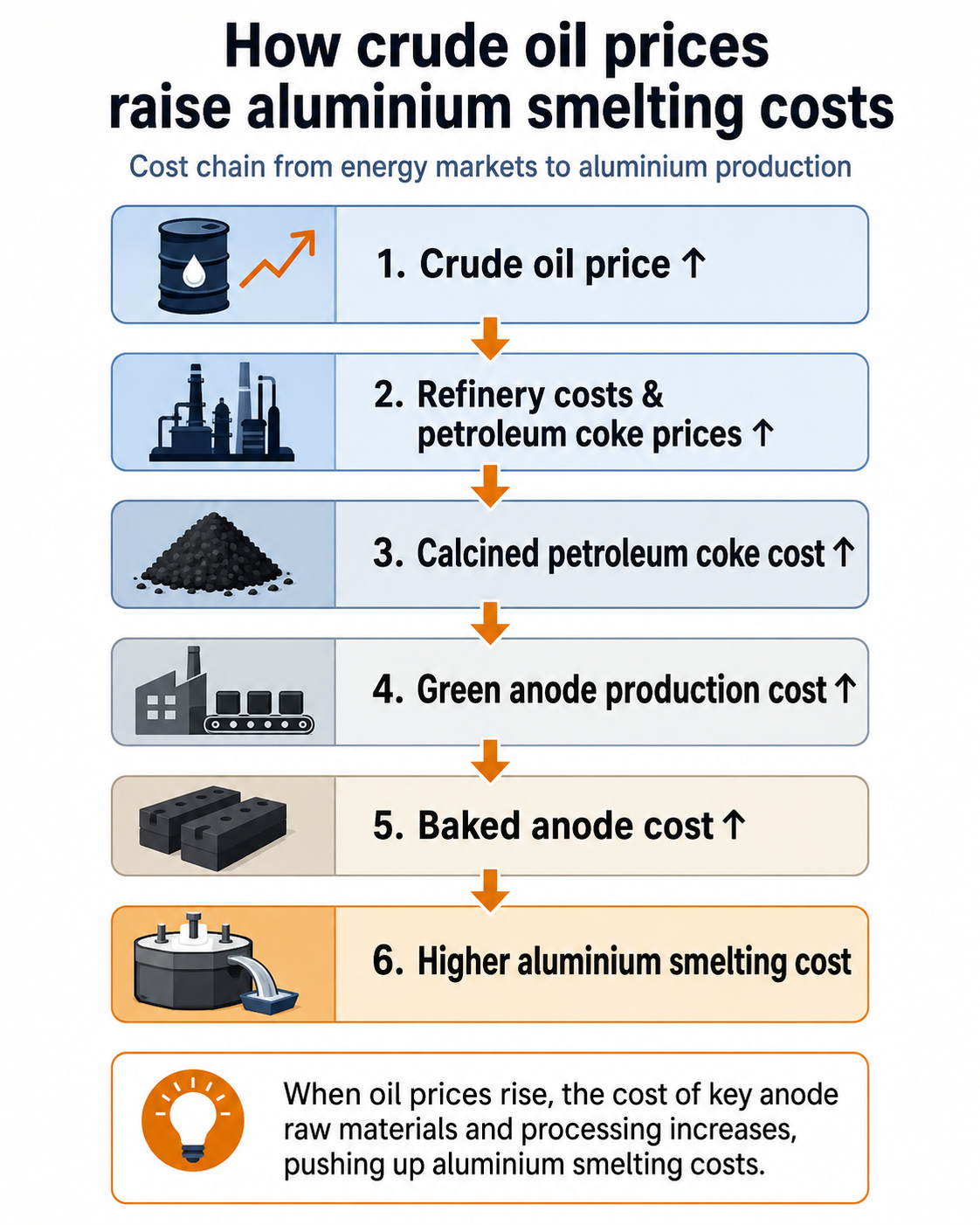
The image used in this article is generated with an AI tool
The final consequence is the increased aluminium smelting cost. On average, anode cost typically contributes 10 to 15 per cent of the total cost of primary aluminium production, albeit the exact share varies depending on energy prices, alumina costs, sourcing strategy, and smelter technology.
One tonne of primary aluminium production requires 400-450 kg of carbon anodes. So, going by the average prebaked carbon anode price between USD 700 per tonne and USD 900 per tonne, its cost contribution comes to USD 294-378 per tonne.
At present, the crude oil price is close to USD 84-90 per barrel. So, if 5 barrels of oil are required to produce 1 tonne of petroleum coke, then the cost would be around USD 420-450 per tonne.
To know the production, demand and consumption forecasts on bauxite and alumina, explore the report "Global Bauxite & Alumina Market Forecast to 2036: Supply–Demand, Trade Flows & Price Outlook"
Why the Middle East crisis matters to aluminium producers?
One of the key reasons is the strong position of the Middle East as a global aluminium producer, accounting for about 10 per cent of the global output. Another no less important reason is the region’s crude oil exports, making developments in the region highly influential for global energy markets.
The renewed military escalation in the Middle East since early July 2026 has pushed up global oil prices, ranging between USD 84-90 per barrel. On Wednesday, July 29, oil prices climbed about 7 per cent. Suvro Sarkar, head of energy research at DBS Bank, estimates Brent oil prices to grow up to USD 100 per barrel in the near term as the geopolitical conflict ebbs and flows in the Middle East.
According to a Reuters update, only a small number of commodity ships could transit the Strait of Hormuz last week. Five transited on Wednesday and 39 on Tuesday through the Bal el-Mandab, an alternative route for Saudi oil shipments to Asia. Speaking of Asia, the region is the highest destination of the Middle East’s oil exports, led by China, India, and Japan.
China’s petroleum coke and anode markets feel the pressure
China, as one of the world’s largest aluminium producers, provides a clear example of how energy market disruptions can flow into aluminium raw material markets.
As a ripple effect of oil price surge and uncertainty around the Middle Eastern supply routes, China, as one of the leading oil importers from the Middle East, has experienced increased pet coke and prebaked anode prices. Although this is one part of the story, reduced availability of certain grades, especially low-sulphur pet coke required for aluminium anode production, and changes in imported pet coke availability were the other half. As of July 30, the north-east China No.1 petroleum coke spot price index was RMB 4,415.73 per tonne, the Shandong No.2 petroleum coke spot price index was RMB 4,276.73 per tonne, the Shandong No.3 petroleum coke spot price index was RMB 3,738.11 per tonne, and the Shandong No.4 petroleum coke spot price index was RMB 2,093.05 per tonne.
The cost increase in pet coke, coupled with many other factors, contributed to the increased prebaked anode price. According to the data revealed by Mysteel, the July 2026 prebaked anode procurement benchmark price at a major Shandong-based aluminium smelter increased by RMB 30 per tonne month-on-month, with the set at RMB 5,683 per tonne by cash and RMB 5,707 per tonne by acceptance.
Notably, the price movement of anode in July was aligned with the upward pricing trends of upstream raw materials, petroleum coke and coal tar pitch, with rising feedstock costs successfully passed through to finished products. While the industry's overall cost faced mild pressure, it remained firmly above the breakeven line, with only marginal fluctuations.
Going by the latest prebaked anode price and taking into account that 400-450 kg of prebaked anodes is used for 1 tonne of primary aluminium production, then anode cost contribution would be around (RMB 5,683 per tonne anode × 0.42 tonne anode per tonne of aluminium) RMB 2,387 per tonne of aluminium.
Explore primary aluminium suppliers, product listings and trade opportunities on AL Biz.
The second pressure point by oil – rising shipping costs
If the surge in oil prices has affected primary aluminium production cost, then the inflated maritime shipping cost cannot be ignored, which ultimately increases aluminium’s CIF price (cost, insurance, freight).
The closure of the Strait of Hormuz and the adoption of other alternative routes as a result have incurred higher shipping costs for aluminium producers and exporters. The Port of Sohar has emerged as an alternative shipping route, but it requires transshipment or inland transport from Gulf producers, raising shipment costs and delays.
Market indicators show marine insurance costs have risen sharply, with war-risk premiums increasing from around 0.25 per cent pre-conflict to as high as 3 per cent of vessel value. At the same time, tanker freight rates have surged amid reduced vessel availability and heightened risk.
Unlock key insights from leading companies and experts across the aluminium ecosystem with our e-Magazine "Mine to Market: Aluminium Producers & Manufacturers 2026"
Aluminium and oil connection reinforced
The connection between oil and aluminium is indirect but increasingly important. A rise in crude oil prices can influence petroleum coke markets, increase anode production costs and raise shipping expenses.
Senior Analyst with Price Futures Group, Phil Flynn, shares with Reuters that normalisation of oil flows from the Gulf will take about four to six months after the United States and Iran reach a durable ceasefire. He assumes full normalisation would be only possible by early 2027.
In this situation, the International Energy Agency (IEA) expects global oil demand to fall by 1 million bpd this year, before rebounding to rise 2 million bpd in 2027.

Note: This is exclusive coverage by AL Circle and may not be reproduced, republished or shared without prior permission.
July’s increase in aluminium’s proportion of liquid aluminium exceeded expectations, and August is expected to edge up
Next articlePBOC releases easing signals, aluminium price upside room limited amid supply-demand and geopolitical game
Grow with
AL Circle