Germany’s construction aluminium demand falls 12%, but 2027 recovery and recycling offer fresh growth prospects
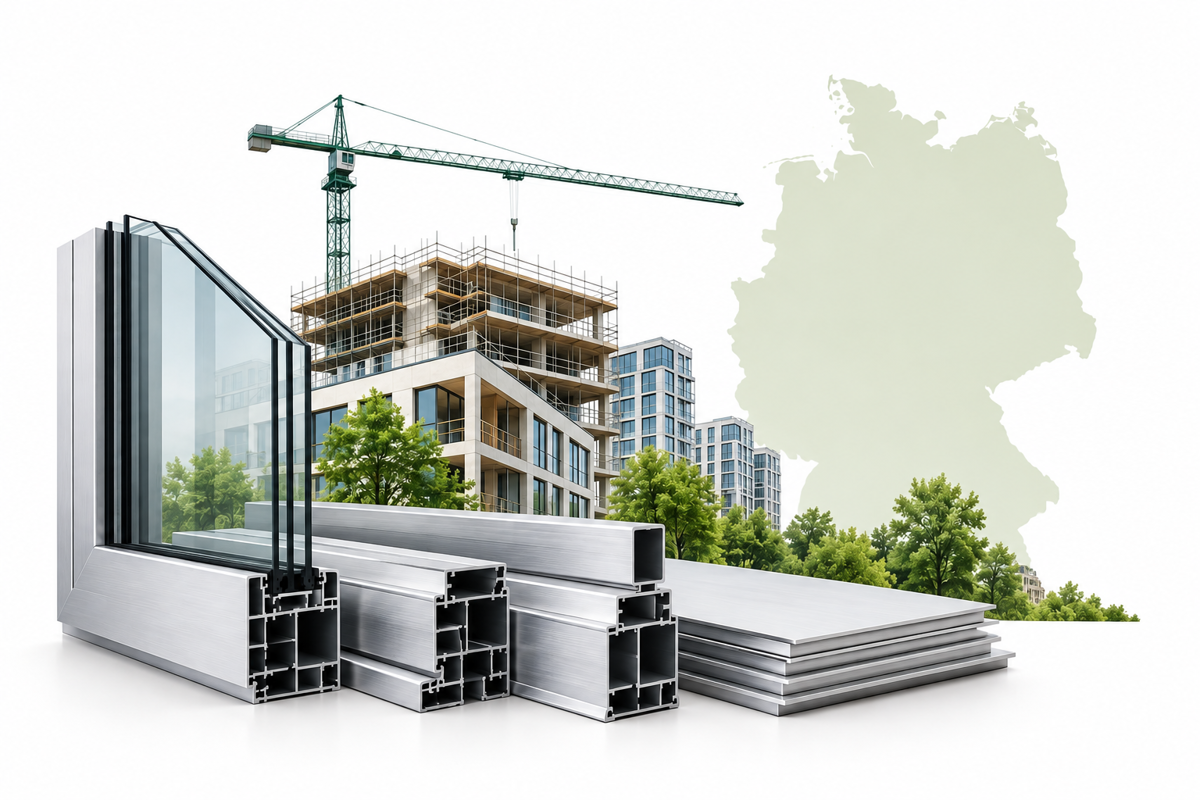
The image used in this article is generated with an AI tool and does not depict any real-time moment.
Germany’s construction industry has endured several years of contraction, weighed down by elevated financing costs, expensive building materials and subdued residential investment. The downturn has also affected the country’s aluminium industry, with estimated construction-related aluminium consumption declining by around 12 per cent between 2022 and 2025.
However, the outlook is beginning to change. With Germany’s construction industry projected to return to growth in 2026 and accelerate further in 2027, opportunities are emerging for aluminium suppliers across residential construction, transport infrastructure, energy networks and commercial developments. At the same time, efforts to strengthen closed-loop aluminium recycling in buildings could provide an additional avenue for growth.
The critical question is whether this anticipated construction recovery will translate into a sustained increase in aluminium consumption or whether weak residential demand and high operating costs will continue to constrain the market.
Germany’s construction downturn: A prolonged challenge
The decline in German construction is a phenomenon since early 2022. High energy prices, increased raw material costs were reasons then and are reasons till now. Mortgage rates exceeding 4 per cent have further weakened residential construction activity, discouraging new developments and affecting investment decisions.
The slowdown has been particularly visible across residential, non-residential and civil engineering activities. In 2022, these segments contracted by 2.4 per cent, 3.5 per cent and 5.8 per cent, respectively. The following year brought further declines of 3.5 per cent, 1.6 per cent and 2.1 per cent. The year next in 2024, the sectors rebounded and saw the growth of 3.6 per cent (residential), 4.4 per cent (non-residential), and 4 per cent (civil engineering) – but short lived as the overall industry further fell by 3 per cent Y-o-Y in 2025.
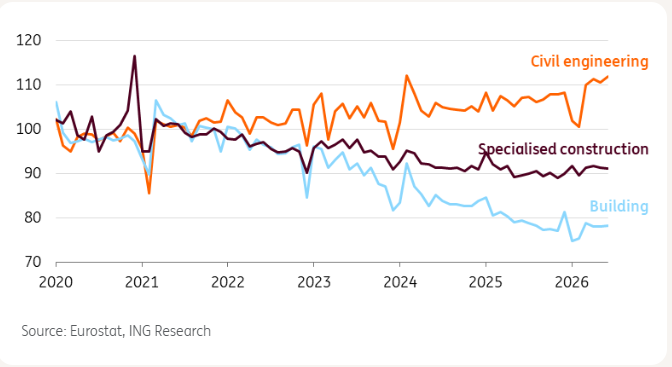
The weakness has continued to appear in recent activity indicators. In September 2026, S&P Global Construction PMI Total Activity Index fell to 43.5 points from 48.7 points in August. New orders continued to decline markedly, though the rate of decline eased to the weakest in three months.
Growth expectations revised, but 2027 offers a turning point
Germany's construction industry is expected to record modest growth of approximately 1 per cent in 2026, following a cumulative decline of around 10 per cent between 2022 and 2025. The forecast, however, represents a downward revision from earlier expectations.
The German Construction Industry Federation, Hauptverband der Deutschen Bauindustrie, initially projected growth of 2.5 per cent for 2026 before revising its estimate to 1 per cent amid weak activity and rising construction costs.
Managing Director Tim-Oliver Müller highlighted the continued pressure on residential construction, explaining that the industry's original forecast was no longer sustainable. Expectations for real residential construction growth were reduced from 2 per cent to just 0.5 per cent.
Nevertheless, the medium-term outlook is more encouraging. Construction industry growth is projected to reach approximately 2 per cent in 2027, supported by infrastructure spending, improving investment conditions and a gradual recovery in residential activity.
Between 2027 and 2030, the sector is expected to record average annual growth of approximately 3.5 per cent, with transport infrastructure, housing, data centres, renewable energy projects and power-grid expansion among the anticipated contributors, while lifting the possible consumption of aluminium for lightweight, durability, recycling advantages.
However, the relationship between construction growth and aluminium consumption is not necessarily proportional. The scale of aluminium demand recovery will depend on the types of projects receiving investment and the amount of aluminium used in each application.
What has Germany's construction slowdown meant for aluminium?
Now, the question is: how the fluctuations in the German construction industry are shaping up the national aluminium industry. In a year, aluminium consumption accounts for 15 to 16 per cent of Germany’s total aluminium usage across the end-use sectors, making an important market for extrusions, sheets, profiles, windows, doors, facades and architectural systems. But with the shift in the construction industry, Germany’s overall aluminium consumption also portrays year-on-year variation. From 3.33 million tonnes of both primary and downstream aluminium consumption in Germany in 2022, the volume decreased to 2.93 million tonnes in 2025. Considering average 15 per cent consumption, Germany’s aluminium usage in the construction sector only was 499,500 tonnes in 2022 and that dropped to 439,500 tonnes in 2025.
The estimated trajectory illustrates how closely aluminium demand has been exposed to the broader construction downturn.
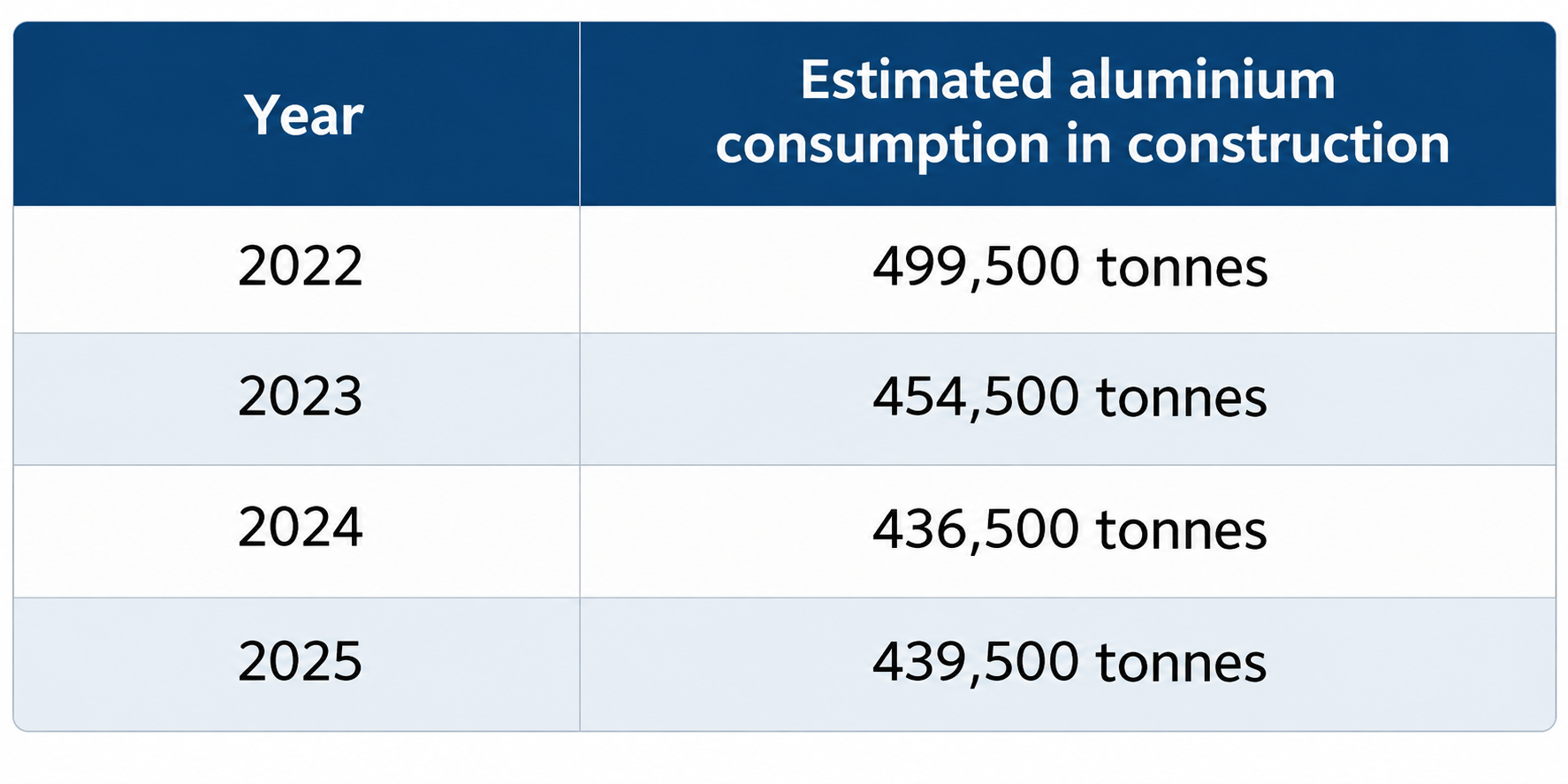 Note: These are indicative estimates calculated using a constant 15 per cent share of Germany's total aluminium consumption, rather than independently reported construction-sector consumption figures.
In tandem with the decline in Germany’s construction sector in 2023, the country’s aluminium construction also reduced to 454,500 tonnes (based on the 15 per cent average consumption of aluminium in the construction sector). However, in 2024, even though the construction sector revived, the aluminium consumption remained sluggish, standing at approximately 436,500 tonnes. Rather, 2025 saw a modest rise in German’s aluminium consumption in the construction sector by about 3,000 tonnes or 0.7 per cent despite a dip in the construction industry.
This divergence highlights an important consideration: construction activity alone does not determine aluminium demand. Changes in project composition, material selection, renovation activity and the relative performance of aluminium-intensive applications can influence consumption independently of overall construction growth.
To know the aluminium casting demand forecast in the construction sector, explore our report "Global Aluminium Casting Market 2026-2032: Plant Economics, Alloy Segmentation, Pricing Intelligence, Supply Chain Analysis & Strategic Recommendations"
However, overall, aluminium consumption in Germany’s construction sector decreased by 12 per cent between 2022 and 2025, alongside the 10 per cent drop in the construction sector during the same period.
Now, that’s the historical consumption of aluminium in German’s construction sector. What does the projection say when the construction sector is on the way to rebound, with the construction investment likely to increase by 1.7 per cent in real terms? Price adjusted turnover in the main construction sector is expected to grow by 2.5 per cent.
Residential construction remains the biggest challenge
Residential construction dominates the overall German construction sector, accounting for 60 per cent. But its weak performance over the past five years offset the country’s overall construction market, leading to turnover decline by 1.5 per cent. According to the Ifo survey, more than 40 per cent of companies reported insufficient orders.
Nevertheless, some forward-looking indicators suggest a stabilisation in the conditions. From 2026, there’s a rise in orders by 10 per cent on a price-adjusted basis, while the volume of new business for residential construction loans increased by 21 per cent. This is also reflected in the number of building permits, which increased by 10.8 per cent last year. While investment in existing residential buildings is estimated to grow slightly in 2026 due to government subsidy measures, investment in new residential construction is likely to grow by 2 per cent.
However, higher permit approvals and financing activity must translate into actual construction starts and project completions before a meaningful recovery in aluminium orders can be established.
Infrastructure, data centres and energy projects could reshape demand
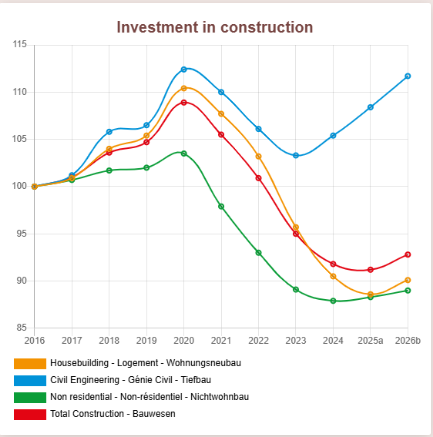
As non-residential projects are concerned, a lion’s share was dominated by data centres in 2025. Incoming orders increased by 5 per cent in 2025 and is likely to continue in 2026.The graph below indicates the future investment in Germany’s construction industry. Investment in housebuilding shows an uptick, while investments in civil engineering and non-residential also project a rise.
These developments could broaden the opportunities available to aluminium suppliers.
In transport infrastructure, aluminium can be used in architectural components, structural systems and specialised applications. Power networks and renewable energy installations support demand for aluminium conductors, cables, mounting systems and related equipment. Data centres and commercial facilities can also create demand for aluminium in building façades, electrical systems, cooling equipment and other infrastructure components.The opportunity, however, will depend on the material intensity of individual projects. Not every increase in infrastructure spending will generate the same level of aluminium consumption.
For the aluminium industry, the most meaningful development may therefore be a gradual diversification of construction demand beyond traditional residential applications.
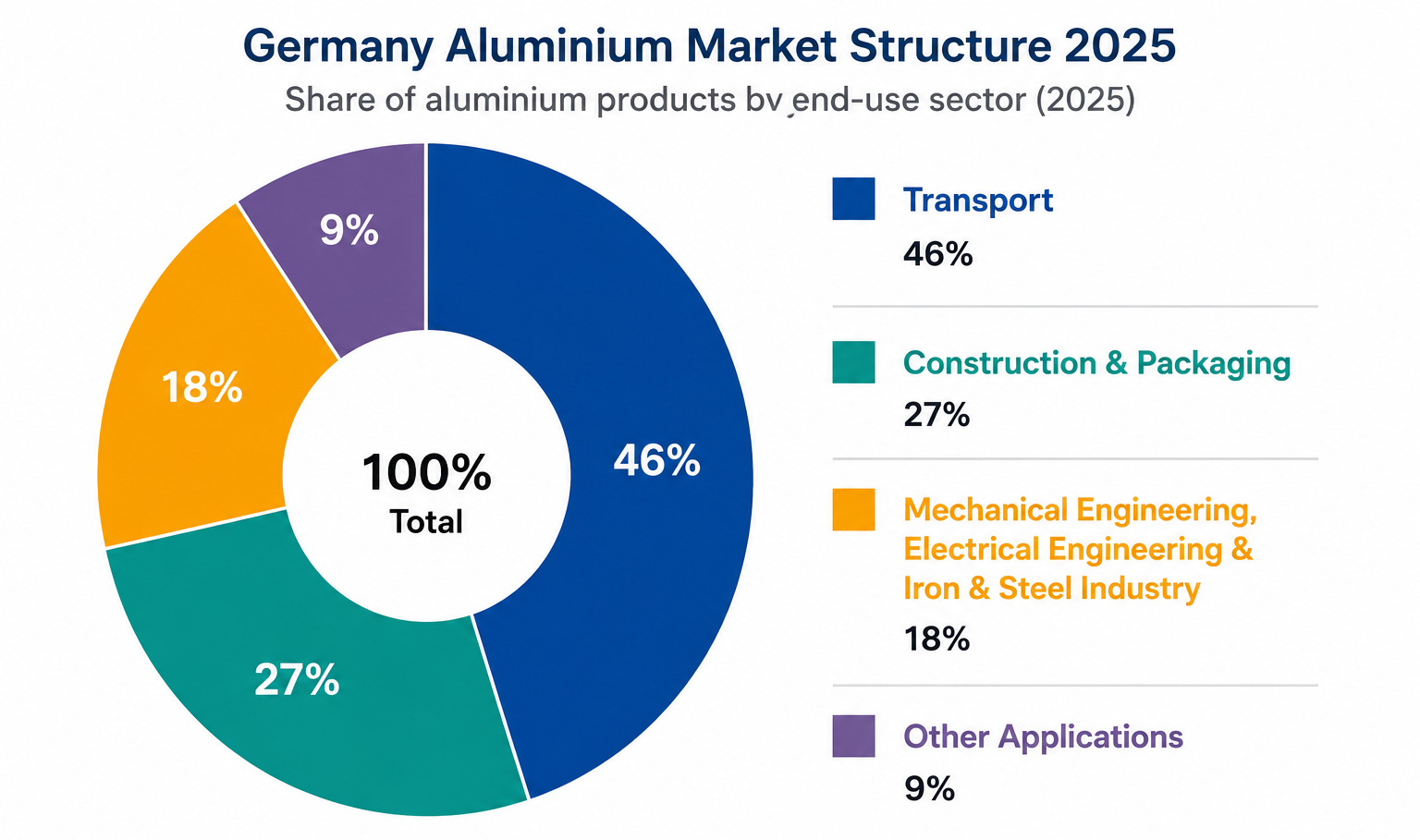
As of 2025, German aluminium market share across the key end-use sectors looks like this –
Closed-loop recycling may offer another opportunity
Alongside the prospect of recovering construction demand, Germany is making progress in strengthening aluminium recycling within the building sector.A report by German industry organisation Aluminium und Umwelt im Fenster- und Fassadenbau (AUF), prepared in partnership with European Aluminium, highlights the progress of closed-loop aluminium recycling in Germany's building sector.
As per the report, AUF collected 75,000 tonnes of aluminium scrap in 2023 through its recycling network. The collection system was supported by seventeen environmental partners and processors, with a total of around 300 collection points across Germany.
The 75,000 tonnes collected through AUF's network is equivalent to approximately 58 per cent of the estimated 130,000 tonnes of building-sector aluminium scrap generated that year. However, this comparison should not be interpreted as a national recycling rate without confirming that both datasets cover the same material categories and collection boundaries.
The broader significance lies in the potential to improve scrap identification, collection, sorting and reintegration into new building products. For manufacturers, closed-loop recycling could reduce dependence on primary aluminium, improve access to secondary raw materials and support the production of lower-carbon building components.
Showcase your brand, aluminium recycling initiatives and sustainability vision in our upcoming magazine: "Sustainability & Recycling: Aluminium’s Commitment 2026".
At the same time, the success of such systems depends on maintaining alloy quality and ensuring that recovered material can be reused in technically suitable applications.
Meanwhile, a study by Delft University of Technology examines the presence of aluminium in selected European building-demolition projects, illustrating how recoverable aluminium quantities can differ substantially depending on building design, materials and construction period.
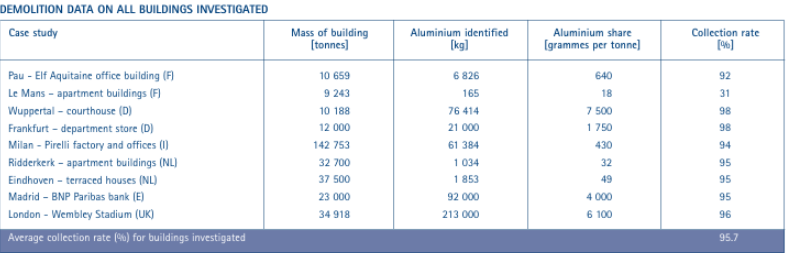
Such research is relevant because aluminium used in buildings often remains in service for several decades before becoming available for recycling. Now, the focus should be how effectively the materials can be identified, separated and recovered when structures are renovated or demolished. Better material tracking, selective demolition and alloy-specific sorting could help improve the quality of recovered scrap and increase its suitability for closed-loop applications.
Outlook: A gradual recovery could open a new chapter for construction aluminium
At this moment, weak residential activity, high financing costs and uncertain investment conditions remain significant obstacles. Moreover, the projected 2 per cent growth in construction activity in 2027 should not be interpreted as a confirmed 2 per cent increase in aluminium consumption.
Nevertheless, the direction of the market is becoming more encouraging. Improving residential indicators, investment in transport and energy infrastructure, expanding data centre development and the growing emphasis on circular construction all offer potential demand drivers.
Germany's established aluminium recycling network could provide an additional competitive advantage by enabling more construction scrap to return to productive use. The next phase of growth may therefore depend not only on how much new construction Germany undertakes, but also on how effectively the industry combines recovering demand with greater aluminium circularity.
After several difficult years, the anticipated construction rebound and expanding recycling opportunities offer Germany's aluminium industry a credible pathway towards renewed growth, stronger resource efficiency and a more resilient domestic value chain.
Grow with
AL Circle