Trace aluminium from slab to packaging, examining conversion yield, manufacturing scrap recovery and regional demand
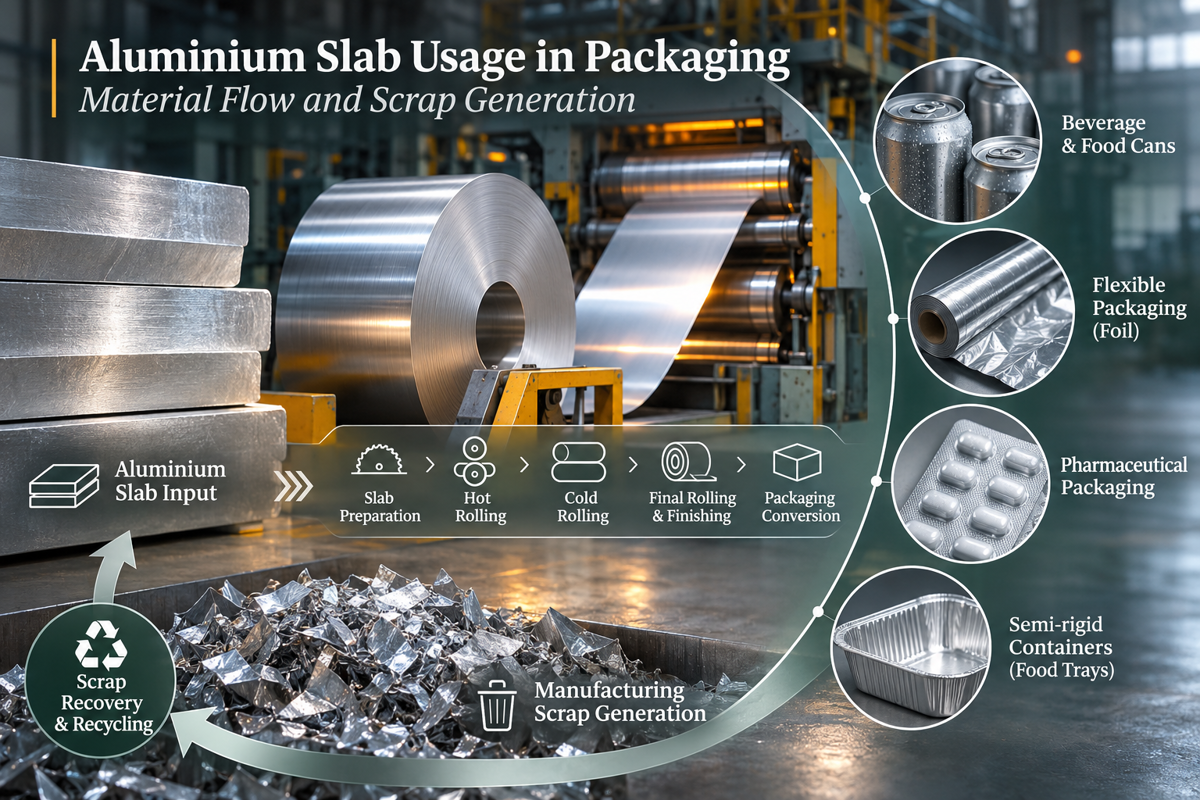
The images used in this article is generated with an AI tool and does not depict any real-time moment
A beverage can, a pharmaceutical blister pack and a semi-rigid aluminium food tray may all originate from the same broad category of rolled aluminium, but their manufacturing requirements are far from identical. The difference lies in the thickness, alloy composition, surface quality and formability demanded by each application.
AL Circle’s material-flow estimates place aluminium slab usage in packaging at approximately 20.64 million tonnes, alongside manufacturing scrap generation of 4.13 million tonnes. The estimated conversion yield is around 78%-82%, indicating that a sizeable proportion of the incoming metal is removed during the production and finishing stages.
This distinction matters because packaging demand is not simply a question of how much aluminium leaves a canmaking or foil-converting plant. It also concerns the volume of slab required to produce that material, the efficiency of successive rolling operations and the extent to which manufacturing scrap can be recovered and returned to production.
From slab to packaging stock: Where the metal goes
The slab-to-packaging route begins with casting, followed by surface preparation, homogenisation, hot rolling and cold rolling. Depending on the final application, the material undergoes further annealing, surface treatment, coating, slitting or cutting before reaching packaging manufacturers.
UACJ explains that flat-rolled aluminium production describes this progression from a cast slab through surface preparation and heating to hot rolling, cold rolling and finishing. The thickness and strength of the resulting sheet are adjusted according to its intended application.
The packaging industry consequently draws on several distinct categories of rolled products.
Beverage and food cans: Canstock is among the largest packaging-related applications of rolled aluminium. It requires sheets with precise thickness, strength and formability so that the metal can withstand drawing, ironing and shaping without compromising container integrity. The requirements for can-body stock and end stock also differ.
Flexible packaging: Aluminium foil used in food pouches, chocolate wrappers, cigarette packaging and laminated products requires substantially thinner gauges. Flexible packaging applications commonly use foil in the 6-12-micron range, including alloys such as 1235 and 8079.
Pharmaceutical packaging: Blister packs require barrier performance and consistent surface quality to protect medicines against external conditions. Aluminium foil used in these applications typically falls within the 20-30-micron range, with 8011 and 8021 among the commonly used alloys.
Semi-rigid containers: Food trays and containers require thicker, more rigid material. The relevant foil applications typically use gauges of 54-100 microns, with alloys such as 3003 and 8006.
Household foil: The familiar foil used for wrapping and food preservation generally falls within the 10-14-micron range, commonly using 8011 alloy.
These differences explain why packaging cannot be treated as one uniform aluminium-consuming segment. A rolling mill must maintain different gauge tolerances, surface characteristics and mechanical properties depending on the product being manufactured.
Regional demand: Canstock and foil reveal different consumption patterns
Although a directly comparable regional slab-consumption dataset is unavailable, regional demand for canstock and aluminium foil provides a useful picture of where packaging-related rolled aluminium is being consumed.
The 2024 figures reveal two distinct demand patterns. China leads both canstock consumption and consumer foil usage, while Europe and North America demonstrate considerably different consumption profiles across the two product categories. To learn the growing contribution of aluminium flat rolled products (FRP) in the packaging sector, explore our report "ALuminium in Packaging: Consumer Trends and Market Dynamics"
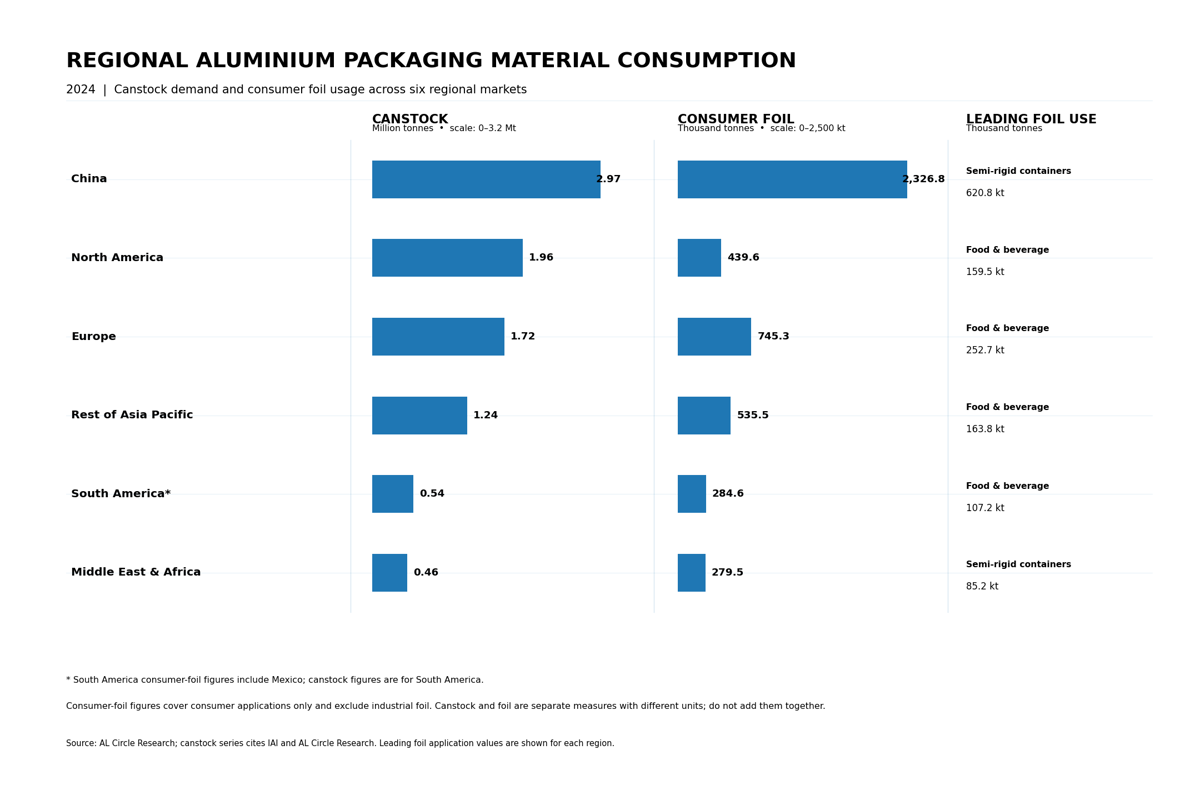
The regional figures and end-use breakdowns are from the accompanying market research; the canstock series identifies IAI and AL Circle Research as its sources.
Three observations stand out in this stance:
China's demand extends across both major packaging material streams. The country recorded approximately 2.97 million tonnes of canstock consumption in 2024, while consumer aluminium foil usage reached 2.33 million tonnes. Within the latter, semi-rigid containers accounted for approximately 620,800 tonnes, narrowly ahead of food and beverage applications at 604,000 tonnes.
Europe demonstrates a substantial appetite for foil-based packaging. Consumer aluminium foil usage reached 745,300 tonnes in 2024, considerably higher than the 439,600 tonnes recorded in North America. Food and beverage applications accounted for 252,700 tonnes of European foil consumption, followed by semi-rigid containers at 172,200 tonnes and pharmaceuticals at 124,800 tonnes.
The Rest of Asia Pacific presents a different growth opportunity. The region consumed approximately 1.24 million tonnes of canstock and 535,500 tonnes of consumer aluminium foil in 2024. Food and beverage applications represented the largest individual consumer-foil category, at 163,800 tonnes, followed by pharmaceutical applications at 131,400 tonnes.
The Middle East and Africa also presents an interesting contrast. Although its canstock consumption stood at 460,000 tonnes, semi-rigid containers represented the largest consumer-foil application, at 85,200 tonnes. The figure points to the importance of food containers and takeaway packaging within the region's foil market.
These numbers should not be added together to calculate regional slab requirements. Canstock and foil are different downstream product streams, and their consumption figures do not include identical geographical boundaries or industrial applications. Nevertheless, they establish where the demand for particular rolled packaging materials is concentrated.
Where manufacturing scrap enters the equation
The conversion of slab into packaging-grade aluminium involves several operations, each introducing opportunities for material removal.
The scrap generated is not confined to one stage. It accumulates through surface preparation, rolling, thickness correction, slitting and downstream forming.
1. Slab preparation - Before rolling, slabs undergo sawing and scalping to achieve the required dimensions and remove surface imperfections.
This generates end cuts, saw chips and scalped surface material. The objective is to eliminate defects before the metal enters the rolling process, where imperfections could compromise the quality of the finished sheet or foil.
2. Hot rolling - The prepared slab is heated and passed through rolling mills to reduce its thickness, eventually producing hot-rolled coils.
Edge trimming and the removal of head and tail sections are necessary to maintain dimensional accuracy and surface quality. Strip breaks and associated cobbles can also generate scrap during this stage.
These operations are particularly important because inconsistencies carried forward from hot rolling can affect the subsequent cold-rolling process.
3. Cold rolling - Hot-rolled coils undergo repeated cold-rolling passes to achieve the required gauge and surface finish.
This stage introduces scrap through edge trimming, gauge corrections and strip breaks. A coil that does not maintain the required thickness or surface characteristics may need to be downgraded or rejected for a particular packaging application.
Intermediate annealing is used to restore ductility and prepare the metal for further reduction. Although it does not normally generate significant physical scrap, defective material may still be downgraded.
4. Final rolling, slitting and foil production - The finishing stage is particularly important for packaging-grade aluminium.
Foil production involves reducing the material to very thin gauges, sometimes just 6-12 microns. The narrower the gauge tolerance, the greater the sensitivity to surface imperfections, inclusions and pinholes.
Slitting also produces side trims when wider coils are divided into narrower rolls for individual packaging applications.
Consequently, foil-side trims, slitter scrap and downgraded coils form an important part of the manufacturing scrap stream. The in-house material-flow assessment identifies foil-rolling trims as the largest individual contributor to packaging-related manufacturing scrap.
Unlock key insights from industry experts on aluminium's applications in end-use with our magazine - End-user Revolution: Aluminium’s Impact on Modern Living
5. Packaging conversion
The metal continues to undergo processing after leaving the rolling mill.
Canstock is cut and shaped into can bodies and ends, while foil stock is converted into pouches, household rolls, pharmaceutical blister components and semi-rigid containers. Blanking, trimming and forming operations generate additional offcuts and rejected material.
This means that the scrap account should extend beyond the rolling mill. Looking exclusively at the mill's output would overlook material removed during the conversion of sheets and coils into finished packaging products.
Manufacturing scrap is not necessarily lost aluminium
One important distinction in the packaging material flow is the difference between scrap generation and irreversible material loss.
Much of the scrap generated during slab preparation and rolling is pre-consumer material with a known alloy composition. Clean saw cuts, edge trims and other segregated process scrap can be returned for remelting, either within the producer's own operations or through an external recycling arrangement.
A 2023 life-cycle assessment of aluminium sheet production for packaging examined the use of pre-consumer scrap and described it as material of known quality and alloy composition, without coatings. The study also identified primary aluminium production, foundry operations and hot rolling as significant contributors to the environmental impact of the manufacturing route.
This makes process scrap recovery important for two reasons. First, it improves the utilisation of metal already purchased or produced. Rather than requiring an equivalent volume of fresh metal for every tonne of packaging stock, manufacturers can recover suitable internal scrap and reintroduce it into the production cycle.
Second, it reduces the requirement for additional primary aluminium, although the precise environmental benefit depends on the remelting process, energy source and quality of the recovered material.
However, not every scrap stream offers the same recycling potential. Alloy mixing, contamination, coatings and laminated structures can complicate material recovery. Clean, segregated rolling scrap is therefore different from rejected coated foil or post-consumer packaging waste.
The distinction between pre-consumer and post-consumer scrap is equally important. Scrap generated during manufacturing can often be identified and recovered before products enter the market. Used cans, trays and foil packaging, by contrast, depend on collection, sorting and recycling infrastructure after consumption.
The International Aluminium Institute’s material-flow work recognises packaging as an important source of post-consumer aluminium scrap, underlining the role of recycling beyond the manufacturing stage.
The importance of conversion yield
For packaging manufacturers, the challenge is not simply to minimise the volume of scrap generated. It is to improve the proportion of incoming material that meets the required product specifications while maintaining an effective recovery route for the material removed.
This requires attention to several operational parameters: slab surface quality, rolling accuracy, gauge consistency, edge-trimming requirements, strip-break frequency and the quality of recovered scrap.
Downgauging can also influence the equation. Thinner packaging material can reduce the amount of aluminium used per container or packaging unit, but it places greater demands on rolling accuracy and product quality. A reduction in material thickness does not automatically translate into an equivalent reduction in slab requirements if defect rates, rejection levels or conversion losses increase.
There is another important boundary to the analysis. Not every aluminium packaging product follows the slab-to-sheet route. Certain aerosol containers, collapsible tubes and bottles are manufactured through impact extrusion using aluminium slugs. These products need to be considered through a separate production route rather than automatically assigned the same slab-to-foil conversion assumptions. The European Commission's evaluation of the aerosol packaging value chain documents these slug-based extrusion processes.
The distinction is essential when assessing the aluminium packaging market as a whole. Slab consumption captures a significant part of the flat-rolled packaging supply chain, but it does not independently represent every aluminium packaging format.
Looking beyond finished packaging demand
Aluminium packaging demand is often measured through the consumption of cans, foil and other finished or semi-finished products. Yet the upstream material requirement is shaped by what happens between the slab and the final packaging specification.
The estimated 20.64 million tonnes of slab usage and 4.13 million tonnes of manufacturing scrap illustrate the scale of this conversion chain. The regional canstock and foil figures further demonstrate that packaging demand is not distributed uniformly across markets or product categories.
For aluminium producers and packaging converters, the more meaningful measure is therefore not simply the volume of packaging stock supplied. It is the relationship between incoming slab, specification-compliant output, manufacturing scrap and recovered metal.
As packaging manufacturers pursue thinner gauges and greater material efficiency, improvements in rolling precision and scrap recovery will increasingly influence how much fresh aluminium the sector needs to sustain its output.
The wider market picture, including consumer trends, regional demand, can manufacturing, pharmaceutical applications, aerosol products and emerging packaging formats, is examined in AL Circle's Aluminium in Packaging: Consumer Trends and Market Dynamics.
Unlock full access – sign up for FREE.
Key benefits
Grow with
AL Circle












_md.webp)
_md.webp)
_md.webp)