Aluminium over innovation? The manufacturing logic behind Boeing's 747-8
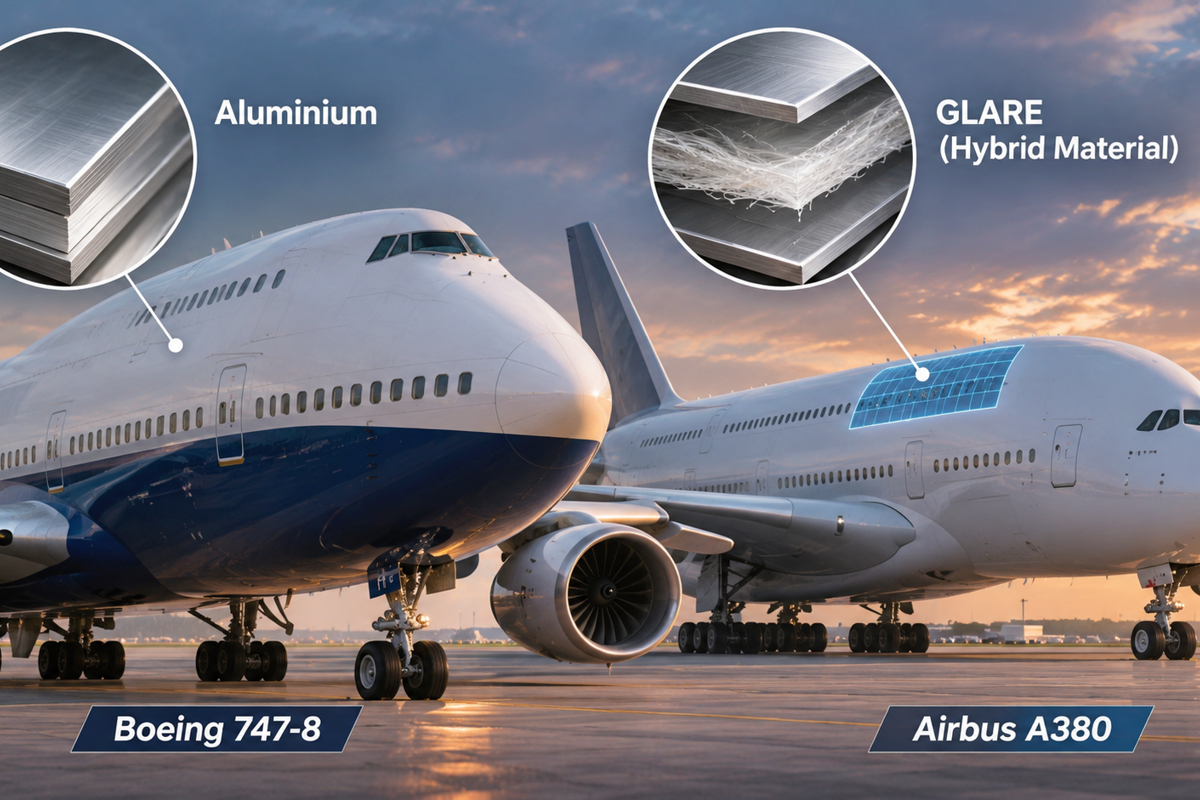
The image used in this article is generated with an AI tool and does not depict any real-time moment
When Airbus introduced the A380 and Boeing developed the 747-8, the two aerospace manufacturers took different approaches to aircraft materials. Airbus incorporated an advanced hybrid material known as Glass Laminate Reinforced Aluminium (GLARE) into selected sections of the A380's fuselage, while Boeing retained conventional aluminium for the main fuselage structure of the 747-8. The difference reflected not only their engineering priorities but also the manufacturing costs and production strategies behind the two aircraft programmes.
GLARE combines thin sheets of aluminium with layers of glass-fibre-reinforced epoxy, creating a material designed to offer improved fatigue resistance while reducing structural weight. Its development represented an important step in aerospace materials engineering, particularly for aircraft exposed to repeated pressurisation cycles during flight.
However, adopting such materials across an aircraft requires more than demonstrating their structural advantages. Manufacturers must also consider production equipment, assembly processes, costs and the specific requirements of different aircraft structures.
GLARE: Airbus's alternative to conventional aluminium
The Airbus A380 used GLARE selectively, rather than across its entire fuselage. Approximately 500 square metres of the material was incorporated into the upper shells of the forward and rear fuselage sections.
These areas experience repeated tensile stresses as cabin pressure increases during flight and decreases after landing. Over thousands of pressure cycles, conventional aluminium structures can develop microscopic fatigue cracks.
GLARE addresses this challenge through its layered construction. The glass-fibre layers can help restrict the propagation of cracks through the aluminium sheets, improving fatigue performance while offering weight-saving advantages.
The material was developed through work involving Fokker, which advanced structural metal-bonding techniques, and research collaboration with Delft University of Technology. Its manufacturing process involves bonding thin aluminium sheets with glass-fibre epoxy layers, using specialised equipment and controlled curing processes.
Despite its advantages, GLARE was not suitable for every part of the A380. Sections exposed to demanding compression, bending and shear loads continued to rely on conventional aluminium structures. Its use therefore represented a targeted material solution rather than a complete replacement for traditional aerospace alloys.
To know the aluminium casting demand forecast in the transportation sector, explore our report "Global Aluminium Casting Market 2026-2032: Plant Economics, Alloy Segmentation, Pricing Intelligence, Supply Chain Analysis & Strategic Recommendations"
Why Boeing retained conventional aluminium
Boeing's approach to the 747-8 was shaped by a different starting point. Unlike the A380, which was developed as an entirely new aircraft programme, the 747-8 evolved from the existing 747-400 platform.
This allowed Boeing to retain much of the established manufacturing architecture, including production tooling, assembly jigs and the aircraft's familiar fuselage cross-section. Maintaining conventional aluminium helped preserve compatibility with existing production processes and limited the need for extensive factory redevelopment.
Introducing GLARE or a predominantly carbon-fibre composite fuselage would have required changes to manufacturing methods, specialised production equipment and assembly infrastructure. The investment would have been particularly difficult to justify for an aircraft programme targeting a relatively specialised, lower-volume superjumbo market.
Boeing focused its material and engineering improvements on selected areas of the aircraft. The 747-8 incorporated advanced alloys and carbon-fibre composites in parts of its structure, including its wings, drawing on developments associated with the 787 Dreamliner programme.
Aluminium-lithium alloys presented another challenge
Both aircraft programmes also encountered difficulties in developing and applying advanced aluminium-lithium (Al-Li) alloys.
Adding lithium to aluminium can reduce material density and increase stiffness, making these alloys attractive for aerospace applications where weight reduction is a priority. They were explored for structural components such as fuselage stringers, floor beams and seat tracks.
However, the supplied account describes problems involving micro-cracking and stress corrosion cracking during manufacturing and assembly. These challenges complicated the use of certain lightweight extrusions and led to a greater reliance on conventional aerospace aluminium alloys in some structural applications.
The experience highlighted an important limitation of advanced materials: improvements in weight and mechanical properties do not automatically translate into easier manufacturing or reliable performance across every aircraft component.
The contrast between the A380 and 747-8 also illustrates why material selection depends on the demands of individual structural sections. Areas exposed to repeated pressurisation, bending, compression and heavy operational loads can require different engineering solutions.
Manufacturing economics shaped the final material choices
The A380 and 747-8 demonstrate two different ways of approaching aerospace innovation. Airbus incorporated GLARE where its fatigue resistance and weight-saving properties offered specific advantages, while retaining conventional aluminium in other structurally demanding sections.
Boeing, meanwhile, prioritised continuity with the existing 747 production platform, avoiding the extensive manufacturing changes that a substantially different fuselage material would have required.
Neither approach eliminated the need for conventional aluminium. Instead, both programmes showed how established alloys and newer hybrid materials can serve different purposes within the same aircraft.
As the commercial aircraft industry moves towards lighter structures and improved fuel efficiency, the experience of these two superjumbo programmes highlights a continuing challenge for aerospace manufacturers: finding the right balance between material performance, structural reliability, manufacturing complexity and investment costs.
Browse through top global suppliers for automotive components on AL Biz.
Grow with
AL Circle












_md.webp)