AL Circle Analysis: 278% China-US FRP rise, $692m Germany-France FRP trade, India’s 300m-can gap draw aluminium map
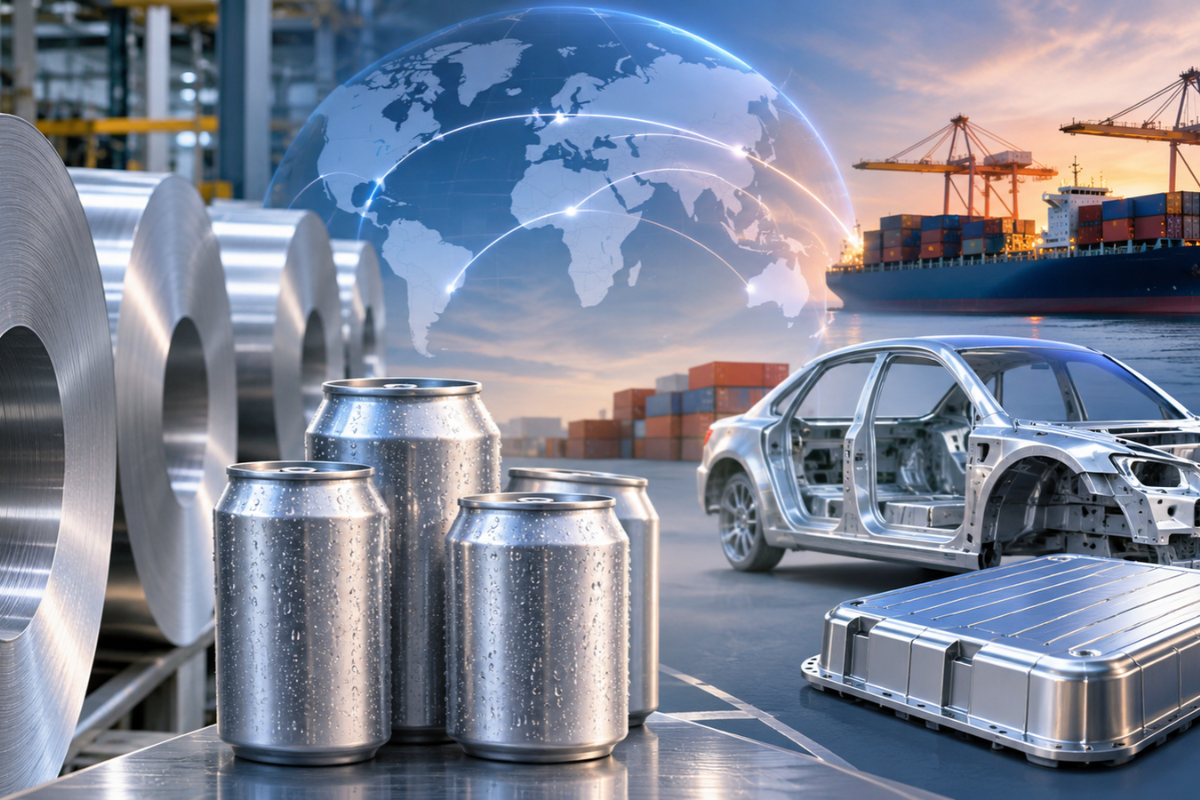
The image used in this article is generated with an AI tool and does not depict any real-time moment
Downstream aluminium is where geopolitics meets the shop floor. Tariffs, shipping disruption, regulation and shifting demand are deciding who rolls the metal, who gets it and what it becomes, whether a beer can, a battery housing or a length of wire. Fifteen recent developments across North America, Europe, Asia, the Middle East and Oceania depict how aluminium flat rolled products (FRPs), packaging and electric vehicle (EV) demand are being rerouted, and where traders, exporters and buyers may need to adjust.
Aluminium FRP and wire: tariffs and policy redraw the flows
The tariff debate has reached the bar counter. In Virginia, Democrat Tom Perriello is campaigning on aluminium tariffs that he says raise brewers’ packaging costs. Across the border, a Windsor, Ontario brewery reports its 473 ml can has risen from about 31 to 35 cents. The cross-border loop adds to the pressure, because some Canadian metal is sent to the US to be rolled into can sheet before coming back.
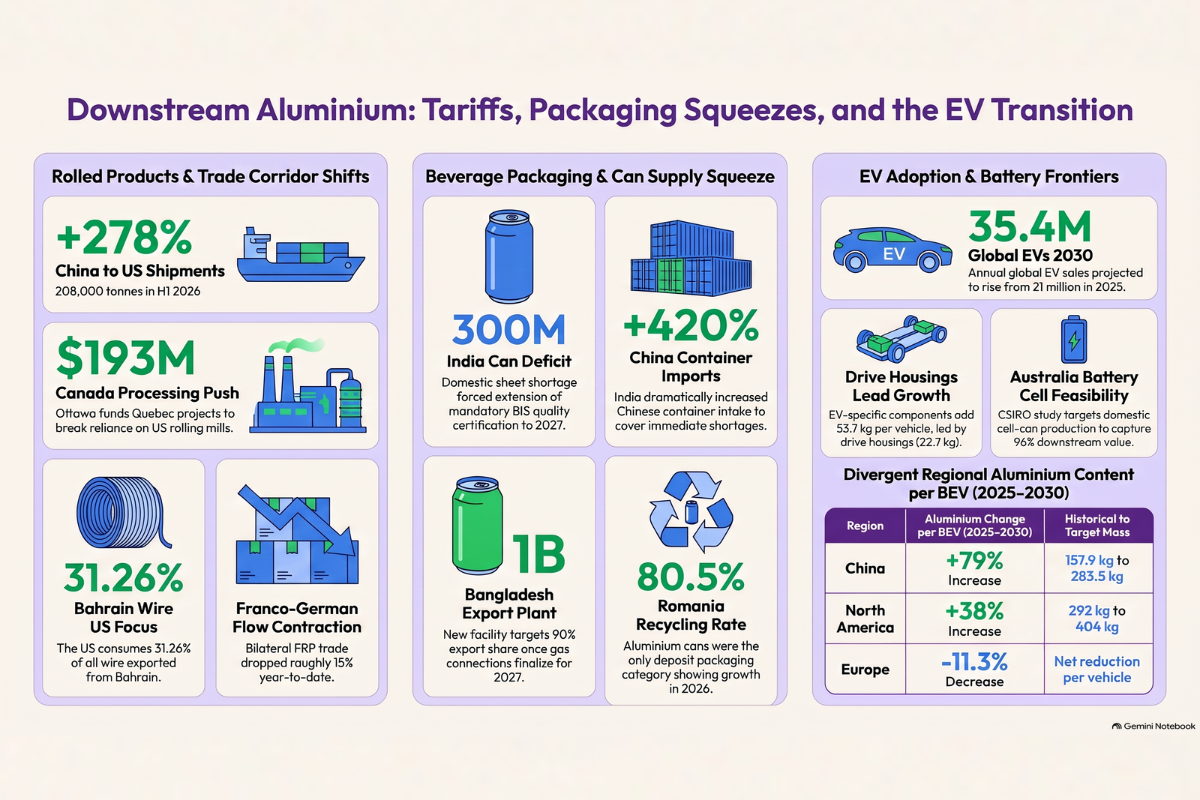
That loop is exactly what Ottawa wants to break. Canada has committed more than USD 193 million towards projects at five industrial sites in Quebec, seeking to strengthen domestic aluminium processing and reduce dependence on US facilities. Industry Minister Mélanie Joly believes it is “not normal” that most Canadian aluminium is processed in the US and returns at higher cost. She is floating financing, equity stakes and defence-related procurement to make rolling mills viable, though no mill has been approved or built.
Europe’s corridor is quieter and shrinking. Germany shipped 68,562 tonnes of aluminium FRP to France in YTD July 2026, 27.33 per cent of France’s imports, worth USD 465.4 million. France sent 50,265 tonnes back. Both legs fell, by 14.68 and 15.92 per cent. Plates, sheets and strips swap almost evenly, while foil flows mainly from Germany: 17,728 tonnes against 1,389.
Explore further insights and forecasts for the aluminium flat rolled products (FRP) market from our comprehensive report - Aluminium Flat Rolled Products: Insights & Forecast to 2030
Elsewhere, flows are heading the other way. In Asia, China’s FRP shipments to the US jumped 278.2 per cent to 208,000 tonnes in H1 2026, driven by plates, sheets and strip (184,000 tonnes against 33,000), while foil grew only 9.1 per cent. Bahrain’s wire exports tell a similar story of US pull. The US sourced 44,867 tonnes of its 143,518-tonne H1 total, or 31.26 per cent of Bahrain’s exports.
Japan’s downstream imports slid 6.2 per cent to 1.36 million tonnes as UAE supply dropped 41.8 per cent and China rose 54 per cent. It also allowed Australia to become the largest supplier among the leading exporters.
Key takeaways
- China’s Q2 sheet shipments to the US (98,000 tonnes) were more than twice Q4 2025’s 41,000 tonnes, so the corridor can move fast.
- Japan paid about 26 per cent more per tonne to Australia and about 17 per cent more to the UAE year on year, so volume swings can hide price effects.
- Bahrain’s top five wire markets take 77.9 per cent of shipments, and the US alone 31.26 per cent. Concentration is the exposure.
- Canada’s rolling-mill goal rests on financing and procurement, not approved projects, so milestones are the signal to watch.
Aluminium can squeeze: shortages, stopgap imports and capacity catch-up
India shows what happens when a producer lacks the middle of the chain. Despite being the world’s second-largest primary aluminium producer, it ran short of Diet Coke when Middle East shipping disruption hit imported can sheet. Hindalco’s extra 50,000 tonnes of can-sheet capacity and Ball’s USD 60 million Sri City investment are two to three years away. A 7.5 per cent duty on primary metal divides producers and users, and 61.4 per cent of India’s roughly USD 7 billion in aluminium exports is plain metal.
India’s aluminium beverage-can industry has fallen around 300 million cans short of its planned additional production. The government has extended mandatory BIS certification deadlines to 2027, giving manufacturers more time to expand capacity and secure supplies. Imports are filling some of the gap. China’s HS 7612 container exports rose 36.1 per cent to 49,000 tonnes, with India’s intake up 420.1 per cent to about 2,300 tonnes, though the category covers more than beverage cans.
Capacity is arriving elsewhere. Europe’s can shipments grew 6 per cent in Q3 while the Americas fell 1 per cent, so Ardagh is adding two lines in the UK and Spain. In South Asia, Bangladesh’s first can plant targets 1 billion cans (approx.) a year, roughly 90 per cent for export, if it secures a gas connection for a second-half 2027 start.
At the other end of the loop, Romania’s can-recycling rate reached 80.5 per cent during the January-September period of 2026, with cans the only deposit packaging category to grow. Can returns increased 6.3 per cent, while the return rate improved to 85 per cent. Aluminium cans were the only packaging category to record growth.
Key takeaways
- India’s 300 million-can gap and Guinea’s 334.8 per cent rise in Chinese container imports show how a shortage pulls in stopgap supply. Quality and certification determine who benefits.
- Bangladesh’s plant sends about 90 per cent of its 1 billion cans abroad. New Asian capacity is built for export, not just local demand.
- Europe’s 6 per cent growth is where Ardagh is investing first, so demand-led capacity follows the strongest region.
- Can sheet, not primary metal, is the bottleneck: a 50,000-tonne addition needs two to three years.
Looking for aluminium flat rolled products? Browse through a comprehensive list here at AL Biz
Battery and EV demand: new aluminium frontiers, uneven by region
The next demand story is about electrification, and it is not uniform. Global EV sales are forecast to grow from 21 million in 2025 to 35.4 million by 2030. Aluminium per BEV is projected to rise 38 per cent in North America (292 kg in 2020 to 404 kg) and about 79 per cent in China (157.9 kg to 283.5 kg), but to fall 11.3 per cent in Europe between 2025 and 2030. EV-specific components are forecast to add 53.7 kg per vehicle, led by drive housings (22.7 kg) and battery enclosures (11.8 kg).
The supply chains behind those vehicles are moving across borders. Mexico’s EV expansion is drawing Chinese battery and materials suppliers, backed by China’s roughly 70 per cent share of global EV battery production, though no aluminium suppliers are named.
On the other hand, Australia’s national science agency CSIRO has identified opportunities to manufacture battery components domestically using aluminium. It marks a practical first step beyond mining, in a field where 96 per cent of the revenue opportunity sits downstream. Its report highlights prismatic aluminium battery-cell cans and copper current-collector foils as potential starting points.
Read our latest magazine “ALuminium’s Frontline: OEM Edition 2026” and learn how OEMs are transforming critical aluminium applications across end-use sectors.
Key takeaways
- Aluminium demand per EV is regional: +38 per cent in North America, about +79 per cent in China, −11.3 per cent in Europe. Volumes will not rise evenly.
- Drive housings (22.7 kg) and battery enclosures (11.8 kg) are the biggest EV-specific additions, so castings and extrusions benefit first.
- Mexico’s EV push may bring Chinese supply chains without confirmed aluminium contracts, so suppliers should watch for the mentioned projects.
- CSIRO’s cell-can idea is a feasibility study. High utilisation rates are the condition for commercial viability.
Grow with
AL Circle