Canada wants to keep its aluminium at home, starting with rolling mills
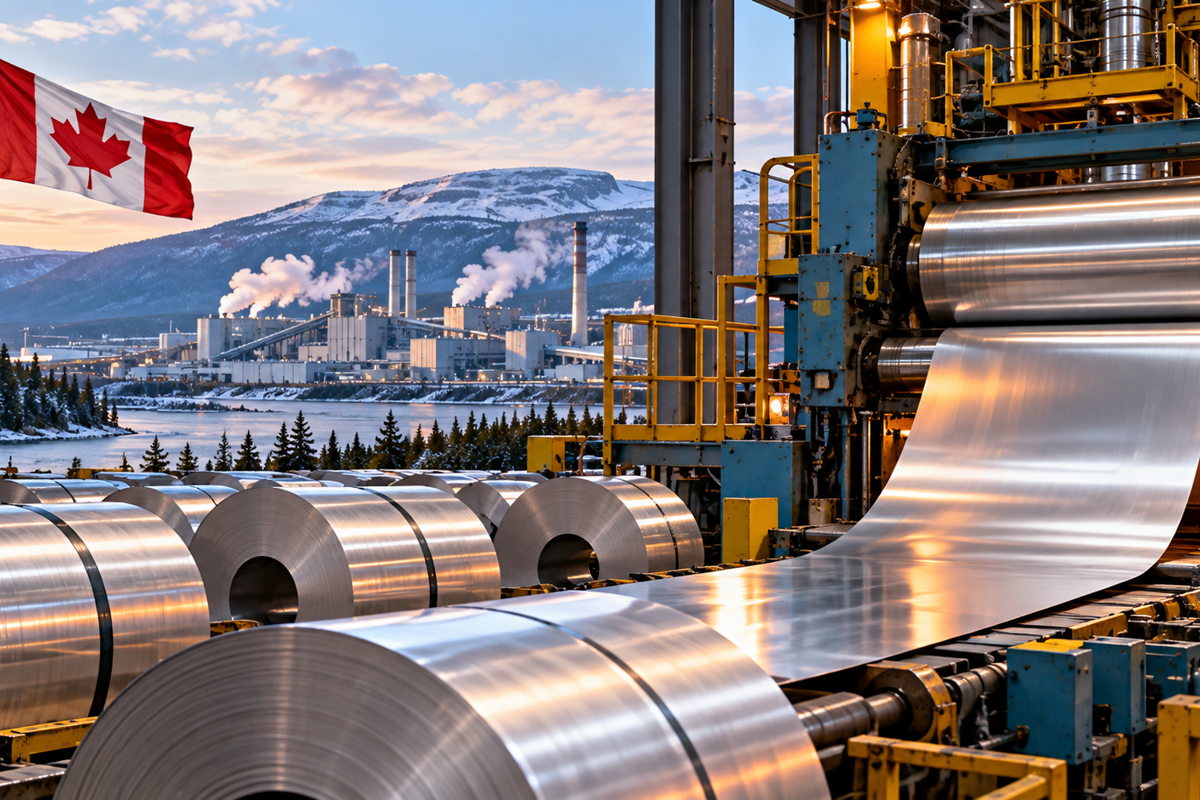
The image used in this article is generated with an AI tool and does not depict any real-time moment.
Canada is looking to expand its domestic aluminium processing capacity as the government seeks to reduce the sector’s dependence on the United States. Industry Minister Mélanie Joly has described more than USD 193 million in federal funding for projects at five industrial sites in Quebec as a first step towards strengthening the country’s aluminium supply chain and building the capacity to process more metal at home.
The funding, announced in La Baie, Quebec, covers projects at four Rio Tinto facilities in the Saguenay-Lac-Saint-Jean region and the Alouette aluminium smelter in Sept-Îles. Joly, who also serves as the minister responsible for economic development in Quebec, said the investment reflects the strategic importance of aluminium to Canada’s economy and national sovereignty.
The government’s broader ambition, however, extends beyond supporting existing production facilities. Joly has highlighted the need to establish more aluminium rolling mills in Canada, allowing domestic manufacturers to access processed metal without relying as heavily on facilities across the US border.
Canada seeks to close its aluminium processing gap
Canada has nine primary aluminium smelters, eight of which are located in Quebec, with the remaining facility in British Columbia. Despite this domestic production base, Joly said much of the country’s aluminium is processed in the United States before returning to Canadian businesses at a higher cost.
“It’s not normal that most of our aluminum is processed in the United States and then comes back at a higher cost to our companies,” she said.
The government wants to change this pattern by encouraging investment in domestic rolling capacity. Rolling mills process aluminium into forms such as sheets and coils that can be used in downstream manufacturing, including packaging and aerospace applications.
Joly identified several sectors that require more processed aluminium, including agri-food, beverages and aerospace. She also pointed to opportunities to attract investment in aluminium processing for Canada’s defence sector.
“We want to be able to produce our aluminum cans here at home; we want to be able to produce our aircraft and aerospace parts here at home; and we also want to attract key investments in aluminum processing for our defence sector,” she added.
To know the global production, demand and consumption forecasts of aluminium extrusions, explore our report "The World of Aluminium Extrusions to 2035"
Tariffs add pressure to domestic processing ambitions
Trade tensions and tariffs have added urgency to the government’s efforts to expand domestic processing. Joly argued that aluminium products can face additional costs when they cross the US border for processing and subsequently return to Canada.
The United States imposes a 50 per cent tariff on Canadian aluminium. Canada, meanwhile, introduced a 50 per cent tariff on processed aluminium from the US effective September 8, following an earlier 25 per cent tariff imposed in March 2025.
According to Joly, these measures can result in a combined tariff burden of 100 per cent in the cross-border transactions she described, increasing the cost pressures facing Canadian businesses that depend on processed aluminium.
She cited tariff-related economic disruption and uncertainty surrounding US government policy as reasons for Canada to produce more of the materials its economy requires domestically.
“The aluminum industry is much more than an economic driver. It is also a strategic industry for our country and for Canadian sovereignty,” Joly said.
Ottawa considers new ways to finance aluminium rolling mills
Alongside financial support for existing aluminium producers, the federal government wants to work with entrepreneurs interested in developing rolling mills. Joly said Ottawa is considering taking equity stakes in such projects, potentially giving the government a direct role in supporting new processing capacity.
The government also wants to use procurement contracts, particularly defence-related contracts for key aerospace components, to help establish a commercially viable business model for rolling mills.
The approach would combine financial support with potential demand from downstream industries, addressing both the investment required to establish processing facilities and the need for customers to purchase their output.
The funding announced for the five Quebec industrial sites represents an initial step in the government’s wider plan. The available announcement does not confirm that new rolling mills have been approved or constructed, but Joly has made clear that expanding domestic processing is a priority.
For Canada’s aluminium industry, the next stage of the strategy will be to translate its established primary production base into greater domestic processing capacity. Whether through new rolling mills, government-backed investment or procurement commitments, Ottawa is seeking to retain more value within the country’s aluminium supply chain.
“Economic sovereignty isn’t something you proclaim, it’s something you build,” Joly stated.
Explore downstream aluminium products from our comprehensive list on AL Biz.
Grow with
AL Circle