India launches anti-dumping probe into aluminium extrusion imports from China, Malaysia, Vietnam and Thailand
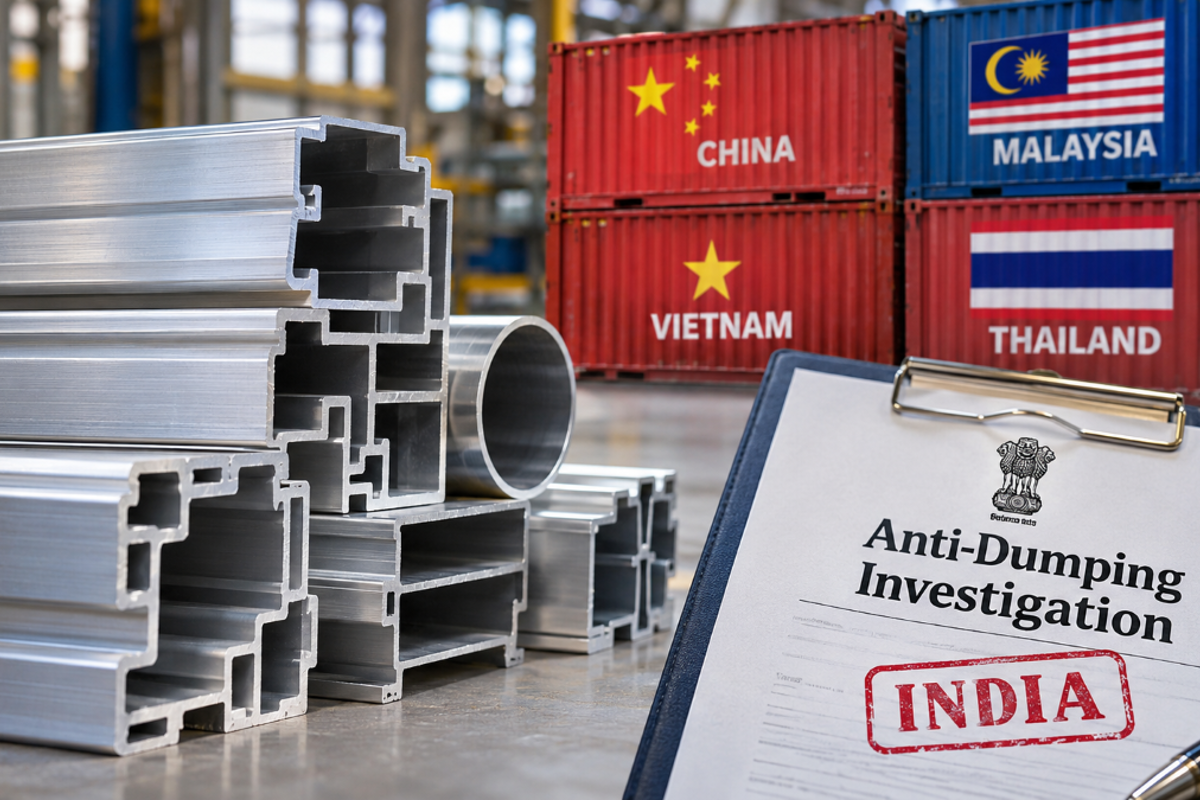
The image used in this article is generated with an AI tool and does not depict any real-time moment
India has launched an anti-dumping investigation into aluminium extrusion imports from China, Malaysia, Vietnam and Thailand after domestic manufacturers raised concerns over rising overseas supplies and their impact on the Indian industry. The four countries accounted for around 90 per cent of India's imports of the products under investigation during the period examined by the trade authority.
The Directorate General of Trade Remedies (DGTR) initiated the investigation on November 9, 2026, on its own initiative, following representations from the Aluminium Extrusion Manufacturers Association of India. The association, which represents 228 manufacturers, alleged that a substantial increase in dumped imports from the four countries had caused injury to domestic producers.
The DGTR said the information available provided sufficient preliminary evidence to open the investigation, although complete information on the impact on the domestic industry was not yet available. The inquiry will establish whether dumping has taken place, the extent of any dumping and whether it has caused material injury to Indian manufacturers. Its initiation does not amount to a final finding against exporters, nor does it impose an anti-dumping duty.
Aluminium extrusion imports from four countries under scrutiny
The investigation covers aluminium extrusion profiles, structures and articles made from them. The product scope extends across several applications in construction, transport, electrical equipment and engineering, reflecting the wide use of extruded aluminium in industrial and consumer products.
To know the global production, demand and consumption forecasts of aluminium extrusions, explore our report "The World of Aluminium Extrusions to 2035"
Aluminium extrusion is a process in which heated metal is pushed through a shaped die to produce profiles. These can be sold in their original form or further cut and processed into finished products. The DGTR's proposed scope includes certain bars, rods, tubes and pipes, as well as doors and window frames, railings, industrial framing, solar mounting structures and some furniture and bicycle parts.
The definition is not limited to basic aluminium profiles. It also covers structures and articles made predominantly from extrusions. However, the authority clarified that this does not mean every aluminium product or all imports from China, Malaysia, Vietnam and Thailand automatically fall within the investigation. The product scope will be examined further after interested parties submit their comments.
The inquiry also brings an existing trade measure into consideration. India imposed an anti-dumping duty in 2024 on anodised aluminium frames used in solar panels or modules from China. The DGTR said it would examine how these products should be treated under the scope of the present investigation. The earlier duty does not, however, determine the outcome of the new case.
DGTR examines import growth and injury to Indian aluminium manufacturers
A key part of the anti-dumping investigation will be the comparison of export prices with normal value, which serves as the benchmark for determining whether products have been dumped. The authority will also assess whether the domestic industry has suffered material injury and whether the imports under investigation caused that injury.
The DGTR said nine domestic producers belonging to the Aluminium Extrusion Manufacturers Association of India had submitted representations and financial statements. Three members also provided summary cost information and estimates relating to dumping and injury. The association informed the authority that most of its members were small businesses.
For its initial assessment, the DGTR used available trade data and found that imports of the products under consideration from the four countries had increased during the investigation period. Their combined share was estimated at approximately 90 per cent of India's imports of these specific products. This figure does not represent their share of the overall Indian aluminium market.
The authority constructed a benchmark value using cost information from three Indian producers. It noted that domestic selling prices and production costs in Malaysia, Vietnam and Thailand were not available at that stage. Transaction-level import data, after adjustments, were used to estimate export prices. These calculations are preliminary reference points for the investigation and do not constitute definitive findings on individual exporters.
The investigation period runs from April 1, 2025, to June 30, 2026. The assessment of injury covers the three financial years beginning in April 2022. The DGTR selected a 15-month investigation period to allow smaller producers to use records maintained on a financial-year basis.
Explore downstream aluminium products from our comprehensive list on AL Biz.
Anti-dumping investigation timeline and next steps
The DGTR is notifying known producers and exporters in China, Malaysia, Vietnam and Thailand, along with their respective governments, Indian importers and users, and domestic producers. These parties can submit relevant information for consideration, while other interested parties may also participate.
The notification allows 37 days for information to be filed, calculated from the transmission of the specified letters. A separate 15-day period has been provided for comments on the product scope, running concurrently with the information-submission period.
The investigation will determine whether the imports were dumped and whether they caused material injury to the Indian aluminium extrusion industry. If the DGTR recommends an anti-dumping duty after examining the evidence, a separate decision by India's finance ministry will be required before the measure can be imposed.
No duty rate or final outcome has been decided at the initiation stage. The current proceedings therefore mark the start of India's examination of aluminium extrusion imports from the four countries, rather than the introduction of a new trade restriction.
Read our latest magazine “ALuminium’s Frontline: OEM Edition 2026” and learn how OEMs are transforming critical aluminium applications across end-use sectors.
Grow with
AL Circle












_md.webp)