Inside Novelis’ 2030 strategy: Aligning scrap supply, recycling investment and new opportunities in aluminium markets

- Category
- Interview
- Date
- Source
- AlCircle.com
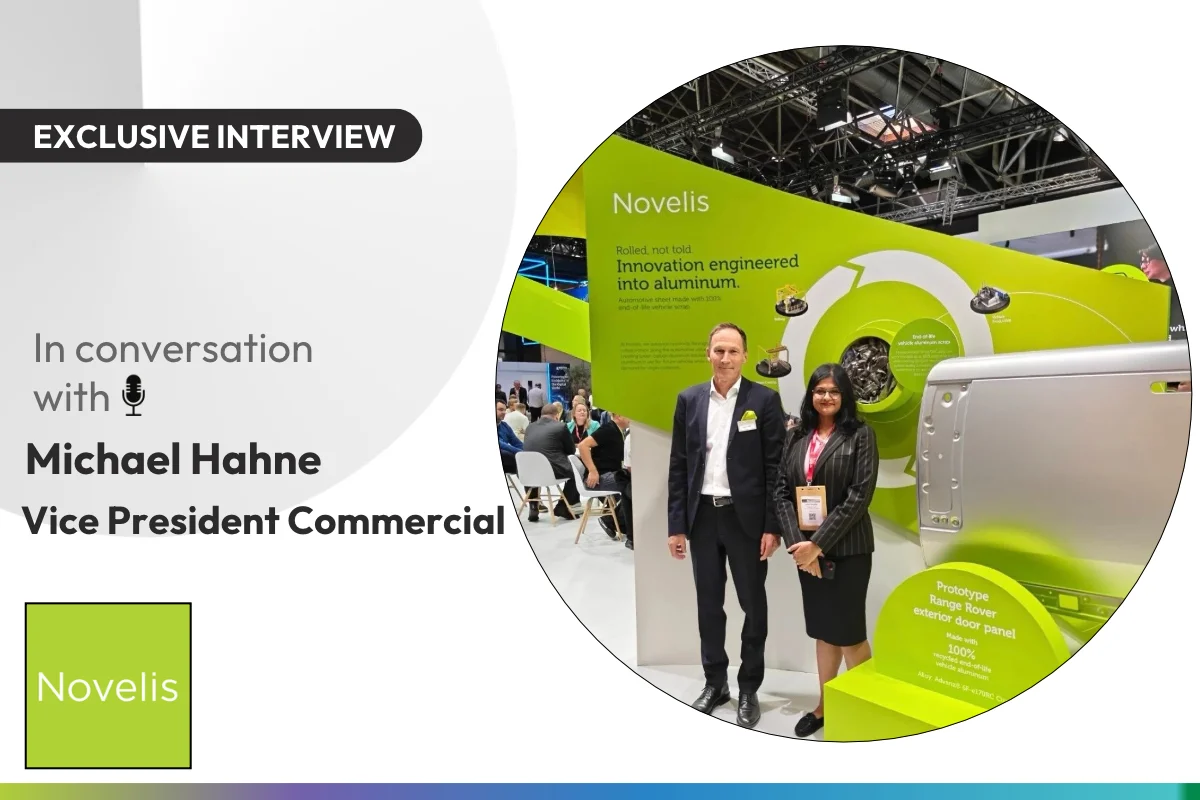
The AL Circle team caught up with Michael Hahne, Vice President Commercial, Novelis Europe, for a conversation at ALUMINIUM 2026 in Düsseldorf, Germany. With experience across the company’s automotive and beverage can businesses, Hahne brings a commercial perspective to the evolving relationship between aluminium, customer needs and circularity.
In this exclusive interview, Hahne explains why aluminium’s next growth chapter will depend on more than expanding production. Securing scrap, closing material loops and turning metallurgical expertise into new customer solutions are becoming central to the industry’s competitiveness.
As automotive lightweighting, battery applications and circularity reshape demand, he discusses the strategies behind Novelis’ global footprint and the challenges of moving towards 75 per cent average recycled content across all Novelis products by 2030.
What will it take to turn end-of-life aluminium into a dependable resource at industrial scale? From digital collaboration to a broader role as a solutions provider, Hahne explores the thinking shaping Novelis’ next phase, and why stronger connections across the value chain could prove decisive.
Join the fourth edition of webinar "Hedging for recyclers - Become an expert in 6 hours" by Jorge Dyszel.
AL Circle: Beyond the FFB facade project, how significant are Germany’s Gigafactories for Novelis’ aluminium sales by 2030?
Michael Hahne: It’s a very good question, and of course it has several dimensions. If we look at batteries for electric vehicles as well as stationary energy storage systems, this is an important strategic area for us and one that we will continue to explore.
Our approach builds on the expertise we have developed in the automotive business, combined with capabilities from our downstream operations in the specialties segment. One example is the use of high-performing, automotive-grade aluminium sheet in multi-layer solutions. By bringing together the right materials and processing capabilities, we can help our customers improve efficiency and reduce costs in their downstream operations. This is where we see an opportunity to take our existing expertise and use it to develop solutions for a new and growing market.
AL Circle: Between Germany and the US, the latter is the largest market by volume, while the former needs the infrastructure, collection, efficiency, and recovery rates. Where do you see stronger recycling investment returns, and what gives that market the edge?
Michael Hahne: If you look at our footprint today, we already operate one of the world’s largest aluminium recycling facilities in Nachterstedt, Germany.
While the US is the larger market, Europe has generally moved faster in establishing closed-loop systems and increasing the use of post-consumer scrap. So, when we consider where an investment makes sense, we have to look at the specific market conditions in each region. In North America, we’re building a USD 5 billion low-carbon, fully integrated recycling and rolling plant in Bay Minette, Alabama, which is the first of its kind in more than 40 years. This facility will help meet the rising demand in North America for sustainable aluminum while strengthening supply chain resilience.
In Europe, our investments tend to be more targeted. In Latchford in the UK, for example, we are investing in used beverage can recycling and doubling the plant’s recycling capacity. This will help us process the additional material expected from the UK’s upcoming Deposit Return Scheme.
We have also invested significantly in Asia, including a new recycling center in Ulsan. Overall, it is a diverse investment landscape. In some regions, scale is the determining factor; in others, it is about applying the right technologies and capabilities for the local market.
To keep your aluminium operations running efficiently, explore essential consumables and connect with global suppliers on AL Biz.
AL Circle: What annual growth do you forecast for global automotive aluminium sheet demand from EVs through 2030, and which country will contribute the most?
Michael Hahne: Here, we rely on publicly available market forecasts for EV and overall automotive growth. These generally indicate global automotive growth in the range of 3 to 5 per cent CAGR.
We do not publish a separate forecast for EV-related growth or a country-by-country split. The development also varies significantly by region, with different growth rates in Europe and North America.
What we continue to see, however, is strong demand for lightweight, lower-carbon materials and greater circularity. Together, these trends are supporting demand for aluminium products in the automotive sector.
AL Circle: Could you please share some of your key initiatives towards the 75 per cent recycled content target? How much of your recycled content comes from post-consumer scrap, and do you set a separate target for it?
Michael Hahne: As part of our 3x30 vision, we are working towards achieving an average of 75 per cent recycled content across our products by 2030. This requires investment in recycling capacity but also access to high-quality scrap in the quantities we need.
In our last fiscal year, we had already reached an average recycled content of 61 per cent. The next step towards 75 per cent will depend largely on increasing the use of post-consumer scrap.
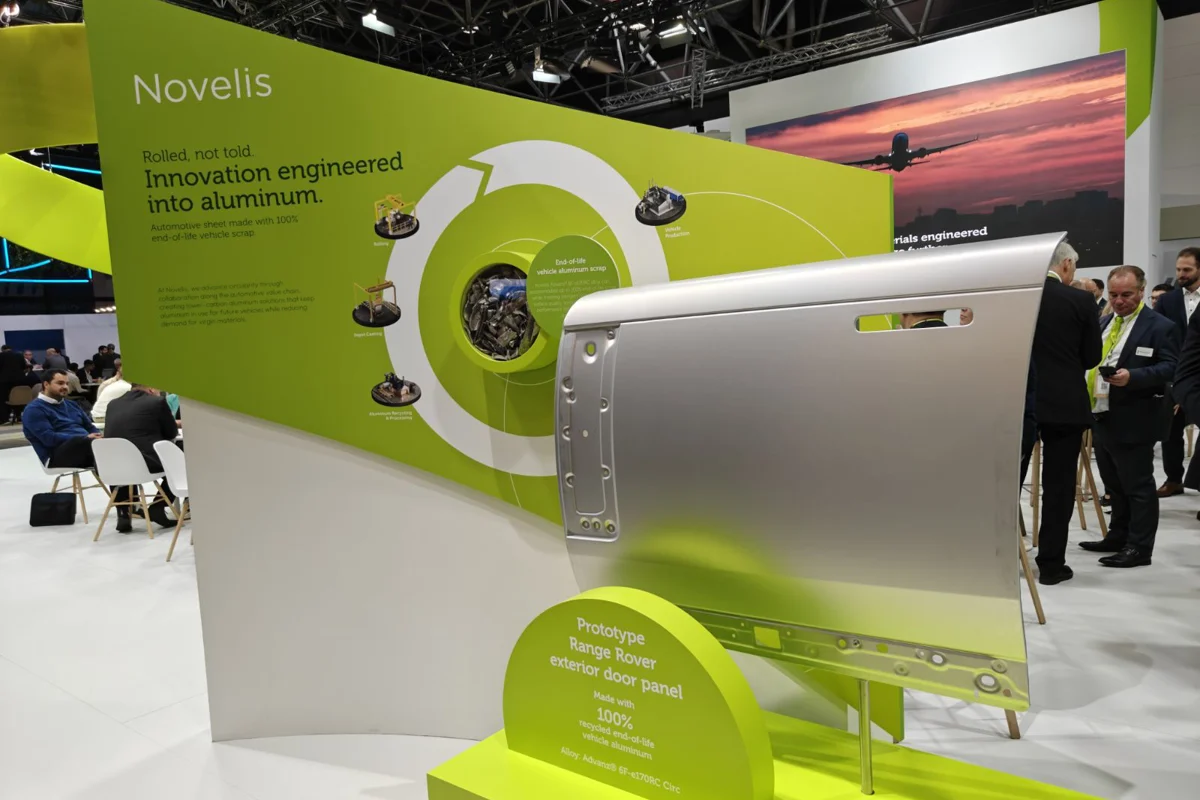
One example is the automotive demonstrator displayed here at our booth: a door component developed with Jaguar Land Rover using aluminium made with 100 per cent recycled content from end-of-life vehicles. Demonstrators like this help us establish a pathway towards industrialisation.
At the same time, we will continue to expand pre-consumer scrap closed loops with our customers. These systems are already well established, so much of the additional potential now lies in recovering and using more post-consumer material.
Scrap availability is clearly part of the challenge. In addition to traditional sourcing routes, we are therefore using digital solutions to connect different parts of the recycling ecosystem. One example is the Automotive Circularity Platform, which brings together major industry participants and helps improve access to high-quality end-of-life automotive scrap at scale.
It is about thinking beyond traditional models and using digital tools to connect to a highly diverse ecosystem more effectively.
AL Circle: After recycling 85 billion beverage cans in a year, what is your next target and can collection keep pace with your scrap requirements?
Michael Hahne: We already recycle more than 85 billion beverage cans annually. However, we do not measure our progress solely by the number of cans. We look more broadly at the growth of our recycling activities, the recycled content in our products and the overall volume of flat-rolled aluminium products we produce. Future growth will depend on several industry factors. Ultimately, the availability of scrap must develop in line with each additional recycling investment. Our immediate focus is therefore on ramping up the new capacity in Bay Minette. Over time, we expect further capacity additions in other regions, but we have nothing further to communicate on that today.

