Germany-France aluminium FRP trade 2026 dips to $692m but specialised exchange holds strong
The image used in this article is generated with an AI tool and does not depict any real-time moment
Germany and France share one of Europe’s busiest downstream aluminium corridors, and the metal flows in both directions. In the first seven months of 2026, aluminium flat rolled products (FRP), which cover aluminium plates, sheets and strips (HS code: 7606), as well as aluminium foil (HS code: 7607), crossed the border each way, amounting to a total of around USD 692 million. However, the bilateral trade flow is tilted towards Germany, which remains France’s largest FRP supplier. Nonetheless, the inter-dependence remains as the countries do exchange the same products but engage in cross-border trade of specialised high-value products and alloys, feeding the demand on either side.
The trade figures for January–July 2026, as compiled from the International Trade Administration, highlight this interconnected relationship, even as import volumes from both sides have declined year-on-year.
Explore further insights and forecasts for the aluminium flat rolled products (FRP) market from our comprehensive report - Aluminium Flat Rolled Products: Insights & Forecast to 2030
France relies on Germany as its leading FRP supplier
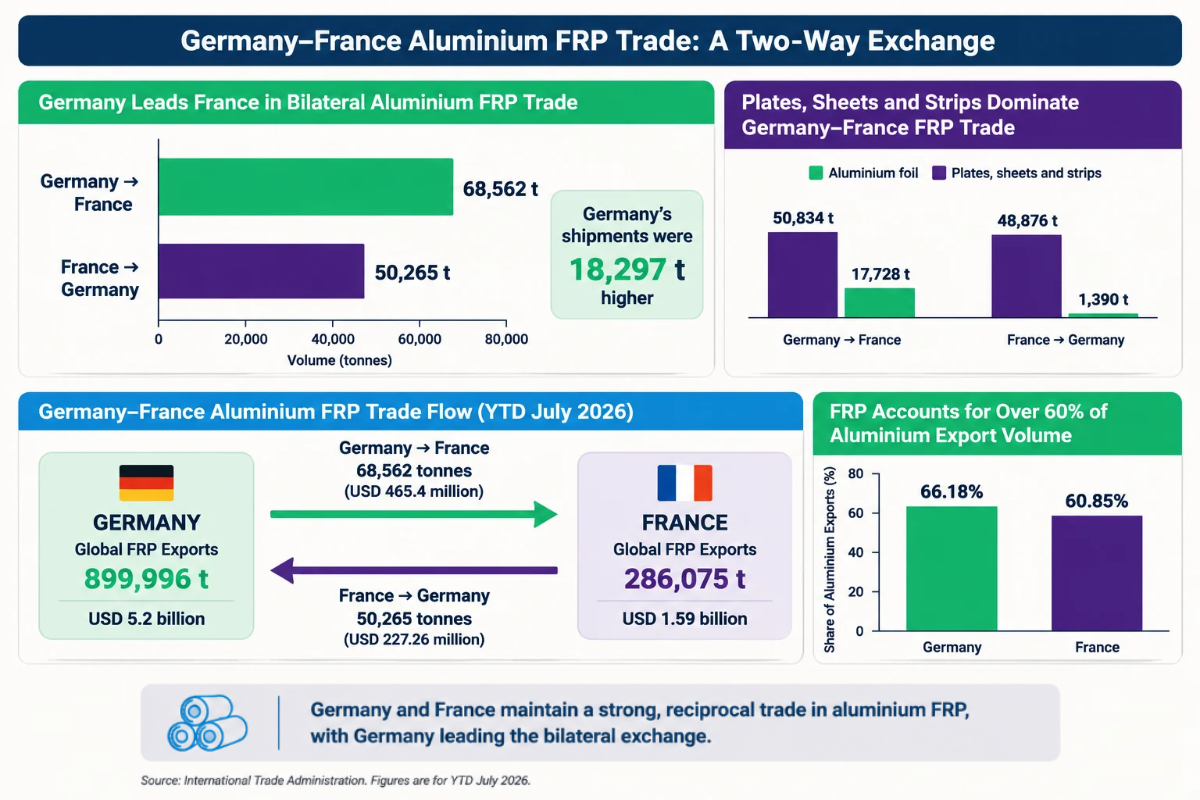
France imported a total of 250,845 tonnes of aluminium FRP from the world during YTD July 2026, valued at USD 1.39 billion. Germany accounted for 68,562 tonnes, or 27.33 per cent of France’s total FRP imports, with shipments valued at USD 465.4 million.
This establishes Germany as France’s largest supplier of aluminium FRP, ahead of Spain (39,507 tonnes), Italy (33,246 tonnes), Turkey (14,912 tonnes) and Belgium (11,075 tonnes).
The bilateral trade flow has nevertheless weakened in 2026. France’s FRP imports from Germany fell by 14.68 per cent year-on-year, from 80,364 tonnes during January–July 2025 to 68,562 tonnes in the corresponding period of 2026.
The decline follows a stronger performance in 2025. Germany’s annual FRP exports to France increased by 5.66 per cent year-on-year, rising from 135,184 tonnes in 2024 to 142,830 tonnes in 2025.
Despite the latest contraction, Germany continues to hold the leading position in France’s FRP import market.
France sends the FRP back to Germany
The trade relationship also runs in the opposite direction, with France supplying aluminium FRP to Germany.
Germany imported 588,573 tonnes of FRP from the world during YTD July 2026, valued at USD 3.17 billion. France supplied 50,265 tonnes, representing approximately 8.54 per cent of Germany’s total FRP imports, with a corresponding import value of USD 227.26 million.
France ranked among Germany’s largest FRP suppliers, securing fourth place after Switzerland (118,977 tonnes), Belgium (73,888 tonnes) and Italy (60,815 tonnes).
As with France’s imports from Germany, shipments from France to Germany declined during the first seven months of 2026. The volume fell by 15.92 per cent year-on-year, from 59,782 tonnes in YTD July 2025 to 50,265 tonnes in the corresponding period of 2026.
The annual figures, however, show a stronger preceding trend. France’s FRP exports to Germany increased by 31.14 per cent in 2025, reaching 100,673 tonnes from 76,770 tonnes in 2024.
The contrasting annual and YTD trends suggest that the bilateral exchange had expanded in 2025 before experiencing a contraction in the first seven months of 2026.
Also read: Germany’s aluminium FRP consumption reaches 1.68 Mt as 2025 trade surplus tops $3.1 billion
Why does the two-way trade persist?
If both countries supply aluminium FRP, why do they keep buying from each other? The product split points to an answer: the two flows are not the same commodity moving in opposite directions.
Aluminium FRP is not a single uniform commodity. Germany and France specialise in different niche alloys, tempers, gauges, and downstream uses.
France, backed by Constellium develops coil and sheet for can stock, food stock and automotive as well as aerospace plate, sheet and wing skins. Meanwhile, Germany, hosting Speira and Novelis, produces semi-finished rolled products and sheet ingots, foil from 6 µm for food, pharmaceutical and HVAC use, rolled products for automotive, can, industrial and construction; surface-treated and coated coil, and foil rolling, foil trays, flexible tubes.
Germany’s FRP industry is a downstream sector that turns imported primary metal and recycled aluminium into higher-value rolled and specialised products for domestic manufacturers and overseas markets.
Germany’s plate, sheet and strip imports come from several European suppliers, France among them, while its exports feed manufacturing markets across the continent.
Demand comes from automotive (5xxx and 6xxx alloys for body structures, crash-management parts and EV battery trays), packaging, building and aerospace plate. A buyer in one country may therefore want a different alloy, gauge or temper from the one the nearest domestic mill supplies.
Hence, a German manufacturer may import a specialised French alloy for a particular application while exporting a different grade of rolled sheet or foil back to French industrial buyers.
Looking for aluminium flat rolled products? Browse through a comprehensive list here at AL Biz
Selling more than buying FRP
The bilateral relationship forms part of France’s broader aluminium export activity.
During YTD July 2026, France exported 470,096 tonnes of aluminium products worldwide, covering unwrought aluminium, bars, rods and profiles, foil, plates, sheets and strips, tube and pipe fittings, and aluminium wire.
Of this total, aluminium FRP accounted for 286,075 tonnes, representing approximately 60.85 per cent of France’s aluminium export volume. The FRP shipments were valued at USD 1.59 billion.
This underlines the importance of FRP within France’s overall aluminium export mix and demonstrates that its role in Germany’s supply chain is part of a wider export business.
Germany’s larger export base reinforces its position
Germany’s aluminium export activity is considerably larger in volume.
During YTD July 2026, Germany exported approximately 1.36 million tonnes of aluminium products worldwide, including unwrought aluminium, bars, rods and profiles, foil, plates, sheets and strips, tube and pipe fittings, and aluminium wire.
Aluminium FRP accounted for 899,996 tonnes, or 66.18 per cent of Germany’s total aluminium export volume, with exports valued at USD 5.2 billion.
The figures demonstrate the scale of Germany’s FRP export business relative to France’s. Germany’s larger global export base, combined with its position as France’s leading FRP supplier, makes it the stronger exporter in the bilateral relationship.
Read our latest magazine “ALuminium’s Frontline: OEM Edition 2026” and learn how OEMs are transforming critical aluminium applications across end-use sectors.
Aluminium foil draws the line of difference
Plates, sheets and strips are close to an even swap: 50,834 tonnes from Germany against 48,876 tonnes from France, a gap of just 1,958 tonnes, or about 4 per cent. Foil is a different story. Germany sent 17,728 tonnes against France’s 1,389 tonnes, nearly 13 times as much, so Germany supplied about 93 per cent of the foil traded between the two.
That makes aluminium foil responsible for roughly 89 per cent of Germany’s 18,297-tonne surplus in this corridor. The trade is complementary in foil and mirror-like in plates, sheets and strips.
Both countries sourced less FRP, which points to softer European demand. The corridor fell with the market. Germany’s 14.68 per cent decline is slightly steeper than the 13.36 per cent drop in France’s total imports, so its share of French imports eased to 27.33-27.76 per cent. France lost more ground. Its shipments fell 15.92 per cent against an 8.77 per cent drop in German imports, so its share of German imports shrank to 8.54 per cent from 9.27 per cent.
A reciprocal trade relationship, with Germany in the lead
Germany and France remain closely linked through aluminium FRP trade. France is an important supplier to Germany, while Germany holds the leading position in France’s import market.
The France-Germany relationship, therefore, stands tall on a reciprocal supply base, with Germany holding the trade reins tighter with a stronger bilateral position and the wider export significance of FRP for both economies.
Note: This is exclusive coverage by AL Circle and may not be reproduced, republished or shared without prior permission.
Grow with
AL Circle