German downstream aluminium exports fall 13% in H1 2026 but US enters top 5 with 228.1% import surge
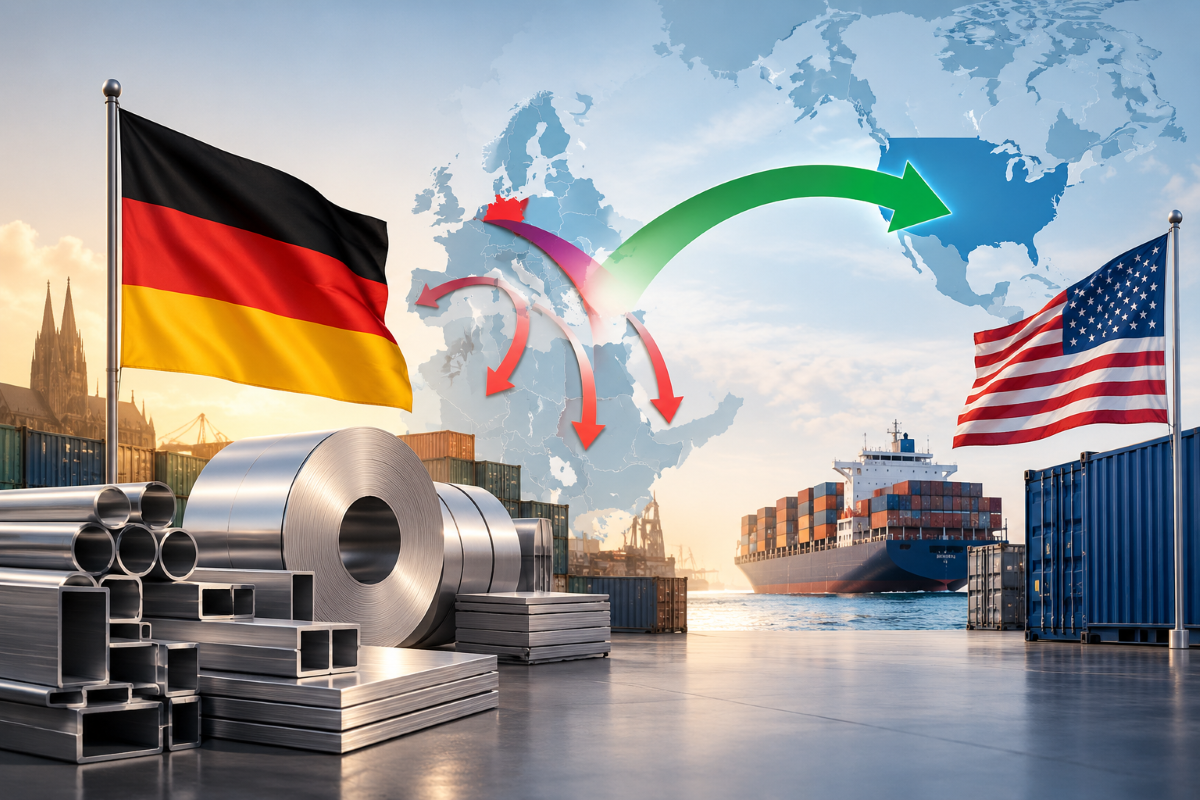
The image used in this article is generated with an AI tool and does not depict any real-time moment
Germany’s downstream aluminium export map underwent a noticeable shift in H1 2026. Shipments to the world fell, with most of Germany’s traditional European customers taking less aluminium downstream product. Yet, amid that broad retreat, one market moved in the opposite direction: the United States.
German downstream aluminium exports to the world fell to 897,773.19 tonnes in H1 2026 from 1 million tonnes in H1 2025, a decline of 13 per cent year on year.
The contrast was particularly sharp in the US market. American imports of German downstream aluminium reached 68,061.61 tonnes in H1 2026, up 228.1 per cent from just 20,743.62 tonnes in H1 2025. The increase of more than 47,000 tonnes was enough to push the US into Germany’s top 5 destinations for the first time.
The export map is changing, but Europe still holds the centre
Despite the US surge, Germany’s downstream aluminium trade remains firmly anchored in Europe.
The top 10 destinations together accounted for 654,654.87 tonnes in H1 2026, or roughly 73 per cent of Germany’s total worldwide downstream aluminium exports. What changed was the volume flowing into those markets.
The UK remained at the top. German shipments increased from 132,568.50 tonnes in H1 2024 to 146,392.88 tonnes in H1 2025, but then fell 17.4 per cent to 120,890.88 tonnes in H1 2026. Even after that decline, the UK remained Germany’s largest destination, although its latest volume was 8.8 per cent below H1 2024.
Poland retained second place despite a similar reversal. Exports had risen from 87,591.75 tonnes in H1 2024 to 99,198.05 tonnes in H1 2025, before dropping 19 per cent to 80,304.67 tonnes in H1 2026.
France followed almost the same path. Shipments climbed 4.7 per cent to 88,855.50 tonnes in H1 2025 from 84,906.38 tonnes a year earlier, then slipped 13.4 per cent to 76,976.05 tonnes in H1 2026. The latest volume was 9.3 per cent below H1 2024.
For the exact figures and detailed sector-wise global outlook, read our updated aluminium extrusion report - The World of Aluminium Extrusions to 2035 - Demand Forecast | Price Benchmarking | Plant Economics | Strategic Growth Sectors.
One European market breaks from the wider decline
Switzerland offered a different picture. German downstream aluminium exports to Switzerland had jumped 43.7 per cent from 51,664.54 tonnes in H1 2024 to 74,248.61 tonnes in H1 2025. The market did ease in H1 2026, but only by 5.8 per cent, taking imports to 69,960.24 tonnes. That still left shipments 35.4 per cent above H1 2024.
The improvement was enough to move Switzerland from ninth place in H1 2024 into the upper tier of Germany’s top 10 destinations.
Austria, sitting just below Switzerland in H1 2026, could not maintain the same momentum. German shipments rose 13.2 per cent from 71,516.33 tonnes in H1 2024 to 80,983.12 tonnes in H1 2025, before falling 19.1 per cent to 65,543 tonnes in H1 2026.
The slowdown deepens across other European markets
The pressure became more pronounced across several other major European destinations.
Exports to the Netherlands were almost unchanged between H1 2024 and H1 2025, slipping just 0.4 per cent from 67,008.03 tonnes to 66,757.19 tonnes. But shipments then fell 24.8 per cent to 50,184.07 tonnes in H1 2026, leaving them 25.1 per cent below H1 2024.
Spain saw an even sharper reversal. German exports rose 2.5 per cent to 68,602 tonnes in H1 2025, only to fall 31 per cent to 47,306.03 tonnes in H1 2026. That was 29.4 per cent below H1 2024.
Italy also moved through two consecutive years of decline. Shipments fell 6.9 per cent from 57,780.23 tonnes in H1 2024 to 53,820.25 tonnes in H1 2025, before dropping another 23.8 per cent to 41,010.41 tonnes in H1 2026. Overall, the latest volume was 29 per cent below H1 2024.
The Czech Republic followed a similar trajectory. Exports fell 14.9 per cent from 47,196.27 tonnes in H1 2024 to 40,143.04 tonnes in H1 2025, then declined another 14.3 per cent to 34,417.91 tonnes in H1 2026. H1 2026 shipments were therefore 27.1 per cent below H1 2024.
Explore downstream aluminum products from our comprehensive list on AL Biz.
Why Germany’s downstream aluminium is losing ground in Europe
Slowdown in demand
The broad decline across Germany’s European customers points to a regional slowdown in demand rather than the loss of a single export market. After stronger or stable purchases in H1 2025, buyers in the UK, Poland, France, Austria, the Netherlands, Spain, Italy and the Czech Republic reduced orders in H1 2026 as industrial activity, equipment investment and housing-related demand weakened.
The impact is particularly relevant for German downstream aluminium producers, whose products are used across vehicles, machinery, building systems and consumer durables. As investment and construction activity softened, demand for aluminium sheet, extrusions and fabricated products also came under pressure.
The European Commission cut its 2026 euro-area growth forecast to 0.9 per cent following a renewed energy shock.
Read our latest magazine “ALuminium’s Frontline: OEM Edition 2026” and learn how OEMs are transforming critical aluminum applications across end-use sectors.
High energy costs
High energy costs added to the pressure on Germany’s downstream aluminium exporters. EU electricity prices rose 22.8 per cent between February and August 2026, while gas prices surged 88.4 per cent, raising production and conversion costs for energy-intensive producers.
At the same time, leaner customer inventories and competition from lower-cost semi-fabricated imports, particularly amid Chinese overcapacity in semi-finished aluminium products, further squeezed European producers.
Note: This is exclusive coverage by AL Circle and may not be reproduced, republished or shared without prior permission.
Sampat Aluminium shareholders approve four resolutions with 100% votes at 27th AGM
Next articleHighway Roop acquires Chamundi to expand aluminium die-casting, machining capabilities
Grow with
AL Circle






















