German aluminium foil exports fall 2.8% in H1 2026 as France gains while other key markets weaken: How could H2 unfold?
The image used in this article is generated with an AI tool and does not depict any real-time moment
Germany’s aluminium foil export market is showing a shift after two years of steady recovery. The upward trend that had returned after the 2023 downturn failed to hold, with shipments slipping again even as some markets continued to show resilience in H1 2026.
The change becomes clearer when the recent history is put together. Germany exported 151,000 tonnes in H1 2022, but the volume dropped to 138,000 tonnes in H1 2023, down 8.6 per cent. Exports then began to recover, reaching 141,000 tonnes in H1 2024, up 2.2 per cent, and 144,000 tonnes in H1 2025, an increase of 2.1 per cent, according to ITC data.
In H1 2026, however, exports fell back to 140,000 tonnes, down 2.8 per cent year on year. The decline is relatively modest, but it marks a break in the recovery - raising the question of whether Germany’s foil exports can regain momentum in the second half of the year.
Five years of quarterly shifts reshape Germany’s foil exports
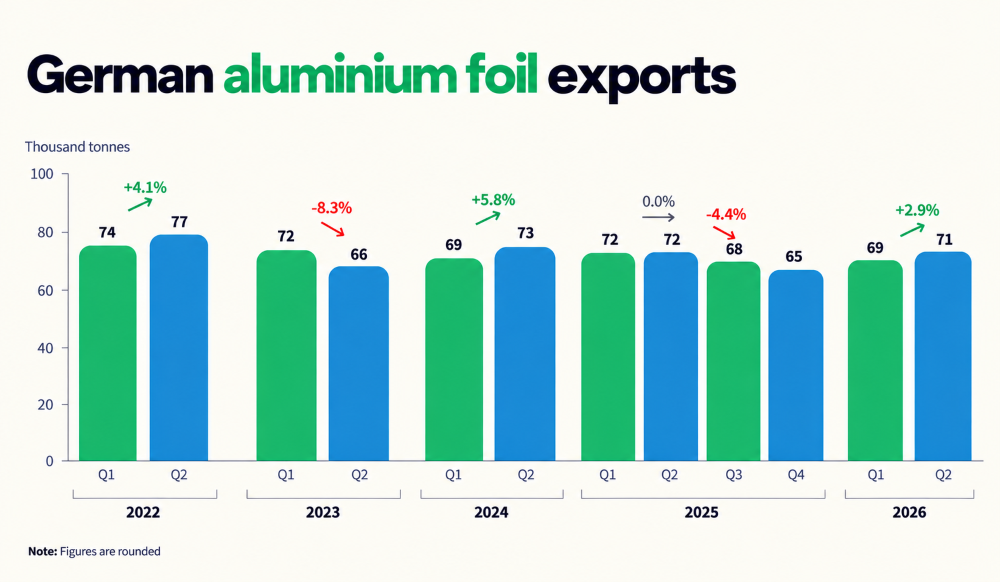
Germany’s aluminium foil exports have followed a mixed quarterly pattern over the past five years. In 2022, exports rose from 74,000 tonnes in Q1 to 77,000 tonnes in Q2, up 4.1 per cent. In 2023, the direction reversed, with shipments falling from 72,000 tonnes in Q1 to 66,000 tonnes in Q2, down 8.3 per cent.
The market recovered in 2024, when exports increased from 69,000 tonnes in Q1 to 73,000 tonnes in Q2, up 5.8 per cent. In 2025, shipments stood at 72,000 tonnes in both Q1 and Q2, before declining to 68,000 tonnes in Q3 and 65,000 tonnes in Q4, with Q4 down 4.4 per cent quarter on quarter. Explore: The most comprehensive and forward-looking industry-focused report – Aluminum Foil Market Report Forecast Till 2035
In 2026, exports moved higher again, rising from 69,000 tonnes in Q1 to 71,000 tonnes in Q2, an increase of 2.9 per cent. However, Q2 remained below the 72,000 tonnes recorded in Q2 2025, showing that the latest improvement has yet to bring shipments back to the previous year’s level.
Softer demand and rising competition weigh on exports
The H1 2026 decline came mainly as demand softened in key European markets while industrial activity remained under pressure. Germany depends heavily on nearby European buyers, and weaker manufacturing, packaging and end-user demand reduced new orders and encouraged more cautious inventory management.
Demand for thin-gauge and standard foil also remained subdued, particularly in flexible packaging and household applications. At the same time, German producers faced stronger competition from lower-cost suppliers, making it harder to maintain export volumes in price-sensitive markets.
High energy, labour and conversion costs added to the pressure. These costs continued to affect the competitiveness of German foil producers against suppliers from lower-cost regions. Softer demand outside Europe and greater availability from alternative suppliers further limited overseas orders.
Connect with verified aluminium extrusion buyers and suppliers through the AL Biz marketplace
Germany’s key export markets take different paths
The destination data shows that Germany’s export weakness was not spread evenly across its major markets. France remained the leading destination among the five, with German aluminium foil exports increasing from 22,000 tonnes in H1 2025 to 24,000 tonnes in H1 2026, up 9.1 per cent.
Shipments stood at 11,000 tonnes in both Q1 and Q2 2025, before rising to 13,000 tonnes in Q1 2026 and easing to 11,000 tonnes in Q2.
Switzerland, by comparison, saw exports decline from 24,000 tonnes in H1 2025 to 23,000 tonnes in H1 2026, down 4.2 per cent. Shipments fell from 13,000 tonnes in Q1 2025 to 11,000 tonnes in Q2, remained at 11,000 tonnes in Q1 2026, and then increased to 12,000 tonnes in Q2.
The United States received 10,300 tonnes of German aluminium foil in H1 2025, compared with 9,900 tonnes in H1 2026, a decline of 3.9 per cent. Exports rose from 4,600 tonnes in Q1 2025 to 5,700 tonnes in Q2, then dropped to 4,000 tonnes in Q1 2026 before rebounding to 5,900 tonnes in Q2, up 47.5 per cent quarter on quarter.
The Netherlands recorded the largest H1 decline among the five destinations. Exports fell from 12,800 tonnes in H1 2025 to 10,600 tonnes in H1 2026, down 17.2 per cent. Shipments stood at 6,400 tonnes in both Q1 and Q2 2025, before falling to 4,900 tonnes in Q1 2026 and recovering to 5,700 tonnes in Q2.
Austria also recorded lower shipments, with exports declining from 9,200 tonnes in H1 2025 to 8,300 tonnes in H1 2026, down 9.8 per cent. Exports fell from 5,100 tonnes in Q1 2025 to 4,100 tonnes in Q2, while in 2026 they declined from 4,400 tonnes in Q1 to 3,900 tonnes in Q2.
Germany’s aluminium foil exports to face pressure in H2 2026
Germany’s aluminium foil exports could remain under pressure in H2 2026 after falling 2.8 per cent year on year to 140,000 tonnes in H1. Exports did improve from 69,000 tonnes in Q1 to 71,000 tonnes in Q2, but Q2 was still below the 72,000 tonnes recorded in Q2 2025. A similar decline was seen in H2 2025, when exports fell from 72,000 tonnes in Q2 to 68,000 tonnes in Q3 and 65,000 tonnes in Q4.
If a similar trend continues in 2026, exports could fall to around 67,000 tonnes in Q3 and 64,000 tonnes in Q4. This would put H2 exports at about 131,000 tonnes and full-year 2026 exports at around 271,000 tonnes, pointing to a mild decline rather than a strong recovery.
Unlock key insights from leading companies and experts across the aluminium ecosystem with our e-Magazine - Mine to Market: ALuminium Producers & Manufacturers 2026
Grow with
AL Circle