India’s 8.25% aluminium duty paradox puts downstream manufacturing under pressure
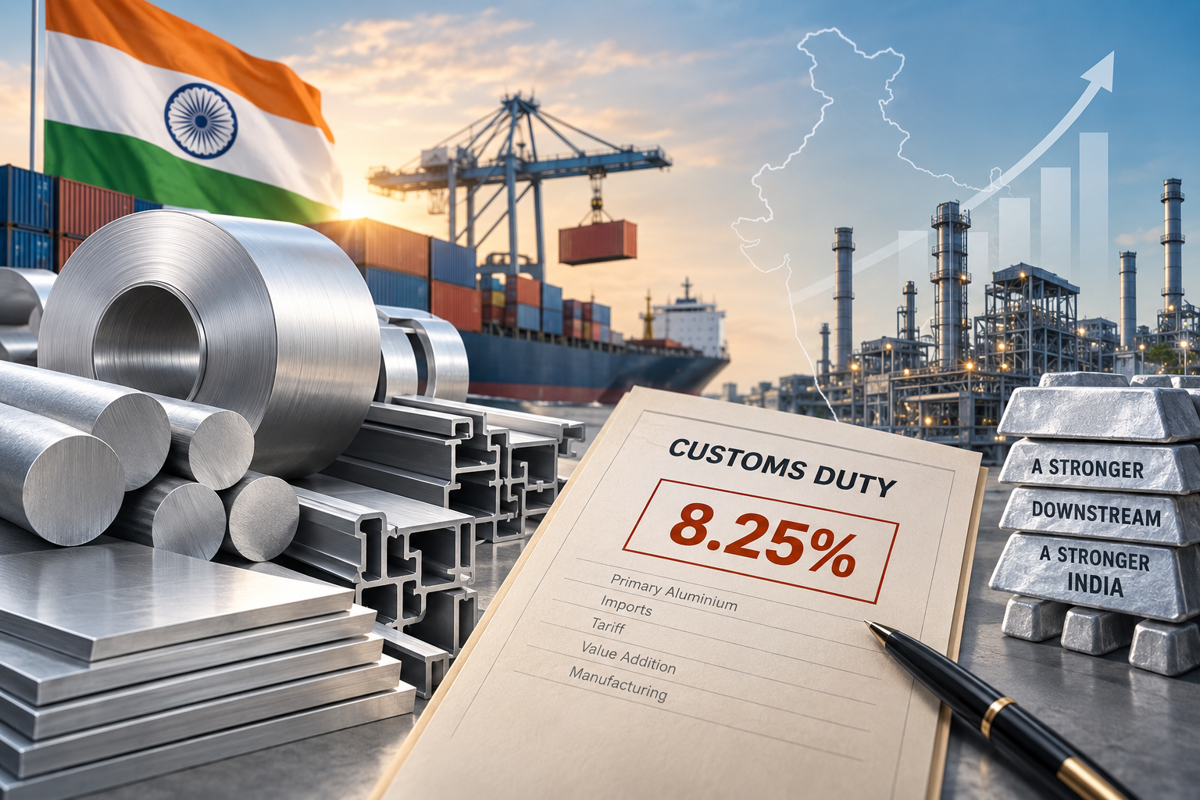
The image used in this article is generated with an AI tool and does not depict any real-time moment
India is producing more aluminium, but a growing policy debate is asking a different question of how much value is the country actually retaining from every tonne it produces?
India is the world’s second-largest aluminium producer, with primary aluminium output reaching around 4.2 million tonnes. Yet, according to the Ministry of Mines’ Aluminium Vision Document, 76 per cent of India’s aluminium exports by volume are primary aluminium, while downstream products account for only 24 per cent.
That imbalance has brought India’s aluminium import duty, particularly the effective 8.25 per cent duty on primary aluminium, back into focus.
The 8.25% question
Primary aluminium currently attracts a 7.5 per cent Basic Customs Duty (BCD), along with a 0.75 per cent Social Welfare Surcharge, taking the effective import levy to 8.25%.
The tariff was originally introduced to support India's domestic smelting industry. However, downstream aluminium manufacturers argue that the same structure is now increasing their raw-material costs.
The issue is linked to import-parity pricing. Domestic primary aluminium prices can reflect international benchmark prices plus the applicable import-related costs, including the Customs duty. This means downstream manufacturers may face higher aluminium prices even when buying metal produced domestically.
In July 2026, two downstream industry associations asked the Ministry of Mines to rationalise the effective 8.25 per cent duty, arguing that the current structure is placing additional pressure on aluminium-intensive MSMEs.
To know the global production, demand and consumption forecasts of aluminium extrusions, explore our report "The World of Aluminium Extrusions to 2035"
Why downstream aluminium manufacturers are concerned
India's downstream aluminium ecosystem includes manufacturers of extrusions, cables, conductors, utensils, sheets, components and other value-added products for whom aluminium is not a minor input. It can account for 60-80 per cent of production costs, according to the recent policy discussion.
The pressure has intensified alongside higher international aluminium prices. Primary aluminium prices are at more than USD 3,200 per tonne in the recent month, compared with around USD 2,200 per tonne three years earlier, while overall input costs were estimated to have risen by 20-35 per cent over the preceding three months.
The Ministry of Mines' Aluminium Vision Document had earlier estimated that import-parity pricing resulted in downstream manufacturers paying approximately USD 470 million more to domestic primary aluminium producers in 2022, with the additional cost affecting investment in value-added manufacturing.
Finished aluminium imports add another layer
While primary aluminium faces an effective 8.25 per cent import levy, several finished aluminium products can enter India at lower or zero duty under applicable free trade agreements (FTAs).
Data cited in the recent industry debate shows that India imported USD 4.1 billion worth of finished aluminium products in FY2025-26, with nearly one-quarter entering at low or zero duty under FTAs.
This has raised concerns among downstream manufacturers that Indian companies can face a cost disadvantage when purchasing primary metal domestically and then competing with imported value-added aluminium products.
Aluminium's downstream gap
The Aluminium Vision Document has set an ambitious target of reaching 37 million tonnes of aluminium capacity by 2047 and securing a 10 per cent share of global aluminium trade, compared with less than 4 per cent currently. At the same time, the document has identified a potential capacity shortfall of at least 7 million tonnes against the longer-term target under existing plans.
The importance of the downstream segment extends beyond aluminium itself. Downstream aluminium products feed into power transmission, renewable energy, railways, automotive applications, packaging, electronics and other manufacturing sectors.
To explore leads and business opportunities in the downstream/semi-fabricated segment of the aluminium value-chain, visit AL Biz now!
The MSME pressure point
The tariff debate is particularly significant for India's micro, small and medium enterprises (MSMEs).
Recent industry representations have highlighted pressure on downstream manufacturers' margins and capacity utilisation. One industry submission cited a margin compression of up to 70 per cent in recent years, while the downstream sector supports a substantial employment base.
Another recent assessment put India's downstream aluminium industry at roughly 3,500 MSMEs, underlining the scale of the manufacturing ecosystem involved.
The Global Trade Research Initiative has also estimated that import-parity pricing can raise the cost of aluminium-intensive government infrastructure projects by around 3 per cent, including projects involving power transmission, railways, Metro systems, renewable energy and defence.
The government has already indicated that correcting inverted duty structures is part of its broader customs policy agenda. The Union Budget 2026-27 said its customs proposals were aimed at simplifying the tariff structure, supporting domestic manufacturing, improving export competitiveness and correcting duty inversion.
Vedanta Aluminium gears up for India’s rising specialised power-grid metal demand
Next articleGerman aluminium foil exports fall 2.8% in H1 2026 despite higher volume supplied to France: How will H2 unfold?
Grow with
AL Circle