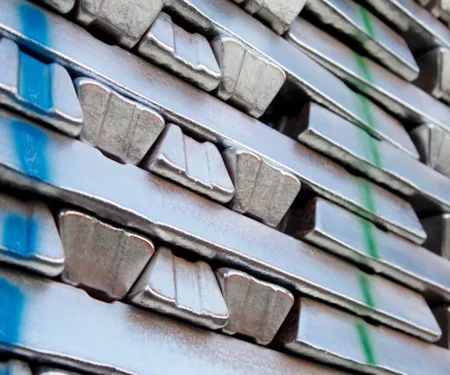
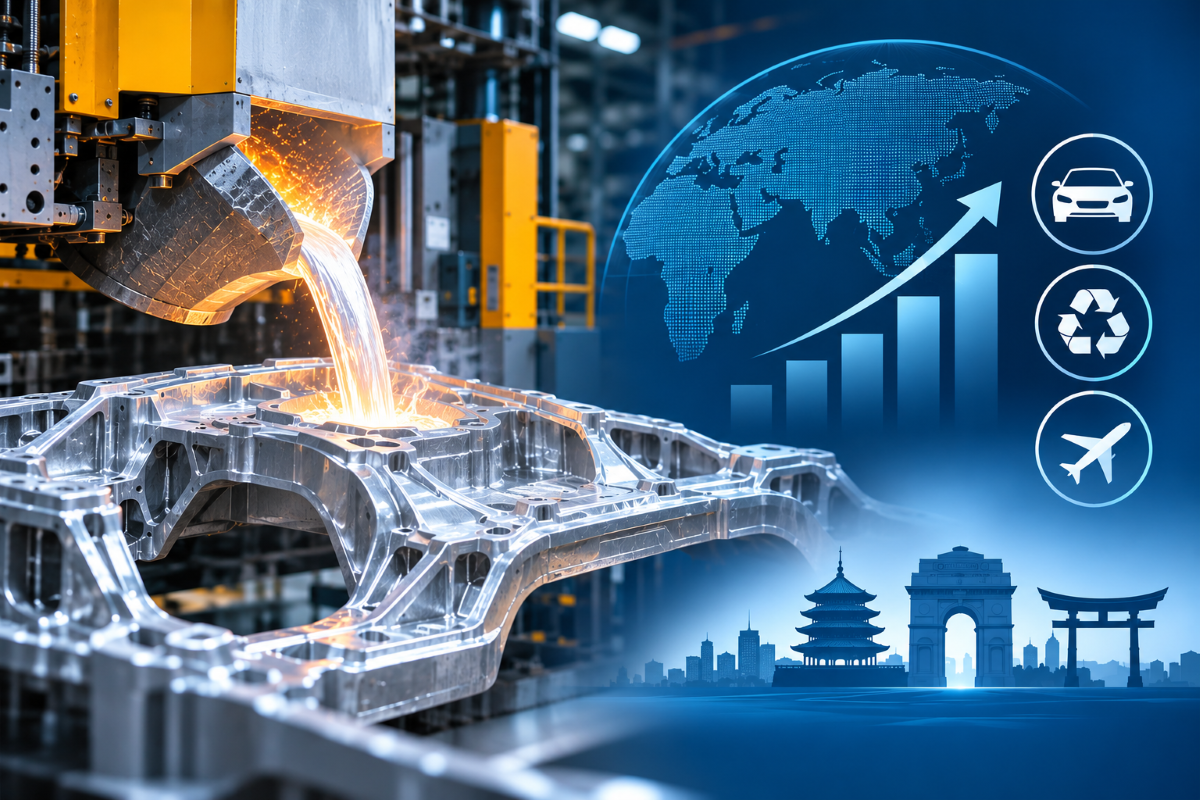
Aluminium casting is entering a new phase of expansion, with manufacturers investing in bigger die-casting machines, new foundries and specialised production facilities. From automotive gigacasting and recycled metal to EV components and aerospace castings, the latest projects highlight the industry's growing focus on scale, precision and advanced manufacturing.
Global aluminium casting consumption increased from 20.38 million tonnes in 2020 to 23.73 million tonnes in 2025, representing growth of 16.44 per cent. Consumption is projected to reach 28.11 million tonnes by 2030 and 30.01 million tonnes by 2032, marking an overall increase of 47.25 per cent between 2020 and 2032.
Now if we look across Asia, China accounted for the largest share of demand among the three markets, with estimated consumption of 11–12.5 million tonnes in 2025. India's demand stood at 1.4–1.45 million tonnes, while Japan recorded 1.2–1.3 million tonnes, according to AL Circle estimates.
China pushes aluminium gigacasting towards larger automotive structures
China is taking the lead in large-scale aluminium casting, with manufacturers investing in ultra-large die-casting machines to produce integrated automotive structures, particularly for electric vehicles (EVs). The expansion of high-capacity presses is enabling the production of larger, one-piece components that can replace multiple individual parts.
By May 2026, more than 60 domestic die-casting presses with capacities of 6,000 tonnes or above were reportedly operating in China. This included nearly 20 machines with capacities of 9,000 tonnes or more and two 16,000-tonne machines.
Dongfeng is among the manufacturers advancing this technology. Its gigacasting plant has entered trial production in its first phase, with 16,000-tonne and 10,000-tonne presses operational. The complete project involves six production lines across three phases, targeting an annual capacity of 600,000 units. The facility will manufacture large, one-piece EV structural components, including underbodies and battery trays.
Duoli Technology is also expanding its gigacasting operations at its Jintan facility in Changzhou, Jiangsu. Three large die-casting machines are operating at full capacity, with the ability to produce up to 35,000 one-piece rear underbodies per month. New underbody programmes for SAIC and General Motors (GM) entered trial production in the fourth quarter of 2026, with volume production planned from 2027.
Further investment in large-scale casting technology is coming through an agreement between Jiangsu Bojun and LK Group. Signed in April 2026, the deal covers the introduction of die-casting machines with capacities of 10,000 tonnes, 9,000 tonnes, 7,200 tonnes, 5,000 tonnes, 3,000 tonnes and 800 tonnes, alongside Thixomolding equipment.
Explore downstream aluminium products from our comprehensive list on AL Biz.
Recycled aluminium adds another dimension to China's expansion
Investment activity extends beyond automotive gigacasting. Manufacturers are also increasing secondary aluminium and low-carbon alloy production, particularly in Yunnan, where projects are combining green hydropower, recycled metal and downstream manufacturing.
Yunnan Jiantao New Materials' Phase I melting and casting plant in Wenshan is complete, with its alloy-ingot line ready for commissioning. Its planned capacity includes 100,000 tonnes per year of cast alloy ingots, 780,000 tonnes per year of large flat ingots and 600,000 tonnes per year of high-precision sheet and strip under Phase II. The project combines green hydropower and recycled aluminium with downstream high-precision products and is listed as a Yunnan provincial priority project.
Another development in the province is Hongbang New Materials' expansion at the Funing Green Hydropower Aluminium Park. Its Phase I facility, with an annual capacity of 150,000 tonnes, has been operating since early 2024. Phase II involves an additional 50,000 tonnes per year of secondary aluminium alloy capacity, targeted for completion by the end of 2025. The company supplies high-end cast alloy ingots for new energy vehicles (NEVs), 5G and electronics applications.
The expansion of recycled alloy production is not limited to Yunnan. In Fujian, Longyan Ruiqi Aluminium is developing its high-performance aluminium alloy capacity in phases. Its first 100,000-tonne-per-year production line has been operating since March 2023, with total capacity targeted at 300,000 tonnes per year. The facility uses scrap-based secondary aluminium and energy-efficient smelting to supply alloys for NEVs, railways, machinery and 5G applications.
Anhui is also attracting investment in this segment. A recycled aluminium alloy project in Wuhu has a designed capacity of 100,000 tonnes per year, with Phase I accounting for 50,000 tonnes. Construction began in December, and production was scheduled to start in April. The facility will manufacture recycled aluminium alloy liquid metal, with plans to expand into downstream die-casting operations.
Meanwhile, Shanghai Yongmaotai announced an RMB 998 million placement in September 2026, of which RMB 520 million was earmarked for magnesium precision components in China. The project has a planned construction period of 24 months and forms part of the company's expansion across Anhui, Chongqing and Mexico.
India expands foundry and HPDC capacity for automotive manufacturing
Unlike the emphasis on ultra-large gigacasting, India's aluminium casting investments are centred on expanding foundry capacity, adding high-pressure die casting (HPDC) machinery and strengthening domestic automotive and EV component manufacturing. New facilities and production lines are being developed to serve two-wheelers, passenger vehicles, commercial vehicles and electric mobility.
Uno Minda's greenfield aluminium casting facility on Thally Road in Hosur, Tamil Nadu, is among the major announced investments. The company is investing INR 510 crore in the project, with Phase I production expected to begin in the fourth quarter of FY2028. Its existing Hosur operations are scheduled to be relocated by the first quarter of FY2029.
Once fully utilised, the new facility will increase Uno Minda's aluminium casting capacity from approximately 13,000 tonnes to 30,000–34,000 tonnes. It will manufacture structural and general castings for two-wheelers, passenger vehicles, commercial vehicles, EVs and powertrains. The plant will also have the capacity to produce up to 1 million HPDC two-wheeler alloy wheels.
Jaya Hind Industries is pursuing another major capacity expansion through a phased investment of INR 600 crore across Akurdi and Urse in Pune and Chennai during FY2026-27 and FY2027-28. The project will add more than 12 HPDC machines, with capacities ranging from 1,200 tonnes to 3,500 tonnes. It also includes a new Chennai facility and additional capabilities in machining, heat treatment, impregnation and powder coating. Groundwork for the Chennai expansion began in December 2025.
New foundry projects are also extending into other industrial locations. In Maharashtra, Varad Alloy Casting received approval for land allotment at the Shendra-Bidkin Industrial Area (AURIC) in Chhatrapati Sambhajinagar in November 2026. The allotted 6,057-square-metre plot will be used to establish a new aluminium castings and die-casting foundry. The development is part of a wider AURIC investment package exceeding INR 200 crore, expected to generate around 1,000 jobs.
EV components and high-performance billets widen India's casting portfolio
Beyond conventional automotive castings, manufacturers are developing aluminium components for electric mobility and specialised industrial applications. Battery enclosures are one of the product segments covered by these investments.
Hindalco's battery-enclosure plant in Chakan, Maharashtra, is operational and scaling up production. By December 2024, the facility had shipped 10,000 battery enclosures to Mahindra Electric. Its planned annual capacity is 160,000 units by FY2027.
Other automotive capacity additions are expected to contribute to the industry's expansion. Mahindra CIE's die-casting plant in Igatpuri, Maharashtra, is among the projects cited in industry capacity forecasts. Its expansion, alongside Bharat Forge's Chakan campus, is expected to contribute nearly 60,000 tonnes of additional aluminium capacity by 2027.
The development of downstream aluminium supply is also supporting applications beyond vehicle manufacturing. Remal's aluminium billet casthouse at Vile Bhagad, Maharashtra, began production in 2025 and completed its 1,000th billet cast in November 2026. The facility is progressing towards an annual capacity of 72,000 tonnes of high-performance aluminium billets, supporting downstream casting requirements and aerospace demand.
Japan focuses on precision casting and complex components
Japan's aluminium casting investments follow a more specialised direction, with manufacturers focusing on precision engineering, aerospace and defence components, recycled alloys, automation and automotive hybrid and EV parts. Companies are upgrading facilities to manufacture complex components with tighter specifications.
Kimura Group's Advanced Aluminium HQ Plant in Shizuoka began operations in February 2026. The facility combines low-pressure sand casting, V-process vacuum moulding and proprietary heat treatment, supported by 200 kg and 400 kg low-pressure casting machines.
The plant is designed to produce large, thin-wall structural castings with wall thicknesses as low as 2 mm. Its capabilities support prototype development and small-lot production of complex structural components, providing a specialised approach to gigacasting.
Ninomiya is also expanding its casting operations with a new plant at its headquarters site in Nishio, Aichi. Full operations were scheduled for autumn 2026, with the facility expected to more than double the company's combined casting capacity. The expansion will also diversify production beyond automotive components into construction machinery and semiconductor manufacturing equipment.
Recycling and automation remain important to Japan's casting strategy
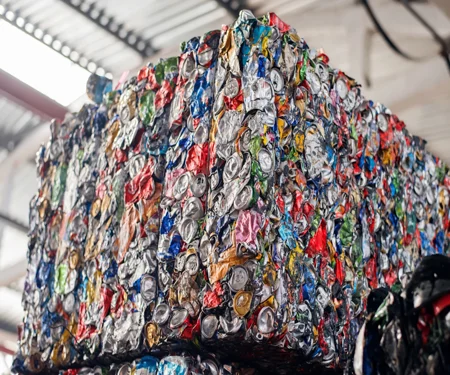
Alongside specialised manufacturing, Japan is continuing to invest in recycled aluminium and advanced production systems. UACJ is undertaking capital expenditure across Fukui, Shizuoka and Oyama, including additional used beverage can (UBC) melting and recycling capacity in Fukui, expanded shredding and scrap-furnace capabilities, and an advanced casting system at Oyama. The company is also developing alloys using recycled raw materials.
In automotive manufacturing, Ryobi operates a substantial installed base of large die-casting machines across its Shizuoka and Hiroshima facilities. As of December 2025, the company had 33 die-casting machines, including 22 large units at Shizuoka and eight large units at Hiroshima East. These facilities support high-precision aluminium and magnesium castings, including hybrid transaxle housings and large automotive structural components.
Japanese suppliers are also investing in vacuum HPDC, robotics, optical and X-ray inspection, and rapid die-change systems to meet original equipment manufacturers' (OEMs) quality requirements. About 96 per cent of aluminium alloy castings and 92 per cent of aluminium die castings in Japan are used by the automotive industry.
Read our latest magazine “ALuminium’s Frontline: OEM Edition 2026” and learn how OEMs are transforming critical aluminium applications across end-use sectors.












_md.webp)
_md.webp)
_md.webp)