Aluminum investment across North America and Asia: Who leads reshaping the next phase of growth?
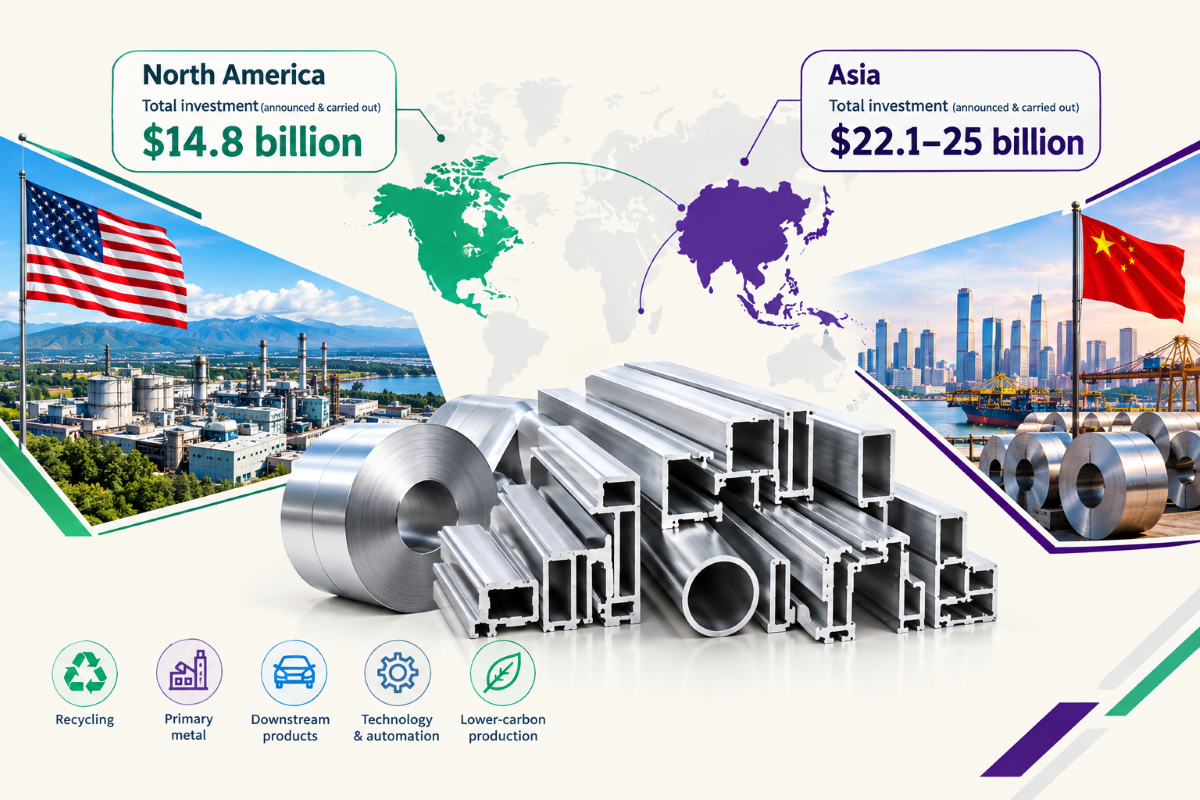
The image used in this article is generated with an AI tool and does not depict any real-time moment
Aluminum investment has been spreading across the entire value chain, from primary smelting and alumina refining to recycling, rolling, extrusion and battery foil, building more integrated and higher-value supply chains.
During the past 5 years, the US and Canada in North America and China in Asia have been grabbing headlines pertaining to the aluminum industry. These updates have involved growth stories or have shed light on volatile market situations. How have these headlines contributed to a greater picture for the benefit of the aluminum industries of the two continents?
Between 2021 and 2026, major projects across North America and Asia have targeted new primary capacity, lower-carbon production, recycled aluminum and higher-value downstream products.
But the investment pattern is different: North America is concentrating on recycling, downstream processing and domestic supply resilience, while Asia is expanding across a much broader upstream-to-downstream chain. The result is two distinct models for the next phase of aluminum growth.
To know the global production, demand and consumption forecasts of aluminum extrusions, explore our report "The World of Aluminium Extrusions to 2035"
North America: Recycling-led growth with a primary-metal reset
North America’s recent investment cycle is centered on recycled metal, flat-rolled products and lower-carbon production. The region is also seeing its first serious attempt in decades to rebuild primary-aluminum capacity.
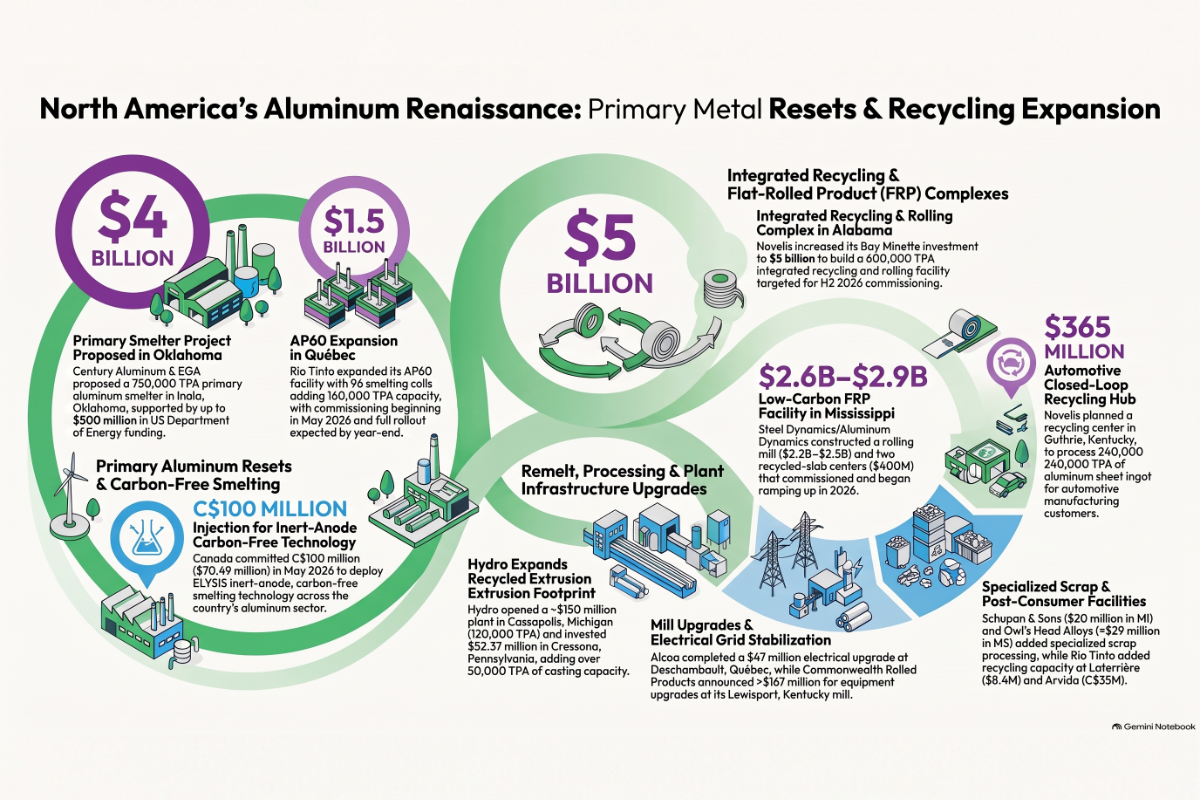
North America is not pursuing primary aluminum volume alone. The projects place recycled aluminum, flat-rolled products (FRP), extruded products, lower-carbon smelting and domestic processing capacity alongside new primary production. That makes the investment cycle more about rebuilding a connected regional supply chain than simply adding smelter tonnes.
Asia: Upstream integration with downstream capacity expansion
Asia is investing across a wider set of aluminum segments, ranging from bauxite and alumina to smelting, rolling, recycling, extrusion and battery foil. The region’s projects also tend to be closely aligned with electric vehicles, energy storage, packaging and large-scale industrial manufacturing.
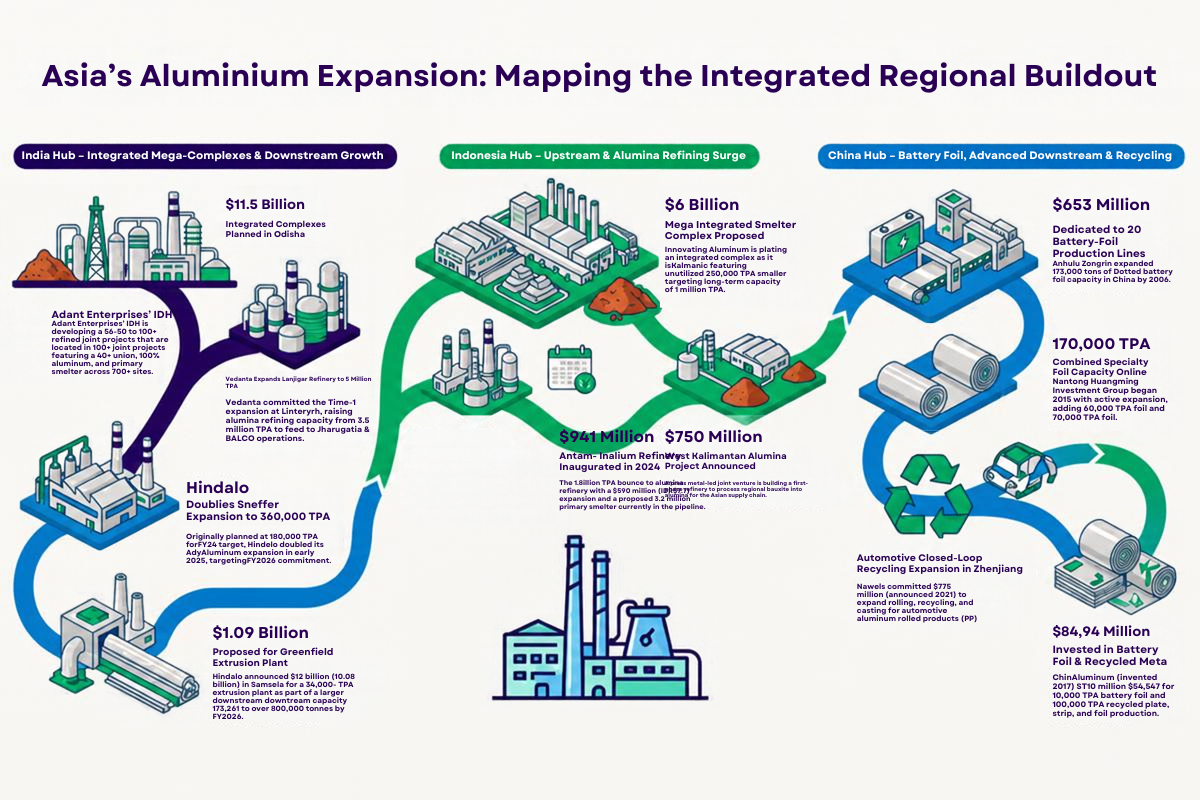
Asia’s project mix is notable for the number of layers in the aluminum chain that are being developed at once. Alumina, smelting and downstream products are being expanded alongside battery foil, recycling, rolling and extrusion. Thus, it depicts an investment model built around scale and vertical integration, with downstream capacity tied directly to expanding industrial and EV demand.
Explore downstream aluminum products from our comprehensive list on AL Biz.
What does the investment trend reveal?
Based on the selected projects, North America has committed around $14.8 billion to aluminum investments since 2021, centered on recycling, flat-rolled products, low-carbon smelting and domestic supply-chain resilience. Asia’s comparable disclosed project pipeline totals about $22.1 billion, reflecting broader investment across alumina refining, primary aluminum, battery foil, rolling, recycling and EV-linked downstream manufacturing; the figure rises to approximately $25 billion when Indonesia’s planned second alumina-refinery phase and smelter are included.
While Asia leads in aggregate disclosed investment and upstream integration, North America is strengthening its position through large recycling-and-rolling projects such as Novelis Bay Minette and Steel Dynamics’ Mississippi complex, Québec’s low-carbon AP60 smelter expansion and inert-anode technology, and the proposed Century–EGA primary smelter in Oklahoma.
This strategy prioritizes higher-value, lower-carbon aluminum products and a more secure regional supply base rather than competing solely on primary-metal volume.
Read our latest magazine “ALuminium’s Frontline: OEM Edition 2026” and learn how OEMs are transforming critical aluminum applications across end-use sectors.
US companies positioned to benefit from the aluminum investment cycle
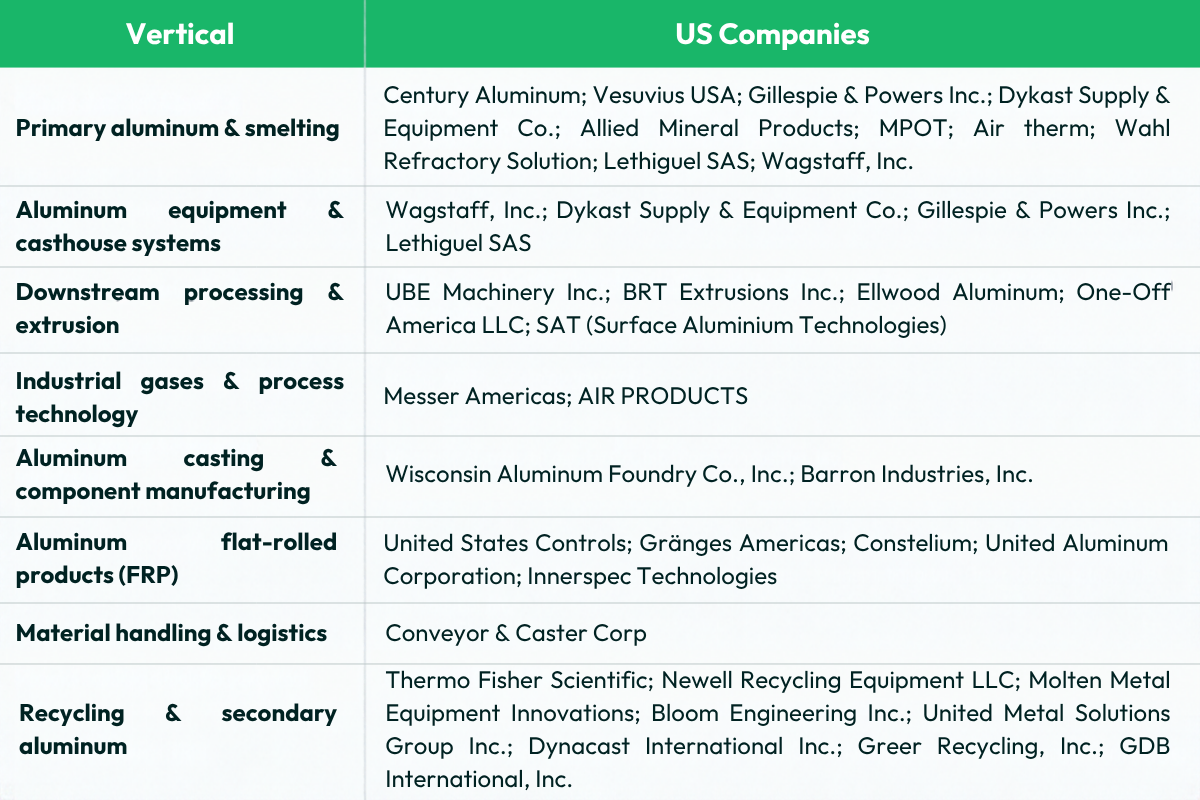
Beyond the projects themselves, the US aluminum investment cycle could create opportunities across a much wider domestic industrial ecosystem. The expansion of primary aluminum, recycling, rolling, extrusion and downstream capacity is likely to generate demand not only for aluminum producers but also for companies supplying smelting and casthouse equipment, refractory systems, molten-metal handling solutions, recycling technologies, process automation, industrial gases, casting systems, tooling and specialized downstream manufacturing.
Against this backdrop, the following US-based companies, which play significant roles across different segments of the aluminum value chain, could potentially benefit from the investment pipeline as new capacity moves from development to construction, commissioning and full-scale operation.
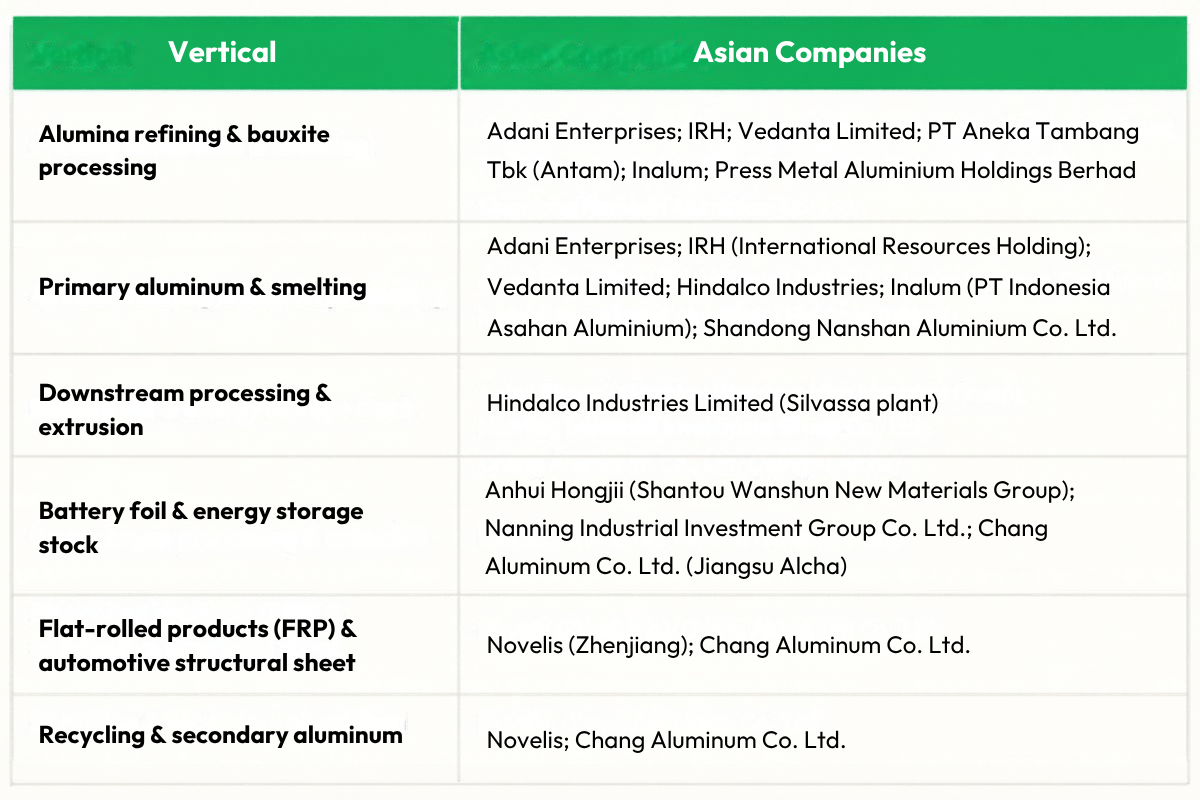
Asian companies positioned to benefit from the aluminum investment cycle
Asia’s investment cycle creates a different opportunity set because projects are spread across the entire aluminum chain. Companies involved in alumina refining, primary aluminum, battery foil, rolling, recycling, casting and extrusion are directly aligned with the expansion underway across India, China and Indonesia.
The vantage point comes from companies linking upstream resources with downstream products.
Who is shaping the next aluminum growth model?
The investment figures point to two different directions rather than a simple regional winner.
North America’s selected $14.8 billion pipeline is smaller but more concentrated. Recycling, flat-rolled products, lower-carbon smelting and domestic supply-chain resilience dominate the project mix, with Québec’s AP60 expansion and ELYSIS technology, and the proposed Century-EGA smelter representing different pieces of that strategy.
Asia’s selected pipeline is larger at about $22.1 billion, rising to approximately $25 billion when Indonesia’s planned second alumina-refinery phase and smelter are included. Its strength lies in the breadth of investment, from alumina and primary aluminum to battery foil, rolling, recycling and extrusion.

The longer-term question, therefore, is not simply which region is ahead, but how far and in which direction each aluminum model can expand. Although China has nearly hit the carbon emissions cap, the country continues to invest in overseas projects. The US, on the other hand, remains focused on rebuilding domestic capacity, strengthening recycling and downstream manufacturing, and developing lower-carbon aluminum technologies.
Note: This is exclusive coverage by AL Circle and may not be reproduced, republished or shared without prior permission.
Guwahati police recover 100 kg aluminium wire, investigate theft network
Next articleSampat Aluminium shareholders approve four resolutions with 100% votes at 27th AGM
Grow with
AL Circle






















