Speira

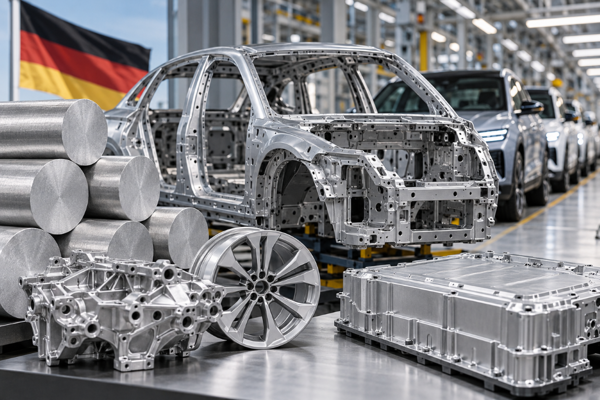
Germany’s automotive industry drives 32.8% of aluminium consumption as EV production rises 23%, led by Volkswagen, BMW & Mercedes-Benz
Germany’s automobile industry is a major part of the country’s aluminium story, with the metal used in everything from vehicle body panels and chassis components to battery enclosures and electric-drive systems. As automakers develop lighter vehicles and expand their electric models, aluminium has become an important material across the manufacturing process. Germany’s automotive industry consumes around 950,000 tonnes of aluminium annually, accounting for a substantial share of the wider transport sector’s demand. In 2025, Germany’s total aluminium consumption stood at approximately 2.9 million tonnes, with the transport sector accounting for 1.35 million tonnes, representing 46 per cent of the total. This extensive use of aluminium in transport mirrors its importance to the global...
60kt a year: Red Bull backs Speira’s €40m aluminium recycling furnace at Rheinwerk
Speira has commissioned a new aluminium recycling furnace at its Rheinwerk site in Grevenbroich, Germany, completing a EUR 40 million (USD 44.75 million) investment aimed at expanding recycled aluminium production for beverage cans. The facility has an annual capacity of around 60,000 tonnes, while Red Bull’s use of cans made with Speira’s recycled aluminium highlights the growing role of circular material in the beverage sector. The development marks another step in transforming a site long associated with primary aluminium production into a centre for the circular aluminium economy. Join the fourth edition of the webinar "Hedging for recyclers - Become an expert in 6 hours" by Jorge Dyszel. Rheinwerk shifts towards recycling The investment covers the new furnace, optimisation of the...
Grow with
AL Circle
Price
→Events

15th International Bauxite, Alumina & Aluminium Conference & Exhibition - IBAAS–VFMSTA 2026
ICSOBA 2026 - 44th International Conference and Exhibition
India Mining Week 2026
15th International Bauxite, Alumina & Aluminium Conference & Exhibition - IBAAS–VFMSTA 2026
ICSOBA 2026 - 44th International Conference and Exhibition
India Mining Week 2026
Business Cards
A report that reveals where the aluminium casting industry is heading and how businesses can act.
LEARN MORE
A report that reveals where the aluminium casting industry is heading and how businesses can act.
LEARN MOREGermany’s automotive industry drives 32.8% of aluminium consumption as EV production rises 23%, led by Volkswagen, BMW & Mercedes-Benz
AL Circle Analysis: US scrap imports hit 580kt as China slips 3.2%, who drives aluminium recycling?
A should-cost analysis of an aluminium tower furnace in India: Comparing the economics of LPG, PNG, and electric energy sources
Germany’s construction aluminium demand falls 12%, but 2027 recovery and recycling offer fresh growth prospects
AL Circle analysis: Germany’s aluminium trade surplus, Novelis’ US expansion, Asia’s EV demand & India’s underutilised downstream capacity
News
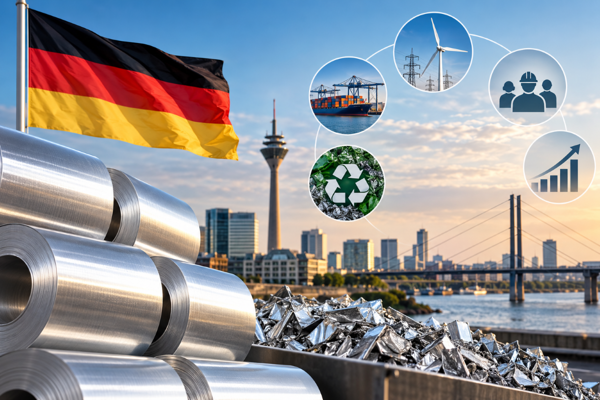
IG Metall and IGBCE call for stronger action as Germany’s aluminium industry faces energy and trade pressures
Germany’s aluminium industry is facing growing pressure from energy costs, international trade conflicts, industrial competitiveness and the need for skilled workers as the country works to strengthen its industrial base and accelerate the economic transformation. These challenges came into focus at an Aluminium industry conference hosted by IG Metall and IGBCE in Düsseldorf today, bringing together policymakers, aluminium producers, industry representatives, works council members and trade unionists. Held at the opening of the Aluminium trade fair in Düsseldorf, the conference focused on the future of Germany’s aluminium industry and the conditions needed to maintain a strong industrial base in Germany and Europe. The discussions centred on European industrial policy, the competitiveness...
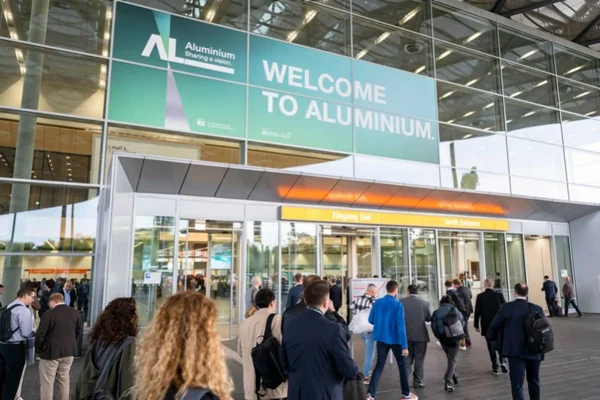
Global aluminium industry gears up for ALUMINIUM 2026 in Düsseldorf with focus on recycling, innovation and demand
Four days to go, and the aluminium world is getting ready to move to Düsseldorf. From October 6-8, the city will host ALUMINIUM 2026 , with more than 800 exhibitors and partners and over 21,000 trade visitors expected at Messe Düsseldorf. The event will bring together producers, recyclers, downstream manufacturers, technology providers, equipment suppliers, policymakers and end users from across the global aluminium value chain. The 2026 edition comes at an important point for the aluminium industry. European producers are facing pressure from energy costs, international competition and tighter climate requirements, while concerns around raw material security and resilient supply chains continue to grow. At the same time, demand for aluminium is expanding across electric mobility,...

AL Circle Analysis: How the race for aluminium scrap is reshaping recycling, trade and industrial competitiveness
The aluminium industry has entered a new race. It is no longer just about producing lower-carbon metal but about securing the scrap, infrastructure and policy support needed to keep circular supply chains competitive. For years, recycling has been one of aluminium's strongest sustainability advantages. Recycled aluminium requires up to 95 per cent less energy than primary production, making it central to global decarbonisation efforts. Yet the industry's priorities are evolving. The key question is no longer how much aluminium can be recycled, but who will control the scrap that makes recycling possible. Recent developments across Brazil, the United States, Europe, the Middle East, India and Australia point to the same conclusion. Governments are reassessing scrap exports, recyclers are...

Speira advances Rheinwerk aluminium recycling hub with $46m furnace investment
Speira is progressing with the redevelopment of its Rheinwerk facility in Neuss, Germany, as it continues transforming the site into an aluminium recycling hub. The aluminium rolling and recycling company has invested around EUR 40 million (USD 46 million) in a fourth recycling furnace, which is due to come on stream this autumn. It has also invested in the decommissioning and redevelopment of the site's former aluminium smelter. With the complete phase-out of electrolysis, Speira said it has set the course for a fundamental transformation of the Rheinwerk site. Instead of energy-intensive primary production, the company is now focusing on aluminium recycling and strengthening the circular economy. The new fourth recycling furnace is a key part of this transition. Aluminium scrap will be...

VALIS provides carbon performance you can document, report and rely on
“With our new label VALIS, we define a clear and independently verified carbon threshold. Every product carrying the label is backed by an Environmental Product Declaration and confirmed by an external authority. This means carbon performance you can document, report and rely on," explains Cédric Rauhaus, Speira's Head of Marketing. VALIS is designed for markets where transparency defines trust and documentation drives decisions. The label marks products with a CO₂ footprint of less than 4 tonne CO₂e per tonne of aluminium and provides a reliable basis for reporting and enables consistent, v erifiable carbon accounting over time. Transparency creates value when it can be applied. That is why every VALIS product is backed by an Environmental Product Declaration (EPD) and independently...

How nearly 6Mt of aluminium dross is driving the next wave of recovery technologies and building circular value chains
Every tonne of aluminium produced creates more than just the finished metal. Across primary production and recycling, the processes generate aluminium dross-an oxide-rich material that is increasingly attracting attention across the industry. Global aluminium dross generation is projected to rise from 5.86 million tonnes in 2025 to 6.04 million tonnes in 2026, marking a 3.1 per cent increase, with volumes expected to grow by a further 13.4 per cent by 2030 and 5.7 per cent by 2032. The rise is being driven by expanding aluminium production and, increasingly, the rapid growth of secondary aluminium recycling. This growing waste stream includes white dross, mainly generated during primary aluminium production and clean metal melting, and black dross, which typically arises from secondary...














Blog
LATEST POSTS





Turn marketplace visibility into more relevant buyer enquiries.
View Priority Plans
Turn marketplace visibility into more relevant buyer enquiries.
View Priority Plans
