Germany exports 86% of TRIMET’s aluminium production despite 1.84Mt domestic demand from automotive, packaging & extrusion industries
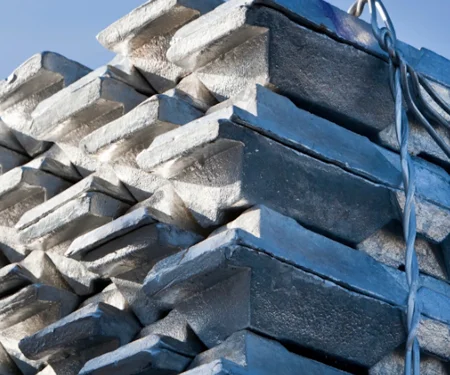
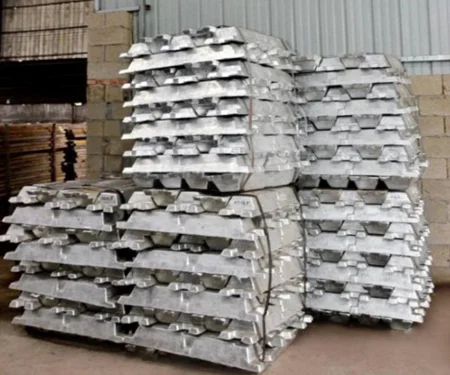
The image used in this article is generated with an AI tool and does not depict any real-time moment
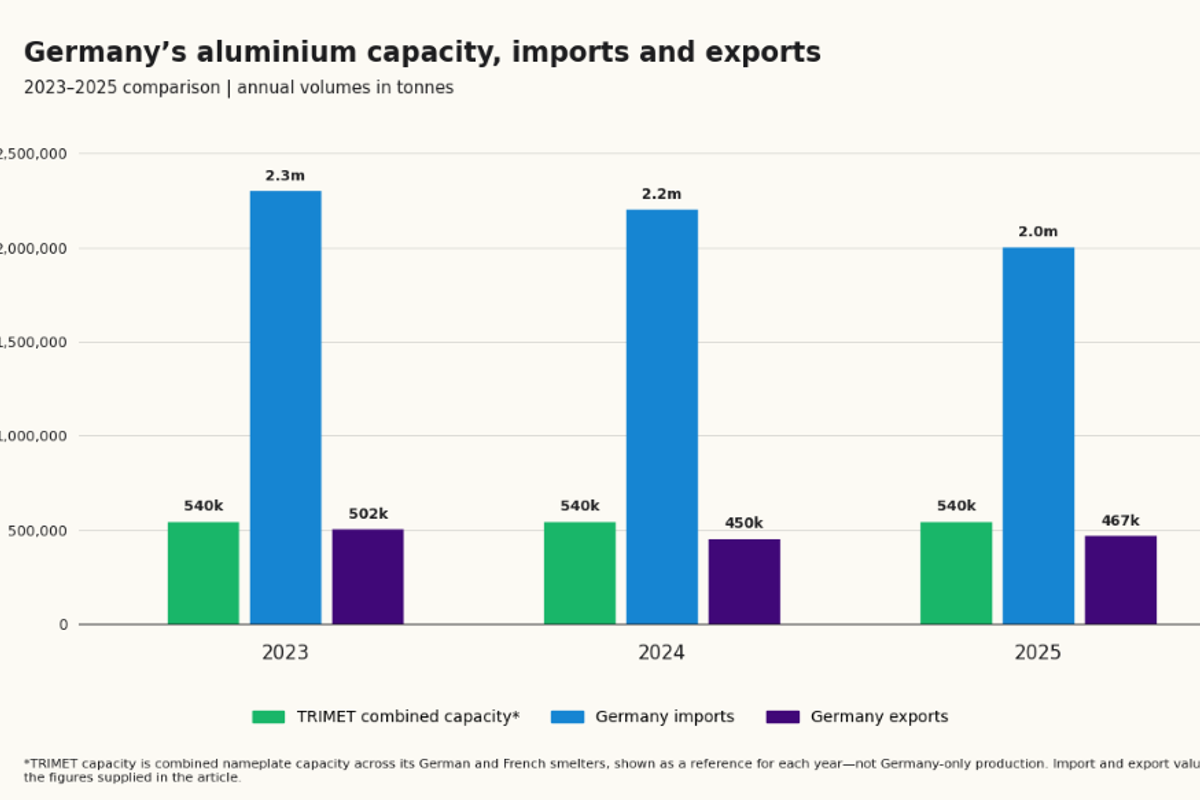
Germany’s last remaining primary aluminium producer, TRIMET Aluminium SE, has a combined nameplate capacity of approximately 540,000 tonnes per year across its German and French smelters. Yet Germany exported 466,756 tonnes of unwrought primary aluminium in 2025, equivalent to 86.44 per cent of that combined capacity. Exports reached 501,678 tonnes in 2023 and 449,590 tonnes in 2024, while shipments totalled 273,080 tonnes between January and July 2026.
The comparison presents an intriguing picture of Germany’s aluminium industry. Despite having a limited primary smelting base, the country continues to export hundreds of thousands of tonnes of unwrought aluminium annually. At the same time, it imported 2 million tonnes of primary aluminium in 2025, more than four times its exports.
Why does Germany export so much primary aluminium when its domestic production capacity is far below its industrial requirements? The answer lies in the distinction between production capacity and trade flows, alongside the country’s extensive downstream manufacturing industry.
TRIMET’s production capacity highlights Germany’s supply constraints
TRIMET became Germany’s last remaining primary aluminium producer after Speira completed the phase-out of electrolysis at its Rheinwerk smelter in Neuss.
The company’s three German smelters are located in Essen, Hamburg and Voerde. Their stated site capacities are 180,000 tonnes, 135,000 tonnes and 95,000 tonnes per year, respectively, adding up to approximately 410,000 tonnes. TRIMET’s combined capacity of around 540,000 tonnes also includes its French smelter at Saint-Jean-de-Maurienne.
There is an important distinction between capacity and actual production. In January 2025, TRIMET said that, once its planned ramp-up was completed, its three German plants would produce around 395,000 tonnes of primary aluminium annually, supplemented by 145,000 tonnes from France. The company expected Essen and Hamburg to reach full capacity by mid-2025, with Voerde following in the fourth quarter.
This difference matters when assessing Germany’s exports. The 540,000-tonne figure represents combined capacity across two countries, not Germany’s domestic production alone. Nameplate capacity also indicates potential output rather than the quantity actually produced and sold in a particular year.
TRIMET’s Essen facility also produces recycled aluminium, while Hamburg and Voerde are dedicated primary smelters. Across its German and French operations, the company produces approximately 700,000 tonnes of aluminium products annually, including primary metal, recycled aluminium and cast components.
Even with these operations, Germany’s domestic primary smelting capacity remains substantially smaller than the requirements of its industrial economy.
To know the global production, demand and consumption forecasts of aluminium extrusions, explore our report "The World of Aluminium Extrusions to 2035"
Germany’s exports remain high, but imports are much larger
Germany’s primary aluminium exports were equivalent to 92.90 per cent of TRIMET’s combined 540,000-tonne capacity in 2023. The ratio fell to 83.26 per cent in 2024 before recovering to 86.44 per cent in 2025.
The import figures reveal a more direct indication of the country’s supply requirements. Germany imported 2.5 million tonnes of primary aluminium in 2022, followed by 2.3 million tonnes in 2023, 2.2 million tonnes in 2024 and 2 million tonnes in 2025. Imports reached approximately 1 million tonnes between January and July 2026.
In 2025, imports exceeded exports by approximately 1.53 million tonnes and were around 4.3 times the export volume. This difference illustrates why Germany continues to depend on international supplies despite maintaining substantial export flows.
Why Germany needs more primary aluminium than it can produce
Germany’s primary aluminium demand reached 1.829 million tonnes in 2025, up 1.84 per cent from 1.796 million tonnes in 2024. Although demand recovered modestly, it remained below the 2.160 million tonnes recorded in 2021.
Demand increased from 1.985 million tonnes in 2020 to 2.160 million tonnes in 2021, an annual rise of 8.82 per cent. It subsequently declined to 2.045 million tonnes in 2022, 1.862 million tonnes in 2023 and 1.796 million tonnes in 2024. The 2025 recovery left demand 156,000 tonnes, or 7.86 per cent, below the 2020 level and 331,000 tonnes, or 15.32 per cent, below the 2021 peak.
Even after this decline, Germany’s primary aluminium demand remained considerably higher than TRIMET’s combined capacity. In 2025, demand of 1.829 million tonnes exceeded the 540,000-tonne capacity by 1.289 million tonnes, or 238.70 per cent. In other words, demand was approximately 3.4 times the company’s combined German and French nameplate capacity.
The shortfall is even more pronounced when demand is compared with capacity located in Germany alone. This helps explain why imports remain crucial to the country’s industrial supply chain.
Automotive and downstream industries sustain demand
Germany’s automotive industry consumes around 950,000 tonnes of aluminium annually, accounting for approximately 32.8 per cent of national aluminium consumption. Volkswagen, BMW and Mercedes-Benz use the metal in body panels, chassis components, castings, wheels and battery enclosures. Electric vehicles also require aluminium for motor housings, power electronics and cooling systems.
Demand extends well beyond automotive manufacturing. Germany is one of Europe’s major downstream aluminium hubs, processing the metal into rolled sheets, coils, foil, extruded profiles, forgings and cast components for machinery, construction and packaging.
The Rhine-Ruhr region, particularly Grevenbroich and Neuss, is an important centre for rolled aluminium products. Speira, established in 2021 following Norsk Hydro’s sale of its rolling and recycling business for approximately EUR 1.48 billion, operates facilities across Germany and Norway, with around 1 million tonnes of annual rolled-product output. Its products include automotive sheet, packaging foil and specialised industrial materials.
Alunorf, a 50:50 joint venture between Speira and Novelis, produces approximately 1.5 million tonnes annually, supplying hot-rolled coil for further processing. Novelis also operates German facilities in Nachterstedt, Göttingen and Ludwigshafen, while Constellium’s Singen plant employs more than 1,600 people and serves the automotive, packaging and e-mobility markets.
The wider supply chain includes Hydro Extrusions, which has approximately 1.4 million tonnes of annual extrusion capacity worldwide. Constellium Extrusions Deutschland in Landau and Hueck in Lüdenscheid supply profiles for industrial and construction applications, while Otto Fuchs in Meinerzhagen specialises in high-strength forgings and extrusions for aerospace, automotive and mechanical engineering. Aluminium Rheinfelden Alloys supplies foundry alloys, while KS Kolbenschmidt manufactures aluminium pistons and engine components.
Browse through top global suppliers for automobile components on AL Biz.
Construction and packaging add to the requirement. Germany’s construction industry is expected to grow by approximately 1 per cent in 2026, supporting demand for aluminium windows, doors, facades and structural systems. Schüco, Wicona and Hueck supply building systems incorporating extruded profiles, thermal breaks, hardware and surface finishing.
In packaging, Speira produces thin foil for food and pharmaceutical applications, while Novelis and other rolled-product suppliers provide can sheet to manufacturers such as Ball and Crown. Building and packaging together account for 27 per cent of Germany’s total aluminium demand.
This extensive downstream manufacturing base needs a reliable supply of metal, even though the country’s primary smelting industry has contracted.
High electricity costs constrain domestic production
One of the major reasons for low domestic production is electricity cost. Producing one tonne of primary aluminium requires around 17,000 kWh of power, which can account for 30–40 per cent of production costs. Electricity prices therefore play a decisive role in determining whether smelters can operate competitively.
Germany also lacks a significant domestic bauxite and alumina resource base, limiting its access to the principal raw materials required for primary aluminium production.
The surge in energy prices following the Russia-Ukraine war further weakened the economics of European smelting. High operating costs and international competition placed additional pressure on domestic producers, contributing to the decline in Germany’s primary smelting capacity.
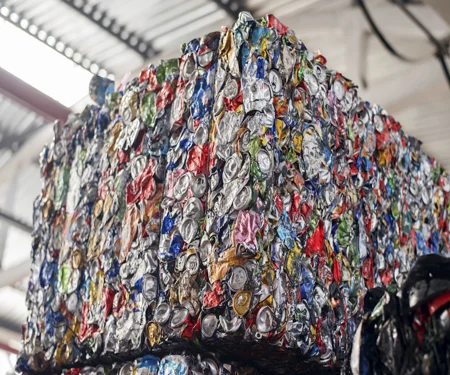
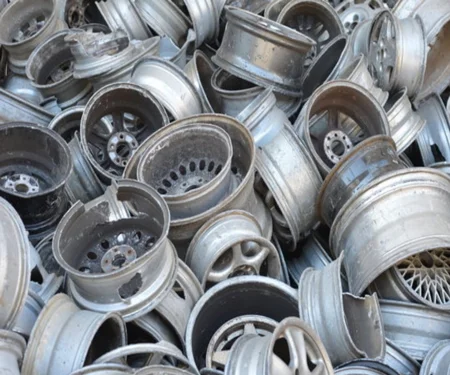
Recycling has become increasingly important, but it has not eliminated the need for primary aluminium. Germany’s manufacturers continue to require substantial quantities of metal for their products, making imports essential to the industrial supply chain.
Germany’s aluminium trade reflects a structural imbalance: its primary smelting capacity is limited, but its downstream manufacturing industry remains extensive, supported by automotive, construction, packaging and wider manufacturing industries.
Read our latest magazine “ALuminium’s Frontline: OEM Edition 2026” and learn how OEMs are transforming critical aluminium applications across end-use sectors.
Note: This is exclusive coverage by AL Circle and may not be reproduced, republished or shared without prior permission.
Grow with
AL Circle