Can predictive AI give aluminium smelters a wider window to act?
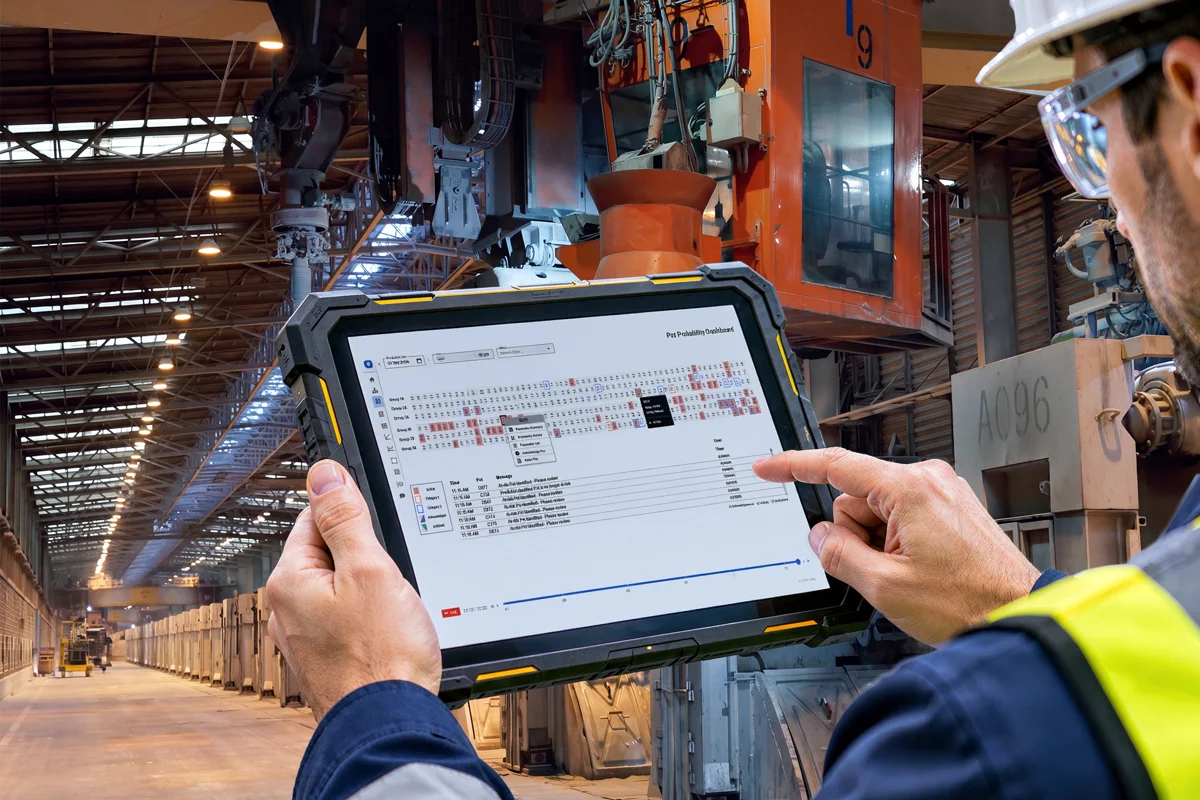
The image used in this article is generated with an AI tool and does not depict any real-time moment
In the aluminium industry, pots rarely go from normal operation to failure without warning signs. Changes in electrical behaviour, thermal conditions, and metal or bath chemistry provide indications of changes and developing problems. The difficulty is recognising what these changes mean and how significant they are, particularly when no individual parameter appears sufficiently abnormal to trigger concern.
This is a familiar operational challenge for Reduction teams as a potline contains hundreds of individual units, each with its own operating history and evolving conditions. Keeping track of them requires continuous monitoring, considerable process knowledge, and the ability to distinguish routine variations from signs of deterioration.
Conventional monitoring systems and alarm thresholds remain essential to potline management. However, they do not always reveal the relationships between several operating parameters that point towards damaging events and a potential emerging failure. By the time the deterioration becomes unmistakable, damage has progressed and engineers may have fewer options to investigate the problem and organise a controlled intervention.
The growing development of artificial intelligence (AI) and digital twins presents an opportunity to close this gap. But it also raises a more important question for the industry's digitalisation efforts: are smelters building replicas because they can, or because those replicas can improve an operating decision?
Explore the production, demand and consumption forecasts of bauxite and alumina in our report: "Global Bauxite & Alumina Market Forecast to 2036: Supply–Demand, Trade Flows & Price Outlook"
A digital twin does not have to replicate everything
Much of the digital twin conversation begins with the physical asset. How much equipment can be represented? How many operating parameters can be incorporated? How closely can the virtual model reproduce the behaviour of the actual facility?
These are relevant technical considerations, but they should not determine the entire direction of a project.
When it comes to an aluminium smelter, a more useful starting point is the operational problem or objective. If the priority is to identify pots developing cathode or sidewall damage, the digital twin should be designed around the information required to recognise those failure mechanisms and support the engineers responsible for responding to them.
A complete virtual recreation of an industrial facility is not required to improve a specific operational decision. The best digital twin is the smallest, most reliable representation that captures the conditions needed to improve that decision. Then the opportunity is to connect the ‘insight’ as close as possible to a decision and action point.
This is particularly vital in aluminium electrolysis where pot deterioration is not always reflected in one abnormal reading. It can emerge as a digital signature, through interactions between electrical signals, thermal measurements, metal and bath chemistry, and other site-specific operating conditions.
A conventional alarm generally responds when a defined parameter crosses a predetermined limit. But an emerging failure pattern may develop through several variables changing in relation to one another, without any single reading immediately indicating a serious problem.
The Reduction engineers’ challenge is compounded by the scale of the operation. Every pot needs attention, but not every pot requires the same level of investigation at the same time. Specialists must balance pot performance with production requirements, process stability, maintenance planning and safety.
The difference between finding a pattern and understanding it
Machine learning has given industrial operators new ways to examine and draw insights from large volumes of process data. It can identify relationships that may be difficult to recognise through conventional monitoring alone. Yet identifying a relationship does not automatically explain why something is happening or establish what should be done about it.
Consider a parameter that repeatedly appears alongside a particular failure event. Its association with that outcome does not necessarily mean changing the parameter will prevent the failure. Statistical relationships and operational causation are not interchangeable.
This is an important distinction when applying AI to complex metallurgical processes. A model may identify a pattern, but its interpretation must be tested against the underlying process and the experience of people who understand how the equipment behaves.
Physics-based models, machine learning and operator expertise each make a different contribution. Physics provides structure for understanding process behaviour; machine learning examines relationships in operational history; and experienced practitioners identify which mechanisms matter and whether the resulting insights make sense in the operating environment.
A digital twin brings these elements together around a particular asset and operational objective. Its effectiveness depends less on how much information it can display and more on whether its output can withstand engineering scrutiny.
Participate in AL Circle’s upcoming e-Magazine Smart ALuminium: Advancing Industrial Technologies in 2027 to showcase how advanced technologies drive sustainability across the aluminium value chain.
Five questions worth asking before investing in a digital twin
1. What operational decision are we trying to improve?
A technology project should begin with a clearly identified objective or problem. For a potline, this could mean determining which pots are developing cathode or sidewall failure risks and where engineering attention should be directed. Without a defined decision, a digital twin risks becoming another information platform without a clear operational purpose.
2. How much of the asset actually needs to be represented?
The model should contain the information necessary to address the identified problem. More data and greater technical complexity do not automatically produce better decisions. The emphasis should be on a reliable representation of the relevant operating conditions.
3. Can the insight lead to a practical intervention?
Identifying a pot at risk is only the beginning. Engineers need to investigate the contributing conditions, assess the operating context and determine what action is appropriate. A prediction that cannot be connected to an established engineering workflow remains an incomplete solution.
4. How will the technology be validated?
A model's accuracy is important, but it is not the only measure of performance. Smelters must establish whether the prediction arrives early enough to be useful, whether its contributing parameters can be understood and whether the system performs reliably against actual operating outcomes.
5. Who remains accountable for the decision?
No predictive model should be treated as infallible. There must be clarity over who reviews the information, who authorises an intervention and who takes responsibility for the resulting action. Technology can support engineering judgement, but accountability cannot simply be transferred to an algorithm.
Bringing predictive intelligence to the aluminium potline
One application of this approach is idoba.predict, developed by idoba specifically for cathode and sidewall failure risk in aluminium smelters.
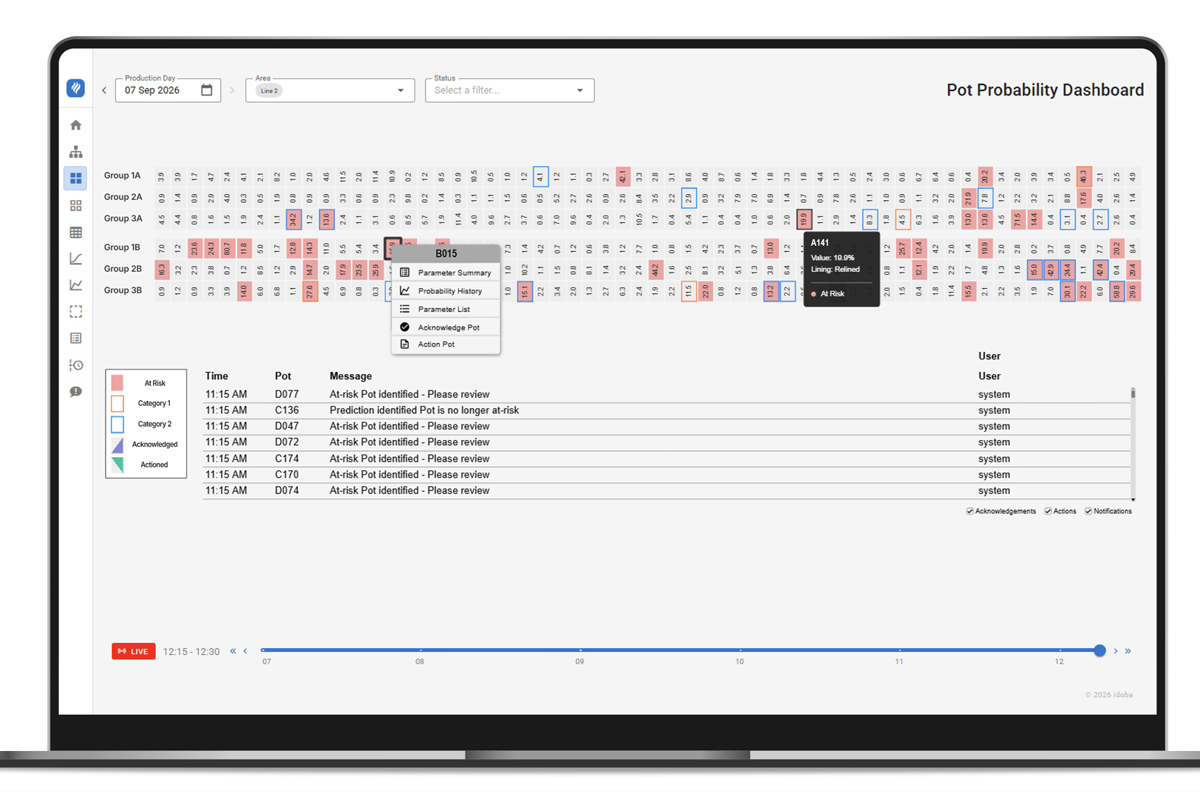
The platform is built around a pot-level digital twin, with separate machine-learning models for cathode and sidewall failure mechanisms. It brings operational and laboratory data together over time, scoring the risk for each pot in near real time so engineers can prioritise investigation.
Rather than requiring smelters to build an entirely new data collection infrastructure, idoba.predict uses information already available at the site. Depending on the deployment, this can include electrical signals, metal and bath chemistry, thermal measurements, soft sensor derivations and other site-specific data. The required inputs and collection frequency are established for each implementation.
The models identify and assess developing patterns beyond individual alarm thresholds. By treating cathode and sidewall deterioration as separate failure modes, the platform can distinguish where the risk lies rather than presenting pot deterioration as one general condition.
The technology’s scope is deliberately narrower, concentrating on a specific failure-related decision that has direct implications for potline performance.
A risk score is not enough. Engineers need to know why.
One of the limitations of predictive systems is that identifying an at-risk asset does not necessarily help an engineer understand what is happening to it. A probability without supporting process information can leave users with another alert to investigate, rather than a clearer basis for action.
idoba.predict addresses this through an interface that connects the overall potline view with individual pot-level information.
Teams can examine how risks are distributed across the operating hierarchy, identify areas where attention is concentrated and compare conditions with previous periods. At the individual pot level, they can rank and filter identified risks according to their failure-mode-specific probabilities.
The platform also allows engineers to examine contributing parameters and review how selected process conditions have changed over a chosen period. Prediction histories and known events can be considered alongside the available operating information.
This makes the investigation more meaningful. Instead of simply being told that a pot is at-risk, engineers can examine the conditions behind the prediction and assess whether they correspond with what they are observing at the site.
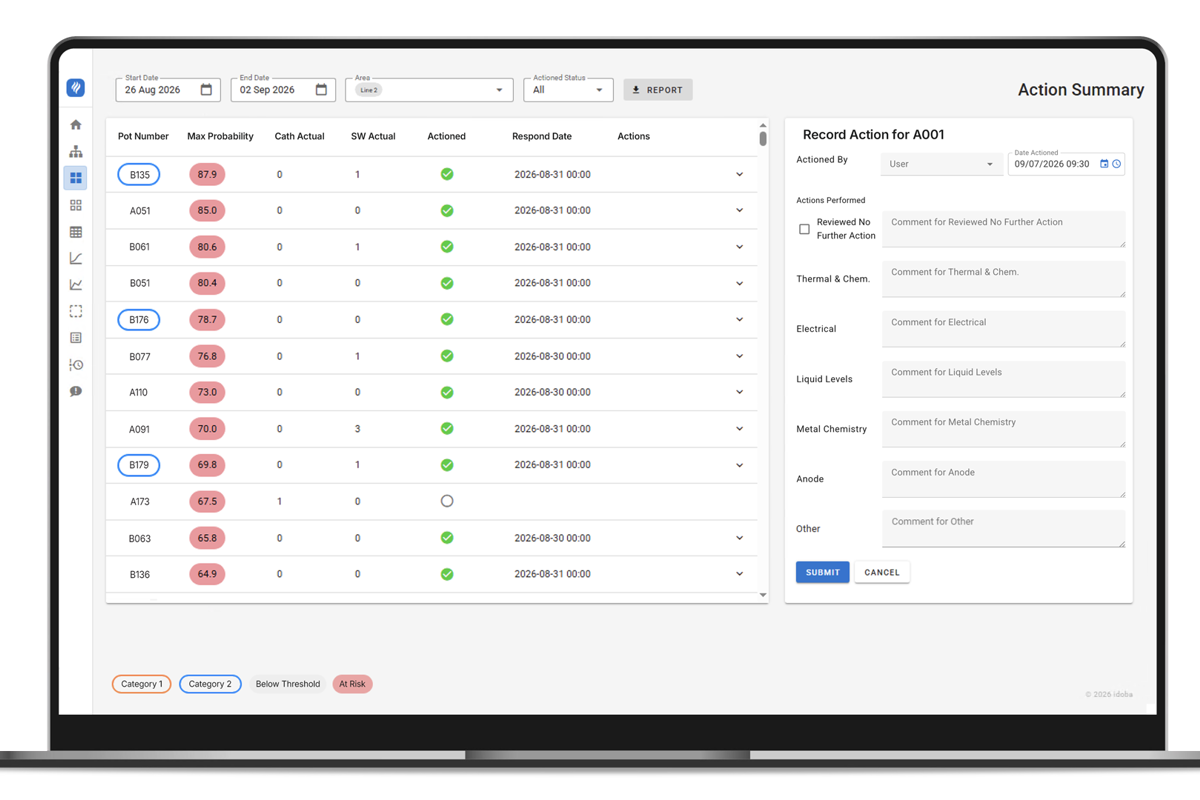
The workflow continues beyond identification. idoba.predict allows teams to acknowledge risks, record investigations and document actions across categories including electrical conditions, liquid levels, metal chemistry and anode-related matters.
The resulting records retain a history of the prediction and the response. Connecting these records with subsequent outcomes also provides a basis for monitoring model performance and informing future model development.
This closed-loop workflow is an essential part of the system's design. A prediction should not disappear once it has been reviewed; the investigation, decision and outcome should be retained so teams can assess whether the system is providing useful intelligence.
Explore primary aluminium suppliers, product listings and trade opportunities on the AL Biz platform
Earlier warnings can change the response to pot deterioration
In potline management, timing can influence the options available to an engineering team.
When cathode or sidewall damage becomes obvious, deterioration may already have progressed. Investigation may become more urgent, intervention planning more difficult and the potential consequences for production and safety more significant.
Earlier visibility widens the response window: the time available to investigate, plan an intervention and protect pot life before damage progresses.
With idoba.predict, the process begins by bringing an individual pot's developing risk to the attention of the engineering team. The affected pot can then be prioritised, its contributing parameters examined and the prediction assessed against actual operating conditions.
The engineers decide whether further investigation is necessary and determine the appropriate response with the potential advantages extending across three areas:
- Pot life and production continuity: Identifying developing damage earlier gives engineers more opportunity to investigate and intervene before deterioration progresses. This supports efforts to protect pot performance and extend pot life.
- Planned rather than urgent intervention: Earlier visibility can provide more time to coordinate a response, reducing the operational and safety exposure associated with emergency intervention.
- Better distribution of engineering attention: Applying failure-specific assessment across every pot in scope helps teams identify where specialist attention is most urgently required, rather than depending entirely on conventional alerts or visible symptoms.
These benefits depend on the quality of the underlying data, the reliability and timing of the predictions, and the ability of the operating team to act on the information. Predictive intelligence cannot guarantee that a failure will be prevented. Its contribution is to give engineers an opportunity to recognise and investigate developing problems while more response options remain available.
Can predictive AI fit within an operating smelter's existing systems?
Any aluminium producer who is considering industrial AI should know that the technical performance of a model is only one part of the evaluation. Data security, operational technology (OT) boundaries and the implications of connecting an external system to existing plant infrastructure are equally important.
A predictive platform must demonstrate that it can work within the operating environment without introducing unnecessary risks to established control systems.
idoba.predict follows a non-invasive deployment approach. It reads operational and laboratory data one way from existing tables, at an agreed cadence, and writes nothing back to the control network, at this time. idoba.predict is control-system agnostic and no new instrumentation is required.
The implementation process begins with a proof of value using the smelter's own historical data, before the system goes live. This allows the technology to be assessed against the site's operating history before a wider deployment is considered. The approach is to establish the initial application, demonstrate the value of the use case and expand based on the evidence.
There is another important consideration, predictive intelligence should not be confused with autonomous operation.
idoba.predict identifies and prioritises developing risks, but the responsibility for interpreting those predictions and deciding on interventions remains with the engineers. They retain control over the operational response.
Along with improving a model's predictive capability, moving towards automation also involves transferring some degree of decision-making authority to technology. Such a step requires evidence, clear governance and confidence in how the system performs under real operating conditions.
For now, the emphasis is on giving engineers earlier, explainable intelligence and a disciplined workflow for action, while keeping operational judgement and control in their hands.
Grow with
AL Circle













_md.webp)
_md.webp)