Top Stories

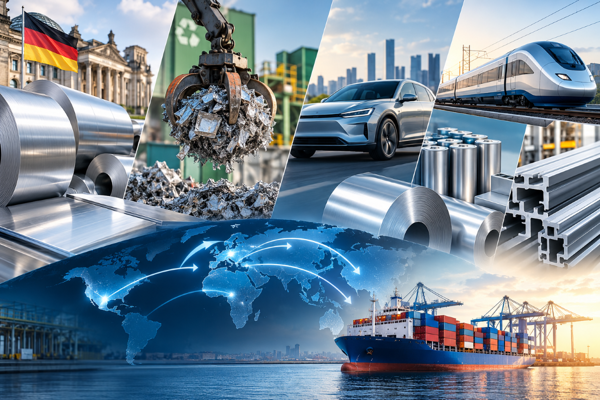
AL Circle analysis: Germany’s aluminium trade surplus, Novelis’ US expansion, Asia’s EV demand & India’s underutilised downstream capacity
Aluminium’s next growth phase is increasingly being shaped by downstream processing, supply-chain resilience and demand from specialised applications. Germany continues to generate a substantial trade surplus in flat-rolled products despite a shrinking primary aluminium base, while North America is investing in recycling and rolling. Across Asia, new manufacturing capabilities and growing demand from electric vehicles, railways and batteries are creating further opportunities. However, declining exports, underutilised capacity and uneven profitability show that investment alone does not guarantee success. For industry leaders, the challenge is to identify where demand is shifting, develop products that meet customer requirements and ensure that new investments translate into sustainable...
AL Circle Analysis: From Guinea to Gulf, how bauxite, tariffs and logistics redraw aluminium map
Aluminium markets in late 2026 are being shaped by more than the headline LME aluminium price. Bauxite security, alumina availability, geopolitical disruptions, tariff negotiations, logistics diversification and regional premiums are increasingly determining where metal moves and what buyers pay. From RUSAL reassessing Caribbean assets and Vedanta securing Odisha bauxite to Brazil extending mine life and EGA rebuilding its Guinea supply chain, producers are strengthening control over critical raw materials. At the same time, the US remains heavily dependent on imported bauxite and alumina, while Europe and Asia are experiencing sharply different premium dynamics. These developments point to a market where physical availability is becoming a regional factor even as aluminium itself remains...
Grow with
AL Circle
Events
Featured News
VIEW MORE
India’s bauxite imports jump 129.5% in H1 2026: Quality gap, refinery expansion outpace 25Mt domestic output
India is producing around 25 million tonnes of bauxite a year, has 4.958 billion tonnes of bauxite resources, and currently produces around 9.5 million tonnes of alumina annually. Yet instead of declining, the country's bauxite imports have been rising. India’s bauxite imports reached 3.70 million tonnes in H1 2026, more than twice the 1.612 million tonnes recorded in H1 2025. The increase of 2.088 million tonnes, or 129.5 per cent, has brought a key question into focus: why are imports rising when domestic bauxite production appears sufficient for current alumina output? The answer becomes clearer when India's bauxite supply is viewed alongside ore quality, refinery requirements, mine development and the rapid expansion of alumina capacity. India’s bauxite production has recovered...
Who’s holding up Germany’s aluminium game? Meet EGA, Hydro and Constellium
Germany does cars, machinery and engineering rather well, and all of that needs a lot of aluminium. So, when three international players put serious money and muscle into the country's aluminium industry, it's worth a look. Together, the three companies offer an interesting snapshot of more recycling, more specialised products, stronger local supply chains and lower-carbon production. Here is who is doing what, and why it matters. EGA: The Gulf giant moving into Hannover Emirates Global Aluminium (EGA) is the world's largest "premium aluminium" producer. It already ships over 600,000 tonnes of primary aluminium to Europe every year, with the automotive and construction industries among its key customers. Then it did something it hadn't done in a decade: it bought a company. That company...
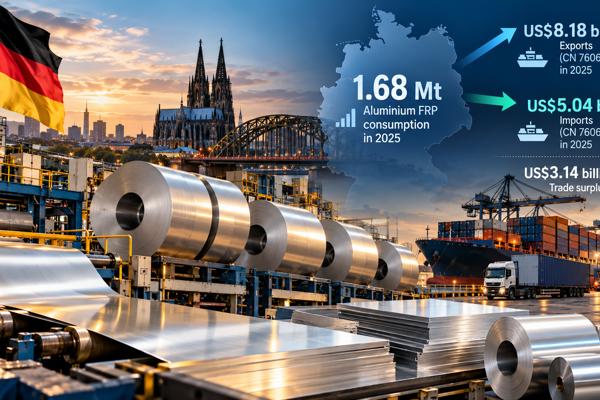
Germany’s aluminium FRP consumption reaches 1.68 Mt as 2025 trade surplus tops $3.1 billion
Germany’s aluminium flat-rolled products (FRP) market is revealing a striking disconnect between its shrinking primary aluminium base and its still substantial downstream manufacturing capacity. Estimated German FRP consumption reached 1.68 million tonnes in 2025, up from approximately 1.66 million tonnes in 2024, even as domestic primary aluminium production had fallen sharply in previous years. The latest trade data add another layer to the picture. Germany’s combined imports of aluminium plates, sheets and strip above 0.2 mm (CN 7606) and aluminium foil of 0.2 mm or less (CN 7607) reached approximately USD 5.04 billion in 2025, while exports climbed to USD 8.18 billion. That left a combined trade surplus of about USD 3.14 billion across the two FRP categories. Germany remains a net...
AL Circle Analysis: Europe’s aluminium scrap curbs, India’s risk and US’s supply opportunity
Aluminium recycling is supposed to be the industry’s easiest win — economic and eco-friendly. Interestingly, this is where the plot thickens. Aluminium recycling is moving from a sustainability objective to a strategic supply-chain issue, with scrap availability, domestic recovery, cross-border waste rules and decarbonisation policy influencing where recycled metal can be produced and consumed. Recent developments across Europe, such as the UK and Greece, in the US and India reveal that investment in recycling is accelerating, but access to suitable scrap and the rules governing its movement are becoming equally important. Join the fourth edition of the webinar "Hedging for recyclers - Become an expert in 6 hours" by Jorge Dyszel. Europe wants more recycled aluminium, but what is the...
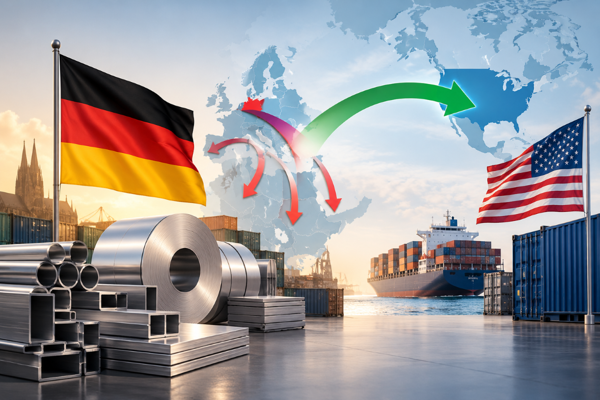
German downstream aluminium exports fall 13% in H1 2026 but US enters top 5 with 228.1% import surge
Germany’s downstream aluminium export map underwent a noticeable shift in H1 2026. Shipments to the world fell, with most of Germany’s traditional European customers taking less aluminium downstream product. Yet, amid that broad retreat, one market moved in the opposite direction: the United States. German downstream aluminium exports to the world fell to 897,773.19 tonnes in H1 2026 from 1 million tonnes in H1 2025, a decline of 13 per cent year on year. The contrast was particularly sharp in the US market. American imports of German downstream aluminium reached 68,061.61 tonnes in H1 2026, up 228.1 per cent from just 20,743.62 tonnes in H1 2025. The increase of more than 47,000 tonnes was enough to push the US into Germany’s top 5 destinations for the first time. The export map is...
Caustic soda plant setup in India: How aluminium growth is reshaping demand, costs and opportunities
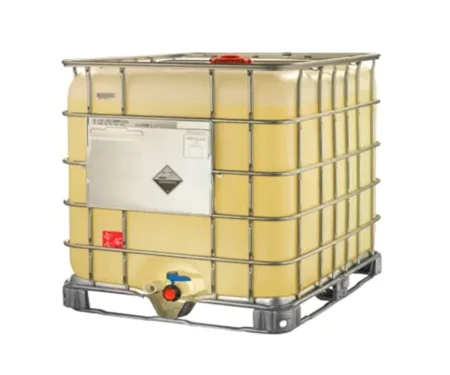
Caustic soda may not be the most visible ingredient in aluminium production, but without it, the journey from bauxite to alumina would look very different. The chemical, also known as sodium hydroxide, is a crucial reagent in the Bayer process, where it helps dissolve alumina-bearing material in bauxite and separate it from impurities. The dissolved material is then processed to recover alumina, which ultimately feeds aluminium production. That makes caustic soda more than just another industrial chemical. Its availability, price and efficient use can influence the economics of alumina refining and, by extension, the wider aluminium value chain. As India expands its alumina and aluminium capacity, the requirement for this chemical is also becoming increasingly important. For companies...












Want to feature your reports and magazines?
Know More
Blog
LATEST POSTS




Turn marketplace visibility into more relevant buyer enquiries.
View Priority Plans
Turn marketplace visibility into more relevant buyer enquiries.
View Priority Plans
