










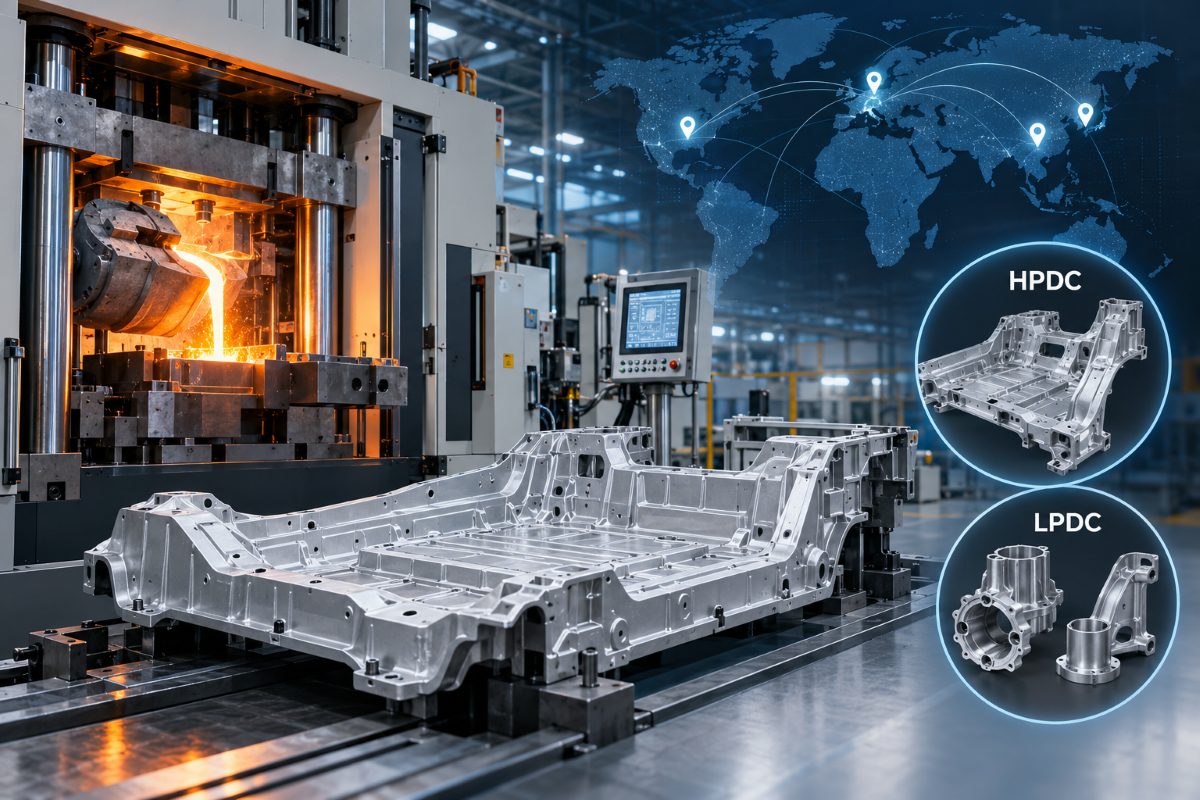

Aluminium die casting is increasingly important for producing lightweight, precise and structurally robust components for automotive and industrial applications. High-pressure die casting (HPDC) and low-pressure die casting (LPDC) serve different production requirements, from high-volume automotive parts to complex structural components.
As demand for lightweight vehicle architectures and integrated castings grows, die casting machine manufacturers are expanding their portfolios with automation, high-vacuum systems, giga casting presses and intelligent process controls.
This article profiles leading HPDC and LPDC machine suppliers worldwide and highlights their key technologies.
Comparing HPDC and LPDC technologies
HPDC and LPDC differ mainly in how molten aluminium enters the mould. In high-pressure die casting, molten metal is injected into a metal die at high speed and pressure, supporting rapid cycles, high-volume production and complex, thin-walled components with good dimensional consistency. HPDC is widely used for automotive structural and powertrain applications.
LPDC uses controlled, lower pressure to push molten metal from a holding furnace into the mould, enabling slower, more controlled filling. The process can support good metallurgical integrity and is commonly used for wheels, engine parts and applications where casting quality and structural soundness are critical.
Top 8 HPDC machine suppliers worldwide
1. Shibaura Machine, Japan
- HPDC machinery: Manufactures small, medium and large aluminium cold-chamber HPDC machines, including the DC-R2 and ultra-high-speed DC-J series.
- Structural casting and control: Offers DEC hybrid machines, DXHV high-vacuum systems and DC-CS Series machines up to the 12,000-metric-ton DC12000GS for single-shot BEV chassis components, supported by TOSCAST-999 and TOSCAST-888 digital management networks.
2. UBE Machinery, Japan
- Cold-chamber solutions: Supplies UB-iS3, UB-iV hybrid and UB-iC toggle HPDC machines.
- Giga casting and process control: Produces two-platen presses from 4,500 to 9,000 metric tons for structural BEV components, with high-vacuum, fast-exhaust shot and squeeze casting technologies.
3. Bihler Group, Switzerland
- Carat and Ecoline series: Offers two-platen Carat HPDC systems up to 92,000 kilonewtons and three-platen Ecoline machines from 3,400 to 8,400 kilonewtons for large structural and high-volume components.
- Evolution series: Provides real-time controlled three-platen HPDC machines from 2,600 to 9,000 kilonewtons for complex technical castings.
4. ItalPresseGauss Srl., Italy
- Toggle and toggle-free HPDC: Offers machines with heavy-forged steel platens and SC 3.0 shot-end technology, alongside compact two-platen systems using a 180-bar hydraulic system and injection speeds up to 12 m/s.
5. Idra Group, Italy
- Cold-chamber solutions: Supplies OL Series toggle presses, eco-friendly X-Press machines and NEO injection technology.
- Giga casting: Manufactures multi-platen Giga Press systems from 5,500 to more than 9,000 metric tons for structural BEV underbody components.
6. Colosio, Italy
- Cold- and hot-chamber machines: Produces NEX, PFO and 2P horizontal cold-chamber machines from 200 to 4,400 tons for aluminium, brass and magnesium, alongside PFZ hot-chamber machines for zinc and magnesium.
7. Yizumi, China
- HPDC platforms: Offers LEAP, HII-S, HII and NEXT² platforms, including closed-loop injection control and two-platen giga casting presses up to 9,000 tonnes for structural EV and industrial applications.
- Automation: Provides turnkey automated foundry workcells and robotic peripherals for molten-metal handling and part extraction.
8. LK Machinery, China
- Giga casting: Its IMPRESS-PLUS series spans 6,000 to 9,000 tons and targets integrated automotive components including EV battery trays, shock absorber towers, subframes and rear underbodies.
- Intelligent production: Provides die-casting units with closed-loop injection control, servo energy-saving systems, automated mould changes and LK-NET network management.
Top 8 LPDC machine suppliers
1. INDUGA GmbH & Co. KG, a Company of OTTO JUNKER GmbH, Germany
- LPDC 2121 Pro: Features an automatic rotary portal, two manipulators and one furnace, with an approximately 40-second cycle time and capacity of about 630 castings per eight-hour shift.
2. ItalPresseGauss S.r.l, Italy
- Automated LPDC solutions: Offers customisable machines and fully automated cells for complex automotive and delicate electrical components, with precise dimensional accuracy, metallurgical integrity and turnkey automation.
3. Kurtz Ersa, Germany
- LPDC portfolio: Its FSC, SC, TC and SR series cover furnace-shuttle, flexible, tiltable-unit and entry-level applications, while variants such as AL28-18-18FSC and AL18-12FSC target higher hydraulic power, clamping area and production efficiency.
4. Isuzu Mfg, Japan
- Intelligent LPDC systems: Commercialises LPDC machines with automated pressurisation controls and intelligent systems designed to improve casting quality while reducing manual intervention.
5. LPM Group, Italy
- Aluminium LPDC lineup: Offers multiple series covering motorcycle rims, high-volume automotive wheels and structural engine blocks, including twin-chamber furnaces and multi-stalk technology.
- Foundry engineering: Its automated LPDC systems use proportional digital cooling, multi-stalk holding furnaces and energy-saving hydraulic inverters to reduce cycle times and scrap rates.
6. CPC Machines, Bulgaria
- Automated LPDC cells: Controls gas pressure in the furnace and mould cavity to produce low-porosity aluminium components, with CPC/LPDC models from 1300 to 3000.
- Thermal control: Provides 12 to 128 independent mould cooling lines and electric holding furnaces with capacities from 500 kg to 1,765 kg.
7. Weltop Machinery, China
- Pressure and process control: Uses automated low-pressure injection from 0.05 to 0.6 MPa, PLC systems and HMI touchscreens to monitor holding pressure, metal flow and solidification.
- Integrated production: Connects holding furnaces, sensors and tooling systems for automated, low-porosity production loops.
8. EMI Foundry Tech, USA
- Automated LPDC centres: Provides enclosed production centres for high-integrity, thin-walled aluminium, with a 75-second dry cycle covering core setting, injection, extraction and mould blow-off.
- High-volume production: Its semi-permanent mould turntables use five casting benches and can produce up to 45 automotive aluminium castings per hour.
Conclusion
The global aluminium die casting equipment landscape is evolving with demand for lightweight components, larger structural castings and increasingly automated production. HPDC suppliers are advancing high-tonnage giga casting, intelligent injection and integrated automation, while LPDC manufacturers are focusing on casting quality, thermal control and production efficiency. For manufacturers assessing equipment and investment opportunities, understanding supplier capabilities alongside broader aluminium casting market trends can provide a stronger basis for evaluating future production requirements.