












The operations of aluminium hot rolling depend on process efficiency, production parameter control and consistent product quality. While factors like material characteristics, rolling speed, equipment performance and temperature require attention, the condition of rolling fluid emulsions can significantly influence mill performance.
Rolling fluid emulsions, traditionally providing lubrication and cooling, played a vital role in aluminium hot rolling. But with the rising demand for better production requirements, management of these fluids became crucial, especially to maintain consistent and reliable mill operations.
However, maintaining emulsion stability over extended operating periods presents several challenges, particularly when microbial activity, fluid degradation and inconsistent monitoring affect fluid performance.
Emulsion degradation affects rolling mill performance
Mixtures of oil and water, emulsions in metal processing operations, create a balance of lubricity, cooling and surface protection. But its operating environment and composition can also generate conditions which are favourable for microbial growth.
How? Water, oil, mild pH levels and warm operating temperatures tend to promote bacteria and fungi. As a result, microbial activity can contribute to emulsion degradation, which further results in fluid instability.
Operational challenges emerging from this may include:
- Reduced fluid life: Deteriorating emulsion conditions can shorten fluid service life, increasing consumption and replacement requirements.
- pH instability: Changes in pH can affect fluid consistency and contribute to corrosion-related concerns.
- Increased additive and biocide consumption: Frequent corrective treatments can increase chemical usage and operational expenditure.
- Biofilm formation and odour issues: Microbial activity can contribute to biofilm accumulation and recurring odour complaints.
- Higher waste disposal costs: Reduced fluid durability can increase the frequency of fluid replacement and associated waste volumes.
At times, these challenges can go beyond just fluid management, as they can influence operations like quality management, resource allocation, and production consistency to keep the rolling mill running effectively.
Shifting to proactive process control from reactive fluid management
Understanding the changing fluid condition during operations and how it is affecting or influencing the overall rolling process is required for effective emulsion management. This is where advances in biotechnology and digital monitoring can offer a different approach.
EMDUR™ biotechnology, developed by Quaker Houghton, is designed to address the emulsion degradation’s underlying mechanisms. This technology aids in disrupting biofilms by using a targeted signal molecule; against microbial attack, it helps to stabilise lubricating molecules and limits acid formation to help maintain pH stability.
Behind this technology lies the aim to improve emulsion durability, support consistent fluid performance and reduce dependence on tank-side additives and biocides. Some of the benefits of this technology include:
- Longer fluid life
- Reduced fluid consumption
- Lower waste volumes
- Consistent lubricity
Fluid management using a digital monitoring process
Useful information about fluid condition can be achieved from periodic testing and manual sampling but may not offer desired visibility for responding proactively to the changing operation parameters. However, this can be achieved by using a digital monitoring process, which addresses these challenges through automated measurement, monitoring and control.
Quaker Houghton’s QH FLUID INTELLIGENCE™ ecosystem combines process fluids, application expertise, equipment and software to support a more integrated approach to fluid and process optimisation.
This ecosystem can include key fluid and process parameters’ real-time measurement, predictive insights derived from historical and real-time data and automated control based on measurement results.
For businesses, this supports reducing downtime, improving manufacturing quality, increasing production efficiency, extending fluid life and having better control over operating costs. Additionally, this moves away from isolated maintenance activities towards a more data-informed approach to process management.
Importance of emulsion management for the aluminium hot rolling professions
With greater focus on improving productivity, controlling operating expenditure and maintaining quality standards, a systematic approach supports production teams to understand the relationship between rolling performance and emulsion condition.
Moreover, it enables producers, in maintenance and reliability terms, to identify the recurring fluid-related challenges and enables quality professionals to have a better understanding of factors influencing surface quality and process consistency. For plant managers and operational leaders, the ability to reduce reactive interventions, extend fluid life and improve production reliability can contribute to more efficient resource utilisation.
Webinar: Advancing emulsions in aluminium hot rolling
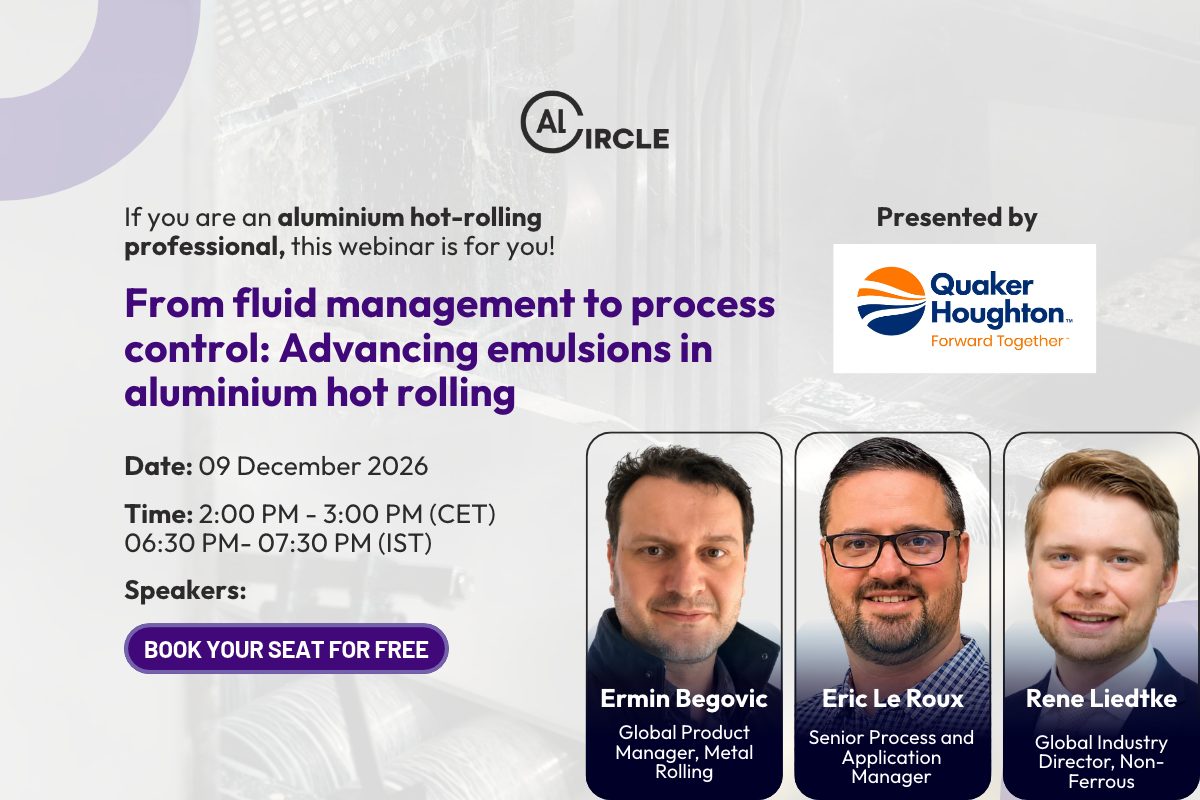
Both technical knowledge and practical process insights are crucial for understanding the relationship between fluid condition and mill performance. To address these challenges and provide a better understanding of these two technologies, AL Circle with Quaker Houghton is hosting a free-to-attend webinar, “From fluid management to process control: Advancing emulsions in aluminium hot rolling”.
The session will feature three industry specialists from Quaker Houghton:
- René Liedtke, the Global Industry Director, Non-Ferrous
- Ermin Begovic, the Global Product Manager, Metal Rolling
- Eric Le Roux, the Senior Process and Application Manager
Webinar details
- Topic: From Fluid Management to Process Control: Advancing Emulsions in Aluminium Hot Rolling
- Date: 9 December 2026
- Time: 6:30 PM – 7:30 PM IST | 2:00 PM – 3:00 PM (CET)
- Participation: Save your seat