










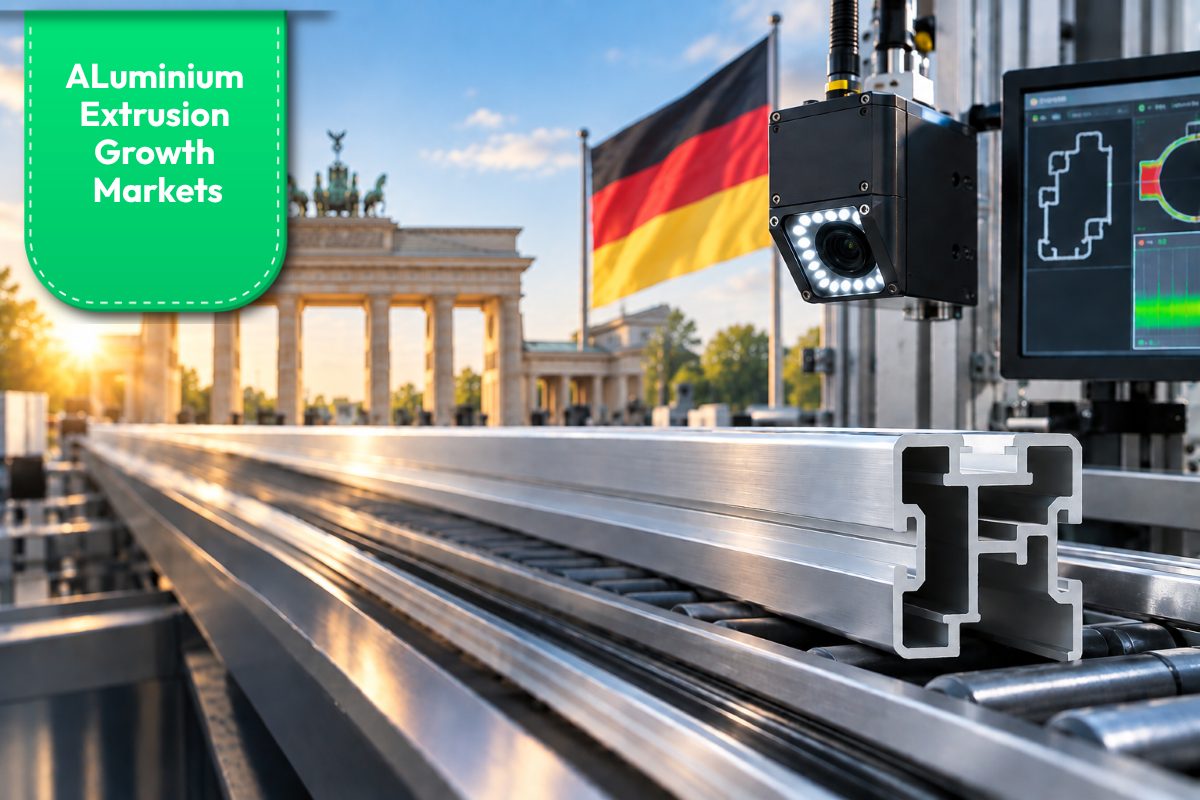
Germany is home to a range of aluminium extrusion technology companies supplying inspection, measurement, coating and surface-treatment solutions that can support aluminium extrusion operations. As aluminium extruders work to deliver increasingly precise profiles with consistent dimensions and high-quality surfaces, the technologies used to monitor and control production are becoming just as important as the extrusion process itself. From detecting a small surface defect as a profile comes off the press to ensuring the right coating performance at the finishing stage, these systems can play a key role in maintaining product quality.
Across Germany, technology providers are addressing these needs in different ways, offering solutions that cover profile measurement, surface inspection, quality monitoring, coating and pretreatment. Some have technologies specifically connected to aluminium extrusion, while others bring capabilities from the broader metals and industrial sectors that can support particular stages of profile production and finishing. Together, they reflect how technology is helping aluminium extruders strengthen quality control and keep pace with the industry’s changing requirements.
Quality control and inspection equipment
1. ASCONA GmbH
ASCONA GmbH supplies quality-control equipment for aluminium extrusion, with systems designed to measure and inspect aluminium profiles. Its optical technologies can identify variations in cross-sectional geometry as well as surface defects during production.
One of its key technologies is promex CT, a computer-tomography-based dimensional measurement system. It is designed to inspect thin-walled, soft, complex and micro-extruded profiles without cutting or other sample preparation. The system offers measurement accuracy of up to ±10 μm, a measuring range of up to 115 mm in diameter and the ability to measure multiple profiles simultaneously. The reported measurement speed is around 150 seconds.
For aluminium extrusion, CT measurement can be useful when conventional sample preparation could alter or deform a delicate profile. It allows the actual profile geometry to be examined, including wall thickness and internal geometry, without mechanically changing the sample.
ASCONA also offers promex CYRUS, an inline surface-inspection system for aluminium profiles. It is designed to detect defects such as blisters, scratches, tears, pickups and stop marks during extrusion. According to an iNOEX release covering ASCONA technology, CYRUS uses AI-based software to categorise surface defects in real time, giving operators information close to the extrusion press.
For extruders, this type of early detection can help identify production problems before large quantities of defective profile are produced. The information can also support process monitoring and traceability by connecting defects with production conditions.
Another system, promex EXPERT, provides dimensional measurement directly on the extrusion line. Depending on the model, it can measure external and internal dimensions, wall thickness, radii, angles, grooves, chambers, cavities and other complex cross-sectional features. Some versions are designed for large aluminium profiles measuring up to 420 × 700 mm.
The system is intended to identify dimensional changes while production is underway. This can help operators respond to issues involving press speed, billet and die conditions, puller settings, cooling or die alignment before the problem results in a larger volume of non-conforming material.
ASCONA’s promex OBJECTIVE product family provides optical dimensional measurement for profiles, including aluminium. It can be used for dimensional checks, cross-sectional measurements and quality verification in laboratory or production environments.
To know about aluminium extrusion equipments click here.
2. PiXARGUS GmbH
PiXARGUS develops inline quality-control systems using optical inspection, image processing and automated evaluation. Its solutions are designed to monitor both profile geometry and surface quality during production.
Its ProfilControl 7 system combines optical sensors, cameras and image-processing algorithms to provide continuous inspection of extruded products. For aluminium extrusion, the system can inspect profile geometry and surface quality throughout production rather than relying only on periodic manual checks.
ProfilControl 7 Surface focuses on surface inspection and can detect defects such as holes, cracks, grooves, scratches, bubbles and other irregularities. The technology is also relevant to reflective aluminium products, including polished and chrome-finished trim profiles, where glare can make conventional optical inspection more difficult.
For applications requiring both checks, ProfilControl 7 DualVision combines surface inspection with dimensional or contour measurement. This allows manufacturers to identify situations where a profile meets dimensional specifications but has a surface defect, or where its appearance is acceptable but its dimensions fall outside tolerance.
PiXARGUS also offers iProfilControl, a compact optical system for automatic dimensional measurement and surface inspection. With up to eight cameras, the system can inspect complex aluminium profiles from multiple viewing angles and identify issues including scratches, bubbles, cracks, grooves, colour deviations and markings.
The company has also developed a hybrid version of ProfilControl 7 that combines surface inspection with 360-degree contour measurement in one sensor unit.
3. iNOEX GmbH
Based in Melle, Germany, iNOEX develops measurement technologies including gravimetric dosing and ultrasonic and radar-based wall-thickness measurement. Its documented connection to aluminium extrusion comes primarily through its role as ASCONA’s exclusive North American distribution and service partner.
Through its US subsidiary, iNOEX, LLC supplies, installs and supports ASCONA’s promex EXPERT dimensional measurement systems for aluminium extruders in the US, Canada and Mexico. The company’s role has been documented at aluminium plants operated by Bonnell Aluminum in Georgia and Tennessee.
For aluminium extrusion plants in North America, this partnership provides access to ASCONA’s profile-measurement technology, along with installation, service and technical support.
iNOEX’s own core technologies are primarily associated with plastic pipe and cable extrusion. Its relevance to aluminium extrusion in the material reviewed therefore comes through its distribution and service relationship with ASCONA, rather than through a dedicated aluminium profile inspection portfolio.
4. Micro-Epsilon
Micro-Epsilon supplies non-contact measurement and inspection technologies for aluminium industries. Its portfolio includes systems for profile, thickness and surface measurement.
The company’s profileGAUGE X.LP-3D is an inline 3D measurement system using four laser scanners to inspect profiles from different angles. It can measure parameters including width, height, wall thickness, angles, radii, depths, gaps, diameters, form and position, as well as deviations from nominal dimensions.
For aluminium extrusion, this type of inspection can help identify dimensional changes associated with die wear, press conditions, cooling, pulling, handling or profile deformation. It is particularly relevant for complex hollow, architectural and industrial sections where a two-dimensional measurement approach may not capture the complete geometry.
Micro-Epsilon also supplies laser profile scanners for non-contact measurement of contours, grooves, seams, gaps, flush alignment and profile surfaces. These scanners can be integrated into inspection frames or measurement systems for aluminium profiles.
The optoCONTROL 2700 is designed to measure the diameter or thickness of continuously extruded products immediately after extrusion. It supports continuous 100 per cent quality inspection for products up to 40 mm in diameter. While the available product information does not specifically identify aluminium as its sole application, it may be relevant to smaller aluminium extrusions, rods and tubes where non-contact measurement is required.
Micro-Epsilon’s publicly available information reviewed here establishes its relevance mainly in dimensional, profile and surface measurement. It does not clearly identify a dedicated system for aluminium-extrusion coating or chemical surface treatment.
5. IMS Messsysteme GmbH
IMS Messsysteme GmbH is a German supplier of industrial measurement and inspection systems for the metals industry. The company’s publicly available information includes applications in aluminium rolling mills, covering areas such as thickness, thickness profile, width, wedge, coating, flatness and surface quality.
IMS’s surcon 2D surface-inspection system is designed to detect surface defects under demanding industrial production conditions. The company has also made the system available for applications in aluminium rolling mills.
The company’s aluminium-related measurement capabilities cover parameters including thickness, thickness profile, width, wedge, coating, flatness and surface quality. These applications are primarily associated with quality monitoring of aluminium sheet, strip and other rolled products.
IMS’s measurement and inspection technologies form part of the broader range of solutions used for aluminium quality assurance, particularly across sheet, strip and rolled-product applications. Some of the measurement principles may also have potential for use with extruded products, depending on the specific inspection requirements and production setup. However, the material reviewed does not specifically identify a dedicated IMS system developed for aluminium extrusion lines.
6. Dr. Schenk GmbH
Dr. Schenk provides automated optical inspection and measurement systems for metals and other materials. Its portfolio includes technologies designed to identify material irregularities and local defects through optical inspection.
EasyInspect is an automated optical surface-inspection solution for detecting material irregularities, local defects and other surface anomalies. EasyMeasure can measure properties such as geometry, surface flatness, deformation and layer thickness.
The company’s metal-inspection systems use MIDA Technology, which employs multiple optical channels along a scan line to inspect material.
These technologies could potentially be used for aluminium products where the geometry and inspection-line configuration are suitable. Possible applications include surface-defect inspection, coated-metal inspection, geometry and deformation measurement, and checks of coating or layer characteristics. However, the material reviewed does not establish a dedicated aluminium-extrusion inspection solution.
7. Polytec GmbH
Polytec, based in Waldbronn, Germany, supplies optical measurement and coating-characterisation technologies. Its wider portfolio includes vibrometry and 3D surface-metrology solutions, although the material reviewed does not identify these technologies as being specifically developed for aluminium extrusion.
A more direct connection to aluminium surface treatment comes through its HAKO measuring stations, which use Enovasense photothermal technology for coating characterisation. These systems can therefore be relevant to aluminium extrusion finishing processes where coating quality needs to be measured.
Surface treatment and coating equipment
8.WAGNER Group
WAGNER Group’s relevance to aluminium extrusion is mainly at the powder-coating stage rather than at the extrusion press or profile-measurement stage. The company supplies powder-coating application systems, powder centres, guns, controls and related equipment.
Its E-Line powder-coating system combines application components within an integrated setup designed to support coating quality, colour changes and process reliability. For aluminium profiles, such equipment can be used for architectural, industrial and protective powder coatings after pretreatment.
WAGNER’s IPS Coating Center is an integrated powder-management system covering powder preparation, feeding, dosing and colour changes. For aluminium extrusion coating lines, this can support more consistent powder delivery, cleaner handling, repeatable coating results and process stability.
The company also supplies powder guns, application controls, booths and material-feed equipment for industrial coating applications. These technologies can be used for aluminium profiles in sectors including windows and doors, façades, transport, industrial enclosures and outdoor structures.
WAGNER has also described an Energy Efficiency Package for powder-coating systems equipped with a monocyclone. In a June 2025 release, the company stated that the package can provide energy savings of up to 40 per cent in relevant powder-coating systems.
The material reviewed, however, relates to powder-coating application and powder management. It does not establish that WAGNER supplies complete aluminium-extrusion lines, chemical pretreatment lines or profile-measurement systems.
9. Eisenmann GmbH
Eisenmann is relevant to aluminium extrusion primarily through its industrial coating and pretreatment technologies. Its portfolio covers industrial painting, powder coating, pretreatment, curing and related environmental and process-control systems.
The company’s technology portfolio includes industrial painting lines, powder-coating systems, pretreatment equipment, curing ovens, environmental systems and cathodic electrocoating technologies. Its recent material also describes the modernisation of a pretreatment and cathodic electrocoating facility, although that specific project concerns automotive axle-carrier production rather than aluminium extrusion.
For aluminium extrusion, the relevant equipment categories include cleaning and chemical pretreatment systems, powder or liquid coating lines, drying and curing ovens, conveyorised handling, exhaust systems and process controls.
Pretreatment is an important part of aluminium finishing because the profile surface can contain oxide layers as well as oil, dirt, lubricant residue and other contaminants from production and handling. Cleaning and conversion treatment can help prepare the surface for subsequent coating and support coating adhesion and durability.
10. AFS Entwicklungs + Vertriebs GmbH
Based in Horgau, Germany, AFS Entwicklungs + Vertriebs GmbH supplies corona and atmospheric plasma surface-treatment systems, with documented applications covering metal sheets and extrusion lines more generally. Its corona treatment systems, including ceramic-electrode configurations, increase surface energy to improve the wettability and adhesion of paint, powder coatings, laminates and adhesives on aluminium surfaces, helping reduce defects such as fish-eyes and poor adhesion.
AFS also offers ALDYNE atmospheric plasma treatment, positioned as an alternative to wet-chemical primers. The system modifies the substrate surface at the nanometre level using controlled process-gas mixtures while leaving the visual appearance unchanged. For aluminium extrusion, this provides an alternative pretreatment route for coating or adhesive bonding without wet-chemical waste streams or energy-intensive drying. The Quick-Test Pen provides a fast, low-cost dyne-level check of treated surface energy, helping coating lines confirm that the corona or plasma treatment has achieved sufficient surface activation before the profile moves to the next process stage.
As aluminium extrusion demands greater precision, consistency and surface quality, advanced inspection, measurement and finishing technologies are becoming increasingly important. The solutions from these German companies support different stages of production, helping extruders monitor profile quality, detect defects and improve surface finishing while meeting changing market requirements.
To know about all aluminium extrsuion products click here.


 Voyagerman Technology


Please share article on various Aluminium components used in EVs and detailed buyer specifications thereof.