










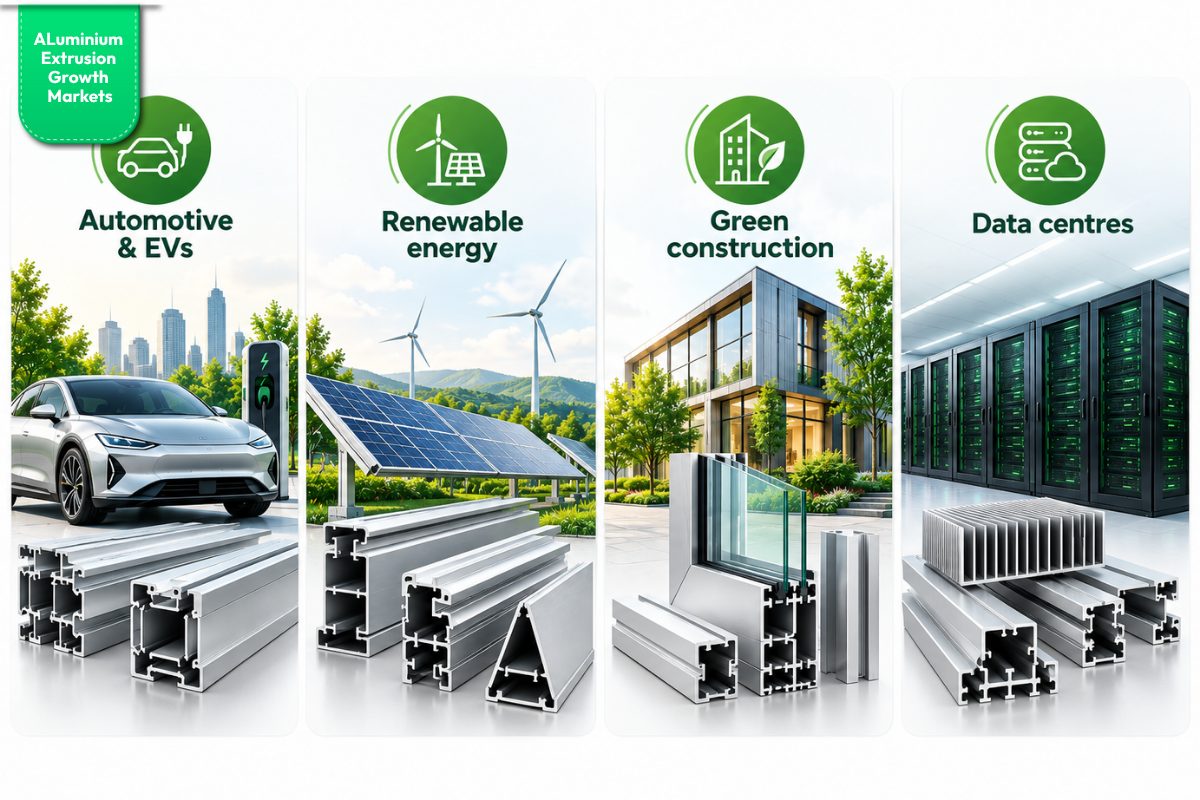

Aluminium extrusion demand is becoming more diversified, with electric vehicles (EVs), renewable energy, data centres and sustainable construction creating new applications alongside established markets. As vehicle architectures evolve, solar infrastructure expands and buildings and digital facilities demand greater energy efficiency, aluminium extrusions are finding opportunities across a wider range of structural, thermal and engineered applications.
According to AL Circle’s latest report, “The World of Aluminium Extrusions to 2035”, four structural growth areas stand out as important sources of modern-day aluminium extrusion demand: automotive lightweighting and the EV transition, renewable energy infrastructure, decarbonised architecture and thermal efficiency, and data centre infrastructure.
Automotive lightweighting & the EV transition
The automotive sector is opening a larger addressable market for aluminium extrusions as vehicle architectures evolve towards lightweight and electrified platforms. EV platforms can consume up to 2–3 times more extrusions than internal combustion engine vehicles, particularly in battery trays, spaceframes and structural rockers, where high-strength 6xxx-series alloys are increasingly relevant.
The wider transportation segment reflects this shift. As per the AL Circle’s research, aluminium extrusion usage in this segment is forecast to increase at a 3.58% CAGR, adding 2.75 million tonnes of demand from 2025 to 2035. For manufacturers, the opportunity is increasingly tied to automotive-grade alloys, tighter tolerances, complex structural geometries and advanced fabrication, rather than conventional profile supply alone.
Renewable energy infrastructure
Renewable energy infrastructure is creating new application opportunities for aluminium extrusions, particularly as solar deployment expands across global markets. Photovoltaic racking and solar mounting frames are identified as some of the fastest-growing end-use applications for structural hollow aluminium profiles, while wind power, grid infrastructure, battery energy storage systems and green hydrogen also contribute to future extrusion demand.
The regional outlook provides further context. Aluminium extrusion usage in the Rest of Asia-Pacific (ROAP) is forecast to grow at a 4.32% CAGR from 2025 to 2035, with localised EV and solar mounting profile manufacturing supporting regional demand. For manufacturers, this creates opportunities in structural profiles designed for solar, power and other renewable energy applications.
Green construction & thermal efficiency
Building and construction remains the largest demand centre for aluminium extrusions, accounting for 54.8% of global extrusion usage in 2025. However, the market is increasingly moving towards higher-performance applications as green building standards place greater emphasis on energy efficiency and thermal performance.
Aluminium extrusion usage in building and construction is forecast to reach 21.84 million tonnes by 2035, up from 19.31 million tonnes in 2025, representing a 1.24% CAGR. Demand is expected to remain centred on windows, doors, façades and curtain walls, while thermally broken profiles, complex architectural systems and structural applications create opportunities for higher-value extrusion products.
Data centres & digital infrastructure
Data centre expansion is creating a distinct growth avenue for aluminium extrusions as AI and high-performance computing increase infrastructure and cooling requirements. Extruded aluminium is used across server racks, structural frames, heat sinks, cold plates, liquid-cooling channels and power distribution systems, while the renewable energy and grid infrastructure required to power these facilities creates an additional demand channel.
The report identifies data centres and AI computing infrastructure as among the fastest-growing structural catalysts for precision aluminium extrusions. For manufacturers, this translates into opportunities for 6000-series structural profiles, high-purity thermal profiles, tight-tolerance geometries and precision-machined extrusions, particularly across North America, Europe, China and the Middle East.
Conclusion
Aluminium extrusion demand is set to become more diversified through 2035, with automotive lightweighting, renewable energy infrastructure, green construction and data centres creating new avenues for growth alongside established applications. The shift towards EVs, renewable power, energy-efficient buildings and digital infrastructure is also increasing demand for extrusion products with greater strength, precision, thermal efficiency and design flexibility.
According to the AL Circle’s latest report, global aluminium extrusion usage is forecast to rise from 35.25 million tonnes in 2025 to 44.22 million tonnes by 2035, at a CAGR of 2.29%. For producers and suppliers, this growth points towards greater alignment between extrusion capabilities and the technical requirements of evolving end-use sectors.