




When an extrusion plant runs short of capacity, the first instinct is to buy another press. A good one, expensive, with every process automated. It looks like the obvious step. Take a hypothetical example: the old press produces 5 tonnes a shift; a new one could produce 9, and there are steady orders for those 9 tonnes. The decision seems clear-cut: find the money for a new press, because the customers are there and ready to buy.
The market backs this up. MarketsandMarkets estimates that the GCC aluminium extrusion market will grow from USD 7.4 billion in 2025 to USD 10.2 billion by 2030, at 6.7% a year [1].
A new press makes sense when the existing presses are working at their limit. That happens less often than it seems. If a plant buys a press before it has used the reserves of the equipment it already has, the cost per tonne of profile goes up and profit goes down: on top of the old losses, the plant now carries the payback on new equipment – for several years at best. That is with its own money. With borrowed capital, and with today’s economic and geopolitical uncertainty, the risk is many times higher.
So how can a plant grow output to meet existing demand without driving up its cost of production? In my experience, there is always a way. Let us look at where it lies.
Where the extra output is hiding
Over 20 years in industrial companies, I have narrowed the factors that hold back output to three: equipment, technology and production processes, and people. One could add financing, order intake, supply of raw materials – the list is endless. Here I deal only with the production side.
Equipment
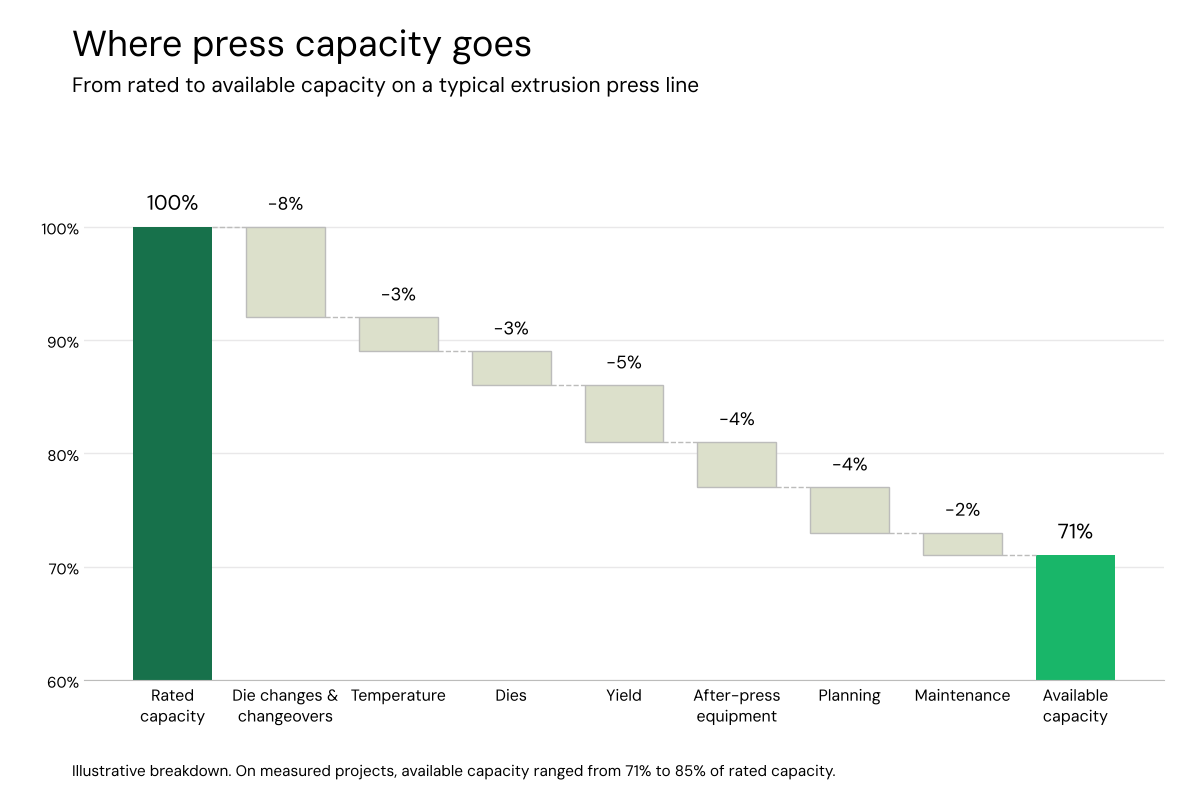
The rated capacity of a press is the maximum it can deliver according to its specification: extrusion speed multiplied by calendar time. Available capacity is what the press actually delivers once technology, scrap, downtime and everything else are taken into account. You measure it in profile that reaches the warehouse, ready to ship to the customer. On the projects where I carried out measurements, the gap between rated and available capacity ran to tens of per cent.
Losses on a press line fall into seven groups:
· Die changes and changeovers. In plants with a wide product range and small orders, the press waits for the next die many times a shift: the die is not at the press, it is not preheated, it has not passed its trial, it has gone back for correction, or it is being swapped for another profile. Each pause costs minutes; over a shift, hours.
· Temperature. The billet is underheated or overheated, the container or die is out of range – the press stops, or runs slower to avoid scrap.
· Dies. A die that produces scrap from the first metres costs press time, metal and the schedule.
· Yield. Butt ends, head and tail cuts, dimensional and surface defects. The metal has gone through the press, the energy and time have been spent, and it never reaches the warehouse.
· Equipment after the press. The press often runs slower than it could because the puller, stretcher, saw, ageing oven or packing line cannot keep up.
· Planning. An order sequence that keeps switching alloy, section and die eats more time than any breakdown. It is the cheapest loss to fix and the most underestimated.
· Maintenance. Downtime from the moment a breakdown request is raised to the start of work and the close-out of the request, plus missing or unfulfilled planned preventive maintenance schedules.
Add these seven groups together, and the typical picture looks like this: a press that is fully loaded on paper delivers good profile at only 71–85% of its rated capacity. That is its available capacity. The 15–30% gap is capacity you have already paid for but are not using.
Technology and production processes
By technology I mean not only the extrusion process itself, stage by stage, but also how well the production processes around it are organised. If the die store is closed on the night shift, there is nowhere to return a faulty die and nowhere to collect a good one – and the press stands idle all night. If quality control sits only at packing, while wall thickness and tolerances at the press are checked by eye, the customer will always have problems accepting your profile. There are dozens of such ifs.
A production chain runs at the speed of its weakest link. On one of my projects, an audit showed that some machines in the chain effectively went on holiday with their operators. Three people ran one operation; when one went on leave and nobody covered, the capacity of that link dropped by a third. Output of the whole chain dropped with it, and delivery dates to the customer slipped.
Another important factor is whether lean manufacturing tools are built into the production and technological processes. On the projects where I carried out measurements, a before-and-after comparison showed that time losses before these tools were introduced were 8–10% higher than after the project was completed.
People
Many times I have seen investors, shareholders and plant directors baffled. They bought expensive equipment that was supposed to solve every problem and make them industry leaders, yet the numbers are dismal. Downtime has stayed, scrap has stayed or even grown, and productivity has not improved. What went wrong?
Once you get inside the plant and analyse the figures, the picture is usually the same. The shine of new equipment kept management from seeing what mattered: staff turnover, a shortage of skills, and people with little stake in the results of their work.
A press operator or a caster does not care what the new press or casting furnace cost. What matters to him is what he will be held accountable for during the shift and how much he will earn. And that has to be transparent: three taps on a calculator, and he knows what he earned that shift.
One approach that works is to combine an hourly wage with a crew bonus for the quantity and quality of output per shift. It needs no extra payroll budget: the bonus is funded from the scrap losses the plant already absorbs every year. The plant would cut the cost of scrap, missed shipments and customer quality complaints, and the workforce would earn a bonus for controlling its own quality.
How to release spare capacity in 3–6 months
This is the sequence I have applied at operations with thousands of employees in metals, mining and engineering. On a press line, it looks like this.
· Two weeks of honest measurement. For each press, record every stop and every slowdown with its cause – from the shop floor, not from summary reports. The result is the available capacity of each press and a ranking of losses by size.
· Attack the biggest loss. Usually it is die changes. Split the work into what can only be done with the press stopped and what can be done in advance: preparation, preheating, trials, delivering the next die to the press before the current order ends. Changeover downtime falls several times over without any investment in equipment.
· The die shop works for the press. A readiness rule: the die for the next order is prepared and checked one shift before the order starts. Die failures are analysed by cause.
· Plan by product family. Group orders by alloy, section and temperature regime so that the press moves from one order to the next with minimal changeover. This is done in the existing planning system, with no new software.
· Relieve the bottleneck after the press. If the press is waiting for the saw or the ageing oven, strengthen exactly that point: the schedule, an extra shift on that section, a small modification. It costs orders of magnitude less than a new press.
· Shift handover. 15–30 minutes before the shift starts, both crews meet in a dedicated room. The outgoing crew leader briefs the incoming one: what scrap there was during the shift and why, which repairs are unfinished and carry over to the next shift, how far the shift fell behind its target – and who exactly did not do what. By this point the outgoing shift already knows how much quality bonus it has earned, and this is announced in front of both crews. Without a proper handover, the plant will be back where it started within six months.
The main cost of these steps is not equipment but well-organised production processes. Every percentage point released on an existing press pays off immediately – with no commissioning and no risk that a new press reaches its design capacity later than promised.
Five questions for the plant owner
Tools for growing output without new capital investment exist, and they work. To find out whether your plant has idle capacity, it is enough to ask your production director five questions:
1. What was the available capacity of each press last month – good profile against rated capacity, not hours of loading?
2. On average, how many minutes does the press stand during a die change, and how many die changes are there per day?
3. What is the yield on each press, and what are the three biggest causes of scrap?
4. Which equipment after the press limits its speed?
5. Who in the plant is responsible for the losses of the press as a whole – not just their own part of them?
If there are no quick and precise answers, the plant almost certainly has spare capacity. And before signing a contract for a new press, it is worth putting that capacity to work.
References
[1] MarketsandMarkets, GCC Countries Aluminum Extrusion Market (2025–2030). https://www.marketsandmarkets.com/Market-Reports/geography/aluminum-extrusion-market/GCC-Countries
Note: The research, data, analysis and opinions expressed in this article are solely those of the author, Dmitry Miroshnichenko. AL Circle has published the contribution without altering its core data or findings. The views expressed do not necessarily reflect those of AL Circle, which assumes no responsibility for the accuracy, completeness or interpretations of the information presented.