




A verified aluminium supplier is one whose identity, factory and product quality you have checked with proof. A claim on a website is not proof. Buying aluminium from another country adds risk. You pay across borders and you cannot walk the factory floor.
Rules also change fast. China ended its export tax rebate for aluminium products in December 2024. The EU now charges a carbon cost on imported aluminium. The US asks where the metal was smelted. A supplier who looks fine today can become a problem next quarter.
This guide shows you how to check a supplier step by step. You will find country-wise checks, a product-wise breakdown, and a checklist for both international and domestic buyers. You will also see how AL Circle helps buyers and sellers verify each other and trade with support and how you can even opt for market intelligence customized for your business requirements.
Why you need a verified aluminium supplier
Most bad deals start the same way. The price looks good, the papers look fine, and nobody checks.
Here are the risks that show up most:
- Fake or cloned identities: The Bureau of International Recycling has warned that scam offers often use the names of real traders whose identities were cloned.
- Forged documents: Mill certificates, inspection reports and bills of lading can all be faked.
- Wrong quality: You order 6063 and get something close. Close is not good enough for an extrusion order.
- Sanctions and origin problems: Metal of Russian origin now faces bans or heavy duties in several markets. A supplier may hide where the metal came from.
- Carbon and tariff costs: EU importers now carry CBAM costs. US importers pay duty based on where the aluminium was smelted and cast.
- Middlemen with no stock: Some sellers have no metal and no mandate from the mill. They hope to buy after you pay.
So verification is not paperwork for its own sake. It protects your cash, your schedule and your customers.
Seller verification, seller mandate and buyer mandate: Here’s what they mean
These terms come up often in aluminium trade. Here is what each one means:
| Term | Meaning | Why it matters |
| Seller verification | Checking that a seller is a real company with a real factory or stock | It filters out shell firms and cloned identities |
| Verified aluminium seller | A seller who has passed those checks and can show documents | You deal with a known business, not a name on a screen |
| Seller mandate | A written authority that lets a person or firm sell on behalf of a mill or owner | It proves a trader or agent can really offer the metal |
| Buyer mandate | A written authority that lets a person or firm buy or source on behalf of a buyer | It shows the agent speaks for a real buyer with real demand |
A mandate matters most when a chain of traders sits between you and the mill. Ask for the mandate letter. Then call the mill or owner and confirm it.
Buyers need checking too. A seller who ships on credit wants to know the buyer can pay. So seller verification and buyer checks go hand in hand. Both sides gain when both are verified.
How to verify an overseas aluminium supplier, country by country
By value, the top aluminium exporters in 2025 were Russia, the UAE, Canada, Malaysia, India, Norway, Australia and Bahrain. China is the largest producer, at about 43 million tonnes a year. It also leads in semis such as sheet, foil and extrusions.
Every country has its own company register and its own rules. Start with the register. Then add the extra checks for that country.
Supplier-side checks by exporting country
| Country | Main exports (2025) | Check the company on | Extra checks |
| Russia | Primary metal, alloys | Russian state company register | Screen the company, owners, smelter and metal origin against EU, UK and US sanctions lists before any talks |
| UAE | Primary metal, billets, alloys, extrusions | Trade licence from the emirate’s economic department | EGA holds ASI Performance Standard and Chain of Custody certificates. Ask any UAE seller which smelter made the metal |
| Canada | Primary metal, billets, wire rod | Federal or provincial business registry | Most smelters sit in Quebec. Ask for the smelter name and the lot certificate |
| Malaysia | Primary metal, extrusions | Companies Commission of Malaysia (SSM) record | Ask where the metal or foil came from. Several anti-dumping and anti-circumvention cases involve Malaysian goods |
| India | Primary metal, wire rod, extrusions, foil | Import Export Code (IEC) from DGFT, GST number, MCA company record | Goods made only for export are exempt from BIS marking. Still ask for the licence if you resell in India |
| Norway | Primary metal, foundry alloys, billets | Brønnøysund Register Centre | Ask for carbon footprint data. Norsk Hydro and Alcoa Norway are the two primary producers |
| Australia | Primary metal | Australian Business Register (ABN Lookup) | Smelters include Tomago and Boyne Island. Ask for the smelter name on every lot |
| Bahrain | Primary metal, billets, wire rod, cable | Commercial registration with the Ministry of Industry and Commerce | Alba is the largest single-site smelter. Gulf shipping has been hit in 2026, so check the route and the force majeure clause |
| China | Sheet, foil, extrusions, wire, cable | Business licence with the 18-digit unified social credit code, checked on the national enterprise credit system | The export tax rebate ended on 1 December 2024. A very low price needs an explanation. Match the exporter on the invoice to the factory on the certificate |
| Indonesia and Vietnam | Extrusions, foil | Business registration (NIB in Indonesia, enterprise certificate in Vietnam) | India has opened an anti-dumping probe into extrusions from China, Malaysia, Vietnam and Thailand. Ask for proof of metal origin |
Registers change names and rules. Always open the official site and confirm the details yourself.
Destination rules that change what you must ask for
Where your metal lands matters as much as where it starts. These rules decide which documents you need from the supplier.
| Destination or topic | What applies | Ask your supplier for |
| EU (CBAM) | Since 1 January 2026, importers above 50 tonnes a year need authorised CBAM declarant status | Verified emissions data for each product |
| Russian-origin metal | The EU allows only a small quota in 2026 and bans Russian aluminium fully from 31 December 2026. The LME also limits warranting. The US charges 200% on Russian-origin aluminium | Smelter name, country of smelt and cast, ownership details |
| United States | Section 232 duty now applies to the full customs value, with 50% on many aluminium products and 25% on others. Rates for UK and US metal are lower | Country of smelt and cast, backed by a certificate |
| India | The Aluminium QCO 2026 makes the BIS Standard Mark mandatory for 17 product categories sold in India | BIS licence number for each product |
| China (scrap imports) | Recycled cast aluminium must meet GB/T 38472 | Assay report and a pre-shipment inspection |
Duty rates have changed several times in 2026. Check the current rate with a customs broker before you sign. This guide is not legal advice.
Product-wise checks for a verified aluminium supplier
The right proof depends on what you buy. A smelter sells ingots. A mill sells coils. An extruder sells profiles. Ask for the proof that fits the product.
| Product | Where it mostly comes from | Ask for | Common traps |
| Primary aluminium (P1020 ingot, T-bar, sow) | UAE, Canada, Bahrain, Norway, Australia, India, Malaysia. Russia, where the law allows | Smelter name, lot analysis certificate, country of smelt and cast. ASI certificate if you need responsible sourcing | A trader posing as a smelter. Metal of hidden origin |
| Billets and foundry alloys | Norway, UAE, Bahrain, India, Malaysia | Alloy grade, chemistry report, homogenising report, dimensions, lot traceability | Wrong grade. Missing heat treatment |
| Extrusion profiles | China, Malaysia, Vietnam, India | Alloy and temper, tolerance report, coating or anodising thickness, test report | Origin shifted through a third country to avoid duty |
| Sheet, plate and coil | China, India, Europe | EN 10204 3.1 mill test certificate, thickness tolerance, mill name | Forged certificates. A trader’s name on a mill’s papers |
| Foil | China, Europe, India | Thickness, pinhole and temper data, food or pharma grade proof | Wrong gauge. Pharma foil without a BIS licence for India |
| Wire rod, wire and cable | Canada, India, Malaysia, Norway, Bahrain, Netherlands | Conductivity test, tensile test, mill certificate | Low conductivity sold as EC grade |
| Scrap and recycled metal | Many sources. India is a top scrap importer | Written grade spec, sample assay, pre-shipment inspection | Cargo that does not exist. Wrong grade. Cloned trader names |
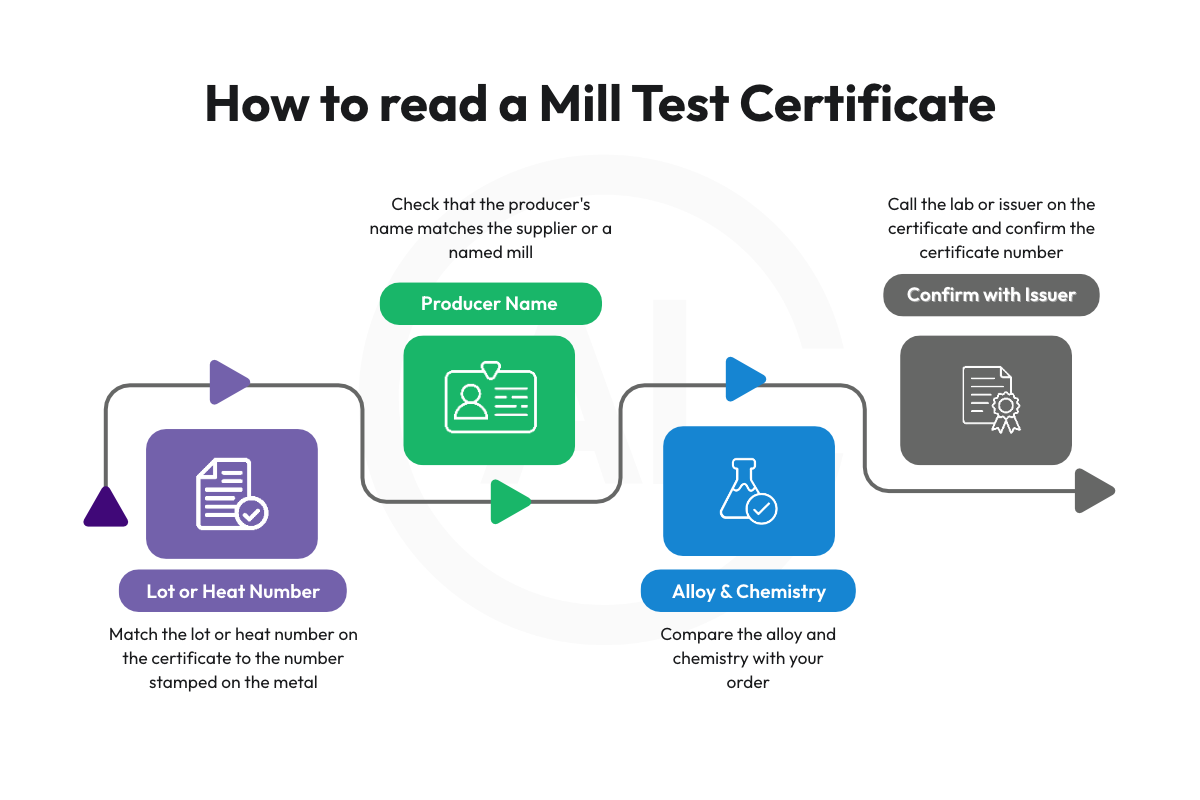
Check out our full guide on how to read a mill test certificate.
Checklist for international buyers: confirm your verified aluminium supplier
Use this list before you send a deposit. Tick each item. If you cannot tick one, pause the deal.
1. Identity
- Find the company in the official register of its country and note the registration number.
- Match the name, address and owners with the contract, invoice and bank account.
- Look up the website’s age and domain owner. A new site with big promises is a warning.
- Ask for two buyer references. Then call them using numbers you found yourself.
2. Capability
- Ask whether the supplier is a producer, a processor, a trader or an agent.
- Request photos or a live video tour of the plant and the stock.
- Visit in person, or hire an inspector to visit for you.
- Confirm the production capacity fits your order size.
3. Mandate and ownership of the metal
- Where the seller is a trader, ask for a seller mandate from the mill or owner.
- Call the mill and confirm the mandate and the stock.
- If you use an agent, give a written buyer mandate that states volume, price limit and terms.
4. Quality proof
- Get a mill test certificate that matches your alloy and temper.
- Confirm the certificate with the lab or issuer.
- Order a sample, and test it at an independent lab.
- Ask for ASI, ISO 9001 or other certificates, then confirm them on the issuer’s website. The ASI member pages list certified companies.
5. Compliance
- Screen the supplier, its owners and the metal origin against sanctions lists.
- Ask for the country of smelt and cast.
- Get carbon data if you import into the EU.
- Check anti-dumping and import licence rules for your product.
6. Money and shipping
- Pay only to a bank account in the company’s own name and country.
- Call the supplier on a known number before you change any bank details.
- Prefer a letter of credit, an escrow service or staged payments over full advance payment.
- Book third-party inspection before shipment, and agree to Incoterms in writing.
- Check the bill of lading with the shipping line.
Checklist for domestic buyers: seller verification close to home
Buying from a local seller feels safer. But many local sellers resell imported metal. So you still need to know where the metal started. Here is what to check.
- Look up the seller’s tax number, such as GST or VAT, and confirm it on the government portal.
- Visit the yard or warehouse. See the stock with your own eyes.
- Ask for the supplier’s own purchase papers, such as the import entry, the mill invoice or the dealer agreement.
- Trace the lot back to the mill or smelter. Then confirm the lot with that mill.
- Match the stock on site to the lot number on the certificate.
- Check any mandatory local quality mark. In India, for example, 17 product categories need a BIS licence.
- Speak to two recent local buyers.
- Start with a small trial order before a large one.
- Keep every document. You may need them for a claim.
A delayed aluminium shipment can disrupt an entire manufacturing schedule. Check out this guide on how manufacturers, procurement heads and importers can manage urgent aluminium sourcing.
Quick comparison: international and domestic checks
| Check | International buyer | Domestic buyer |
| Company proof | Foreign register, trade licence, bank check | Local register, tax portal, bank check |
| Site proof | Video tour or paid inspector | Own visit |
| Metal origin | Country of smelt and cast, sanctions screen | Import or mill papers |
| Quality proof | Certificate, lab test, pre-shipment inspection | Certificate, lab test, stock check |
| Money risk | Higher. Use letters of credit or escrow | Lower. Still avoid full advance payment |
| Law and tax | Duties, carbon costs, import rules | Local quality marks, tax rules |
Red flags that a supplier is not verified
No single sign proves fraud. But several together should stop you. Watch for these.
| Red flag | What to do |
| Price far below the market, with no reason | Compare with the LME price and local premiums. Ask why |
| Pressure to pay fast or pay in full up front | Slow down. Offer a letter of credit or staged payment |
| Seller will not allow a visit, a video call or a sample | Walk away |
| Certificates with no lab contact, or typos and mismatched numbers | Confirm with the issuer |
| Company registered in the last 12 months with large stock claims | Ask for proof of stock and past shipments |
| Bank account in a different name or country | Do not pay. Ask for a written reason, and confirm by phone |
| Email domain differs slightly from the real company | Check the domain. Call a known number |
| Seller cannot name the mill or smelter | Ask for the seller mandate. Confirm with the mill |
| Documents reused under different company names | Report it. The BIR and the ICC International Maritime Bureau share such cases |
Smart safeguards before you pay
Use more than one safeguard.
- First, split the payment into stages that follow real events, such as a passed inspection.
- Second, use an independent inspector at the loading port.
- Third, check the bill of lading with the carrier.
- Fourth, insure the cargo.
- Finally, put the metal specification, tolerances and claim process into the contract.
If something looks wrong, stop and ask. A good supplier will not mind your questions.
How AL Circle helps you find a verified aluminium seller
AL Biz is the B2B marketplace and trade platform from AL Circle. It covers the aluminium value chain, from primary metal to scrap. It checks both sides of a deal, so buyers and sellers meet with more trust.
For sellers: earn the Verified Seller badge
Seller verification on our B2B marketplace is simple. Here is how it works.
- Create a verified online presence for your business. You pick your business type, such as producer, manufacturer, trader, distributor, recycler, service provider or equipment supplier. You also pick your product category.
- Add a brochure and product images.
- Submit your business documents.
- Once approved, your page carries the AL Verified Seller badge.
- Your products then get a higher position in listings, and you get a seller dashboard for leads and reports.
A verified aluminium seller gains more than a badge. Buyers around the world can see a real company with real documents. That shortens the first round of questions.
For buyers: structured checks before the first offer
Buyers go through structured KYC and document checks on our B2B marketplace supplier listings. Supplier offers are also screened before they reach you. So you start from a shortlist, not a cold search.
Still, no platform replaces your own checks. Use the AL Verified badge as a strong first filter. Then run the checklist in this guide on the shortlisted suppliers.
You can also post your request for quote (RFQ) for free on our marketplace and match with reliable suppliers. Watch this video to learn how to post an RFQ on the marketplace.
What to look for on a seller’s profile
- The Verified Seller badge
- The business type: producer, trader or recycler
- Product range that matches your need
- Brochure and product images that look like a real operation
- Answers to your questions about mills, certificates and lots
Trade assistance across the aluminium value chain
Verification is step one. You still need to negotiate, inspect and ship. Our Assisted Aluminium Trade is a managed service that handles this for you.
It works like a buyer mandate or a seller mandate. You ask our in-house trade experts to act for you.
- For buyers, this acts as a procurement partner and finds suppliers that fit your quality, price and compliance needs.
- And for sellers, it acts as a marketing and sales partner and connects you with genuine buyer enquiries. If you need help with feasibility studies, analysis & benchmarking for board-level decisions, you can opt for our custom research and market intelligence.
Some of our active business leads for buyers and sellers:
- Buy ADC12 ingots from United Arab Emirates
- Seller from UAE offering aluminium alloy ingot AK5M2
- Sell silicon metal grade 553, with a specified size of 10–50/60 mm
- Offering aluminium shredded TT scrap with 3% – 5% attachment
How an assisted deal runs
- You post a request for quotation (RFQ) with your specification, quantity, destination and terms. Our team reviews it first.
- We match the request with suppliers and find more local and global options.
- Suppliers send offers. Our team screens them.
- In some cases, we also negotiate between the two parties.
- Contracts and purchase orders are finalised.
- Our team oversees the production, inspections and shipment readiness.
- Shipments are tracked to the destination, and both sides get updates.
- After delivery, our team handles quality feedback, claims and follow-up.
Who it serves along the value chain
The most active segments are flat rolled products (FRP), extrusion, consumables and scrap. The service covers the full aluminium value chain.
| Value chain stage | What buyers get | What sellers get |
| Primary metal and alloys | Screened suppliers matched to your specification | Access to buyers with real demand |
| Flat rolled and foil | Mills and converters that match the spec | Genuine enquiries from converters and packagers |
| Extrusions | Extruders matched to profile, finish and volume | Genuine enquiries from fabricators and builders |
| Consumables | Suppliers of plant and process inputs | Buyers across plants and workshops |
| Scrap and recycling | Screened sources, with inspections managed through the deal | Recyclers reach verified buyers |
Both verified buyers and verified sellers benefit. Buyers cut the time spent on checks. Sellers spend less time on weak leads.
Check out this case study on how our marketplace handles assisted trade across the value chain globally.
FAQs on finding a verified aluminium supplier
How do I know a supplier is real?
Find the company in its country’s official register. Match the name, address and bank account to your contract. Then see the plant or stock through a visit, a video tour or a paid inspector.
What is a seller mandate?
A seller mandate is a written authority that lets a trader or agent sell metal for a mill or owner. Ask for it, and confirm it with the mill.
What is a buyer mandate?
A buyer mandate is a written authority that lets an agent source or buy for a buyer. It should state the volume, price limit and terms.
Is a mill test certificate enough proof?
No. A certificate can be forged. Match the lot number to the metal. Then confirm the certificate with the issuer. A sample test at an independent lab adds more proof.
Should I pay in advance?
Avoid full advance payment with a new supplier. A letter of credit, escrow or staged payments give you more protection.
Does a verified badge remove all risk?
No. A badge is a strong first filter. You should still check documents, quality and payment terms on every deal.
Final thoughts
A verified aluminium supplier can show who they are, what they sell and where the metal came from. Check the company register first. Then check the metal, the papers and the rules of your own country. Keep your payment safe at every stage.
Our B2B marketplace and dedicated aluminium trade platform can take on part of this work. Sellers can build a verified profile for free. Buyers can get help from the first request to the final delivery.