











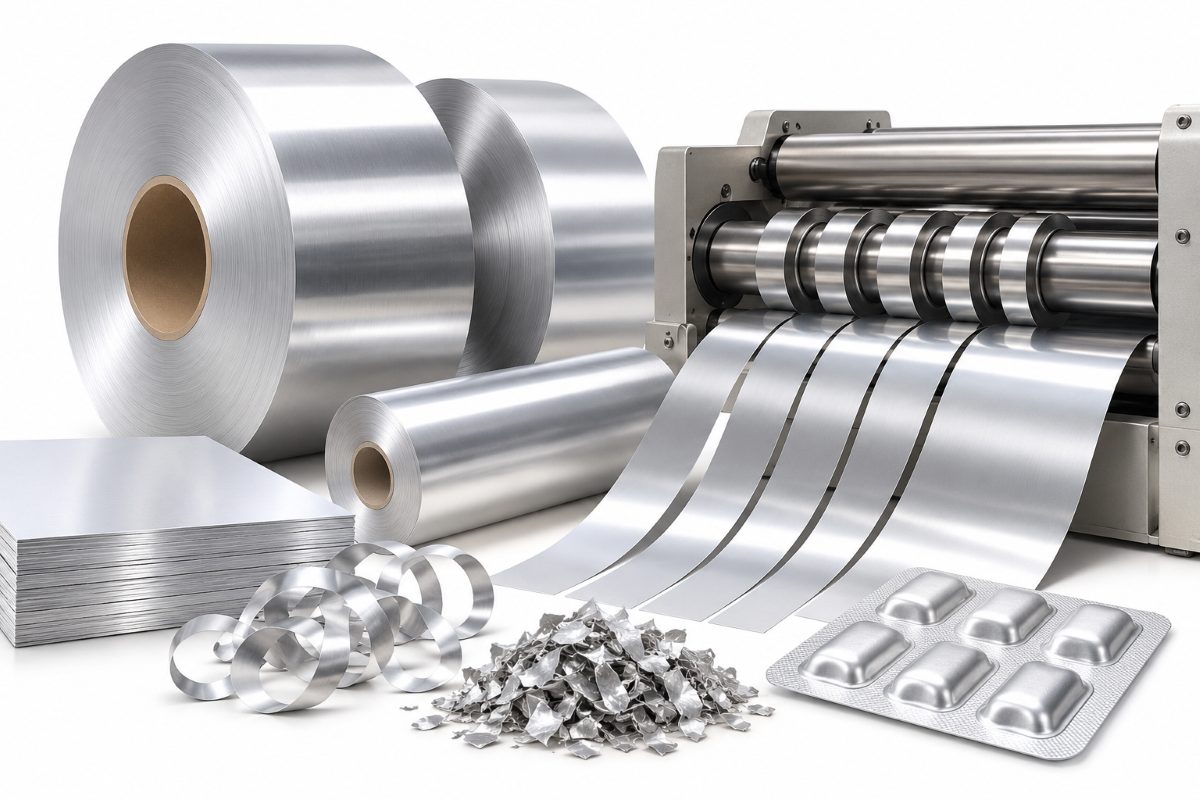

In our daily lives, we have seen the use of aluminium packaging in various types, in food, cosmetics, pharmaceuticals and whatnot. But this packaging type is achieved by converting aluminium slabs into packaging-grade sheets and foil. This packaging generates a higher volume of manufacturing scrap in comparison to any other downstream applications. This is mainly because of the demanding material specifications, precision requirements and multiple processing stages involved.
For the aluminium manufacturers, understanding where the scrap originates and how it can be reduced is vital for improving material utilisation, controlling production costs and strengthening operational efficiency.
Cause behind higher scrap rate in aluminium packaging
In the aluminium packaging production process, the need for tight gauge tolerances, excellent surface cleanliness, freedom from inclusions and high formability is deemed crucial. These requirements mainly emerge from the foil stock and can-body sheets demand, where the final product can get compromised because of minor imperfections. This is why manufacturers trim material and reject coils that do not meet the packaging-grade specifications.
As noted in AL Circle’s report, “ALuminium in Packaging Consumer Trends and Market Dynamics”, about 20.64 million tonnes of aluminium slab are turned into finished packaging products. During this process, it is estimated that about 4.13 million tonnes of manufacturing scrap are generated, yielding 78-82%.
Production stages where scrap is generated
- Slab pre-treatment: Sawing and scalping generate end cuts, saw chips and surface material, accounting for approximately 5–7% scrap.
- Hot rolling: Head and tail crops, edge trimming and cobbles contribute around 6–8%.
- Cold rolling: Rolling trims and gauge correction losses account for approximately 3–5%.
- Final rolling and finishing: Slitting, foil rolling and downgraded coils generate around 6–10%. This is identified as the largest scrap-generating stage, with foil rolling trims being a major contributor.
- Packaging conversion: Blanking offcuts, forming rejections and coil-end leftovers contribute a further 2–4%.
The challenge for the packaging manufacturers becomes more prominent during foil production. Wondering why? Aluminium foil can be rolled in 6-12 microns thickness, making it highly sensitive to surface streaks, pinholes and inclusions. Moreover, when the narrow strips are slitted, it creates side trims, which lead to material loss.
This is not the only challenge the manufacturers face. The scrap generated during manufacturing cannot be discarded easily either. Most of these scraps are clean and can be returned to the cast-house cycle for internal recycling. Nevertheless, reducing its generation remains important because every additional processing and recycling cycle affects overall resource and operational efficiency.
Technologies for reducing aluminium packaging scrap
The need for improvements in rolling, finishing and downstream conversion is crucial to address this higher scrap rate in aluminium packaging. There are certain technologies along with operational approaches for the manufacturers to improve the yield, including:
Precision process control & monitoring
When producing packaging-grade aluminium, maintaining the consistent thickness and surface quality is essential. This can be achieved by making use of advanced gauge control and process monitoring, aiding in identifying deviations during the rolling process. Moreover, this also enables the operators to make adjustments before defects result in significant material losses.
Within the monitoring process, an automated inspection system can be included, which supports surface imperfection identification, including streaks and other defects. Manufacturers, with an automated inspection system, can detect quality issues earlier in the production process.
Optimised slitting & foil processing
Side trims are generated because of the slitting operations, especially when narrow foil widths are required. Unnecessary edge losses can be reduced by accurate width planning, optimised cutting patterns and precision slitting. In order to minimise downgraded coils and avoidable rejections, controlling rolling conditions and monitoring strip quality are equally important for foil manufacturers.
Reducing conversion waste by using in-house digital printing
AL Circle’s report, “ALuminium in Packaging Consumer Trends and Market Dynamics”, features a case study that highlights an in-house printing technology which enables the pharmaceutical foil packaging industry to reduce waste.
Pharmaceutical manufacturers traditionally used to purchase pre-printed foil reels from various suppliers. But the main challenge they faced was the need for a higher quantity of foil during printing to achieve registration and maintain print quality. Due to this, near about 12 out of every 100 delivered reels went to waste.
The case study reflects Hapa (a Swiss-based industrial printing and late-stage customisation company, specialising in printing systems for packaging processes like blister aluminium foils and web-fed packaging lines) introducing an in-house printing solution. This enabled the pharmaceutical manufacturers to purchase blank foil reels and print the required information on-site.
This system, because of its flexographic, digital and hybrid printing, offers greater flexibility, aiding in reducing waste related to printing, lowering delivery frequency and simplifying inventory management.
Improved scrap sorting and recycling
Irrespective of the priority being preventing scrap generation, recovery efficiency remains equally crucial. To maintain material quality and support the return of clean process scrap to the recycling loop, a better segregation and detection system is vital. With effective sorting, the manufacturers can distinguish the scrap streams as well as improve aluminium recovery.
Conclusion
In aluminium packaging, higher scrap generation is closely linked with quality and performance requirements of the end products. But this also presents an opportunity for manufacturers to improve production efficiency. From precision process control and optimised slitting to in-house printing and better scrap recovery, targeted improvements can help reduce avoidable material losses.
As packaging demand continues to evolve, manufacturers that prioritise yield improvement and process efficiency will be better positioned to manage costs, conserve resources and strengthen their competitiveness.