AL Circle Analysis: Europe’s aluminium scrap curbs, India’s risk and US’s supply opportunity

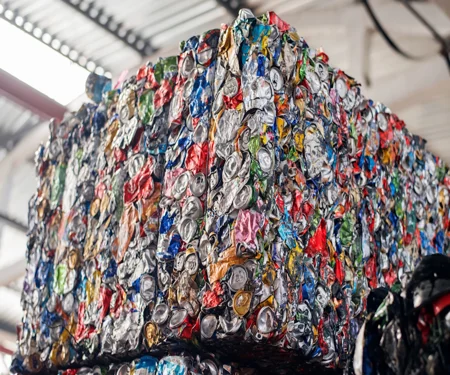
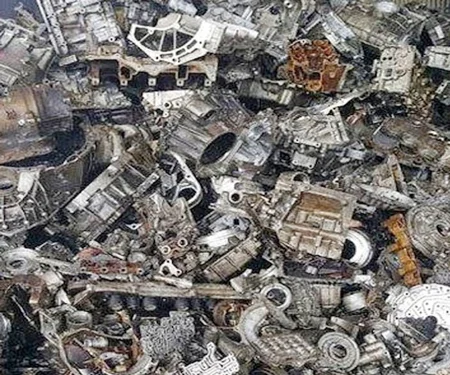
The image used in this article is generated with an AI tool and does not depict any real-time moment
Aluminium recycling is supposed to be the industry’s easiest win — economic and eco-friendly. Interestingly, this is where the plot thickens. Aluminium recycling is moving from a sustainability objective to a strategic supply-chain issue, with scrap availability, domestic recovery, cross-border waste rules and decarbonisation policy influencing where recycled metal can be produced and consumed.
Recent developments across Europe, such as the UK and Greece, in the US and India reveal that investment in recycling is accelerating, but access to suitable scrap and the rules governing its movement are becoming equally important.
Join the fourth edition of the webinar "Hedging for recyclers - Become an expert in 6 hours" by Jorge Dyszel.
Europe wants more recycled aluminium, but what is the scrap source?
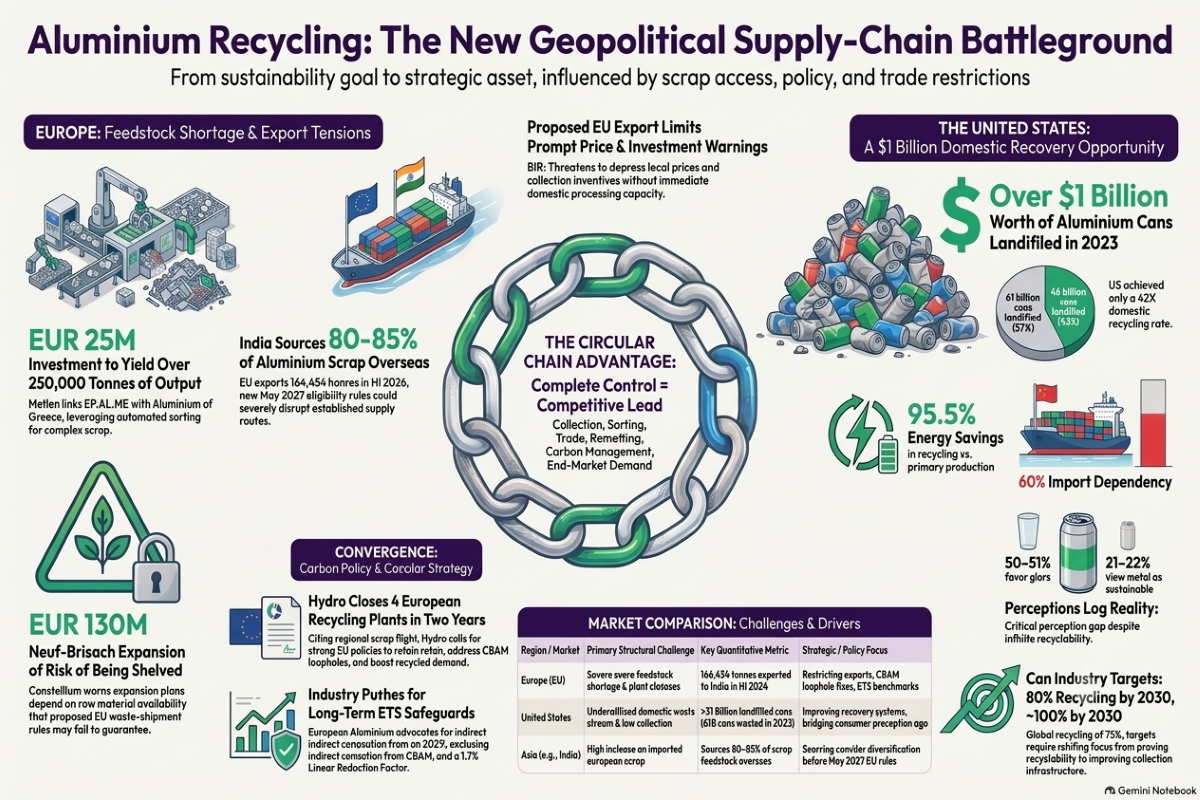
Europe’s recycling ambition is increasingly colliding with a basic feedstock constraint. Metlen’s EUR 25 million investment in Greece shows that recyclers are willing to put capital into automated sorting, processing and melting capacity capable of handling more complex scrap. By linking EP.AL.ME. with Aluminium of Greece, the company is effectively building a more integrated scrap-to-production chain, with combined output expected to exceed 250,000 tonnes.
But Constellium’s position exposes the other side of the equation. The company is reviewing European recycling projects, warning that its EU recycling expansion plans could be shelved entirely if scrap shortages persist, with CEO Ingrid Joerg noting the EUR 130 million Neuf-Brisach project’s scale depends on raw material availability the company doubts new waste-shipment rules will secure.
That tension is also visible in Brussels. Proposed changes to EU waste-shipment rules could restrict shipments of nonferrous scrap to major Asian recycling destinations such as India, Malaysia and Thailand. The Bureau of International Recycling (BIR) argues that closing export routes does not automatically create equivalent processing capacity within Europe and could instead weaken material prices, collection incentives and investment.
That scrap tension has a trade dimension, particularly significant for India. The country sources 80–85 per cent of its aluminium scrap from overseas, while H1 2026 imports from the EU reached 166,434 tonnes. The proposed EU framework could make future access conditional on environmental eligibility, potentially reshaping an established supply route from May 2027.
Key takeaways
- European exporters should monitor non-OECD destination rules before relying on established Asian routes.
- Asian recyclers dependent on European scrap need to assess alternative sourcing corridors and feedstock security.
- New recycling capacity must be matched with long-term scrap availability.
- Restricting exports without expanding domestic collection and processing could create a supply-demand mismatch.
- Investments in sorting and preparation of complex scrap may become increasingly valuable.
To explore trade opportunities of aluminium scrap, visit AL Biz
The US’ side of scrap equation: Where recyclable aluminium goes missing
While Europe is debating how much scrap should remain within the bloc, the US appears to have a different opportunity, i.e., recovering more of the aluminium it already discards.
Greyparrot’s waste-intelligence data revealed the US landfilled over USD 1 billion worth of aluminium cans in 2023, with 61 billion of 107 billion shipped. This leaves a 43 per cent recycling rate even as the country relies on imports for 60 per cent of its aluminium supply, despite recycling using 95.5 per cent less energy than primary production.
The beverage-can market reinforces that opportunity. Global recycling data puts aluminium-can recycling at 76 per cent, with 77 per cent collected, ahead of PET and glass. Yet the industry is targeting 80 per cent by 2030 and close to 100 per cent by 2050. That means the next stage of growth depends less on proving that aluminium can be recycled and more on getting more cans into systems capable of recovering them.
This is where a GlobalData consumer survey underscored why. Only 21-22 per cent of respondents view metal packaging as sustainable, far behind glass’s 50-51 per cent, even though aluminium can be recycled indefinitely. This is a perception gap the industry must close as the EU’s Packaging and Packaging Waste Regulation introduces binding 2030 recyclability targets.
Key takeaways
- Domestic waste streams represent a potentially underutilised source of secondary aluminium.
- Investment in sorting, recovery and measurement can strengthen both feedstock security and energy efficiency.
- “Recyclable” is increasingly insufficient as a sustainability claim; measurable recovery and recycled-content data matter.
- Stronger collection systems can convert aluminium’s theoretical circularity advantage into a verifiable supply-chain benefit.
Showcase your brand, aluminium recycling initiatives and sustainability vision in our upcoming magazine: Sustainability & Recycling: Aluminium’s Commitment 2026.
The scrap-carbon policy convergence
The emerging picture is therefore bigger than a European scrap dispute or a US recycling opportunity. Scrap access and carbon competitiveness are increasingly becoming two sides of the same aluminium strategy.
The concern is echoed by Hydro. The company is calling for stronger measures to keep more aluminium scrap in Europe and support investment in the region’s recycling capacity. In the last two years “Hydro has closed four recycling facilities in Europe,” prompting the company to ask for “strong and effective policy action…to avoid further closures.” The company also wants the EU to address the scrap loophole under the Carbon Border Adjustment Mechanism (CBAM) and introduce measures that increase demand for recycled aluminium.
Rounding out the picture, European Aluminium welcomed the European Commission’s proposed EU Emissions Trading System (ETS) review and adjusted free-allocation benchmarks for 2026-2030, while pushing for stronger safeguards. It is seeking longer-term indirect cost compensation through 2040, keeping indirect emissions outside CBAM, and adopting a gentler 1.7 per cent Linear Reduction Factor from 2031-2035 before any steeper cuts apply.
Trading aluminium across borders? Find out the exact cost you need to bear for the embedded carbon in the product by using this CBAM calculator.
Key takeaways
- Scrap-retention policies need to be matched with sufficient domestic collection and processing capacity.
- Waste rules, trade policy and industrial decarbonisation cannot be designed in isolation.
- Carbon protection must preserve competitiveness without undermining access to the scrap needed for lower-carbon production.
- For buyers, traceable recycled aluminium could increasingly become both a sustainability requirement and a supply-security consideration.
The implication for decision-makers is clear. The next competitive advantage in aluminium may come from controlling the entire circular chain, viz., collection, sorting, scrap trade, remelting, carbon management and end-market demand, rather than from recycling capacity alone.

CMI targets 70% US aluminum can recycling by 2030 as MRF losses come under focus
Next articleGermany’s next big aluminium recycling prospect lies in 600kt of solar PV waste
Grow with
AL Circle