AL Circle Analysis: From Guinea to Gulf, how bauxite, tariffs and logistics redraw aluminium map

The image used in this article is generated with an AI tool and does not depict any real-time moment.
Aluminium markets in late 2026 are being shaped by more than the headline LME aluminium price. Bauxite security, alumina availability, geopolitical disruptions, tariff negotiations, logistics diversification and regional premiums are increasingly determining where metal moves and what buyers pay. From RUSAL reassessing Caribbean assets and Vedanta securing Odisha bauxite to Brazil extending mine life and EGA rebuilding its Guinea supply chain, producers are strengthening control over critical raw materials. At the same time, the US remains heavily dependent on imported bauxite and alumina, while Europe and Asia are experiencing sharply different premium dynamics.
These developments point to a market where physical availability is becoming a regional factor even as aluminium itself remains globally traded.
Explore the production, demand and consumption forecasts of bauxite and alumina in our report: "Global Bauxite & Alumina Market Forecast to 2036: Supply–Demand, Trade Flows & Price Outlook"
Locking feedstock from mine security to integrated aluminium chains
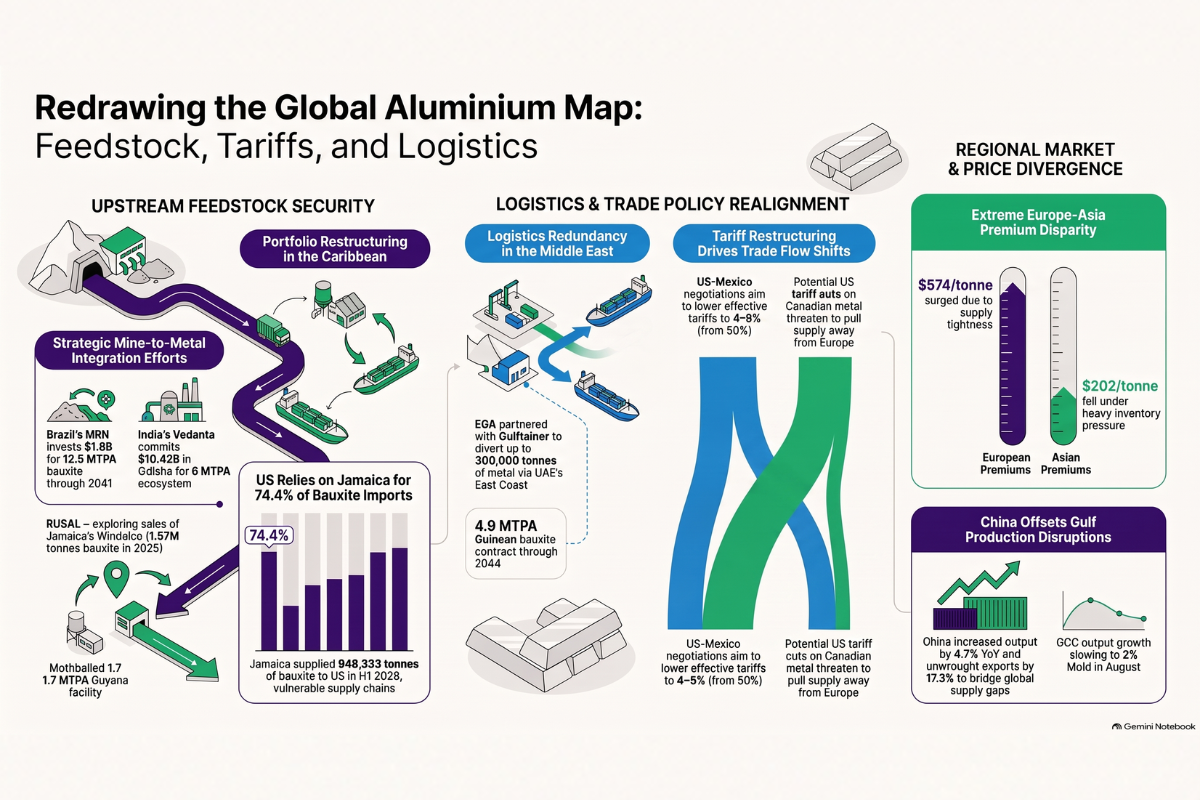
The first signal comes from the upstream end of the value chain. RUSAL is reportedly exploring buyers for Windalco, its Jamaican bauxite and alumina operation, after the unit produced 1.57 million tonnes of bauxite and 396,000 tonnes of alumina in 2025. RUSAL is also assessing the potential sale of its interest in Bauxite Company of Guyana Inc., which has a reported 1.7 million tonne per annum (MTPA) design capacity but has been mothballed since 2020.
The portfolio reshuffle is significant, for Jamaica remains deeply embedded in the US bauxite supply chain. US bauxite imports fell 14.5 per cent in value to USD 68.46 million in H1 2026, even as volumes rose 6.9 per cent to 1.27 million tonnes. Jamaica supplied 948,333 tonnes, or 74.4 per cent.
Elsewhere, supply security is being built rather than sold.
In Brazil, Mineração Rio do Norte (MRN) is investing BRL 9 billion (USD 1.8 billion) through its Novas Minas project to keep its Pará complex operating through 2041. Five new mining sites will allow MRN to maintain 12.5 MTPA of bauxite production. Around 69 per cent of that output feeds Brazilian alumina refineries, while MRN’s shareholders include Glencore, Rio Tinto and Alcoa.
India is following a similar integration strategy. Odisha has committed local bauxite for Vedanta’s Lanjigarh refinery with a proposed INR 1 trillion (USD 10.42 billion) investment programme. The plan covers a 3 MTPA Dhenkanal smelter, 6 MTPA Rayagada alumina refinery and 1 MTPA brownfield expansion at Jharsuguda. Vedanta’s cumulative aluminium production capacity in Odisha could reach 6 MTPA, generating over 200,000 jobs.
Vietnam is also moving further down the chain. In Lam Dong, alumina output reached around 1 million tonnes in the first nine months of 2026, up 1.7 per cent, while bauxite mining grew 19 per cent. The Dak Nong Aluminium Electrolysis Plant, backed by Tran Hong Quan Metallurgical Co. Ltd., has a designed capacity of 450,000 tonnes per year, with full capacity expected after Phase 3 in Q1 2027.
Key takeaways
- Feedstock security is becoming a strategic asset, not simply a procurement function.
- Integrated mine-to-metal investments are reducing exposure to spot-market disruptions.
- Long-life bauxite projects with reliable power and logistics are gaining strategic value.
- Potential changes in ownership of Caribbean assets could alter established US bauxite flows.
Logistics and trade policy redrawing aluminium’s physical map
Raw materials are only useful when they can move reliably. That is increasingly evident in the Gulf.
Emirates Global Aluminium (EGA) has signed an agreement with Gulftainer to route up to 250,000 tonnes of aluminium through the UAE’s East Coast in the first year, rising to 300,000 tonnes in the second year. EGA sold over 2.83 million tonnes of cast metal in 2025 across 50+ countries. The agreement is an attempt to build logistics redundancy around a major global aluminium supplier. Similar resilience strategy is visible upstream. EGA’s renewed agreement with Compagnie des Bauxites de Guinée (CBG) provides for up to 4.9 MTPA of Guinean bauxite through 2044.
Alumina trade is also showing signs of geographical dependence. US alumina imports reached 712,000 tonnes in H1 2026, up 2.7 per cent year-on-year. Brazil supplied 568,000 tonnes, or roughly four-fifths of the total, while China’s shipments rose 12 per cent to 26,700 tonnes. Jamaica, by contrast, saw shipments collapse 76 per cent to 14,000 tonnes. Q2 US alumina imports alone fell 25 per cent, highlighting how quickly flows can change.
Europe faces a different kind of supply-chain risk. Aughinish Alumina is lobbying Irish policymakers as the European Commission considers measures affecting alumina exports from its Limerick facility to Russia. The plant shipped 422,474 tonnes worth EUR 119.5 million (USD133.83 million) to Russia this year, averaging 70,412 tonnes a month.
Looking for alumina refinery raw materials? Compare grades, explore sourcing options, and connect with global suppliers on AL Biz.
Meanwhile, trade policy is changing competitive economics in North America. Mexico is negotiating with the US for lower aluminium and steel tariffs, with officials indicating that a proposed 15 per cent tariff could translate into an effective 4–5 per cent rate after regional-value-content deductions. That compares with the 50 per cent Section 232 aluminium tariff imposed on Mexico since June 2025.
The uncertainty is running in the opposite direction for Canada. A possible reduction in the US tariff on Canadian aluminium from 50 per cent to 25 per cent has raised concerns in Europe that Canadian producers could redirect more material towards the US. Europe’s imports of Canadian aluminium increased 80 per cent year on year to 269,839 tonnes during January-July 2026, while the European premium climbed to USD 574 per tonne.
The result is a market increasingly split by geography. The Asian premium fell to USD 202 per tonne, well below the USD 395 per tonne MJP Q3 benchmark, while MJP Q4 offers dropped to USD 245–260 per tonne from USD 325 per tonne in early September. Rising inventories and weak demand are weighing on Asia, although Vietnam and Thailand have held up better.
Key takeaways
- Logistics redundancy is becoming part of aluminium supply strategy.
- Tariff changes can redirect established trade flows almost overnight.
- Buyers should increasingly evaluate delivered cost and route risk, not just LME plus premium.
- The widening Europe-Asia premium gap signals increasingly regional aluminium economics.
Prices stay supported, but the market becomes more selective
The supply disruptions have provided a floor under aluminium prices even as regional fundamentals diverge.
According to OCBC, Gulf aluminium production recovery has slowed sharply, with GCC output growth falling to 2 per cent month-on-month in August from 6.2 per cent in July. EGA’s recovery remains gradual, with only 25 per cent of the reduction cells at Al Taweelah restored by late August. At the same time, China’s aluminium production increased 4.7 per cent year on year in August, while exports of unwrought aluminium and aluminium products rose 17.3 per cent. China is therefore compensating for part of the Gulf shortfall.
The broader commodity picture reinforces the supply-shock argument. ANZ reported that aluminium prices rose 1.1 per cent in September and were approximately 23 per cent higher year on year, helped by Middle East disruptions and higher energy prices. But higher freight rates are also raising costs, meaning producers and exporters are not necessarily capturing the entire commodity-price gain.
Unlock key insights from leading companies and experts across the aluminium ecosystem with our e-Magazine - Mine to Market: Aluminium Producers & Manufacturers 2026
Key takeaways
- USD 3,150 per tonne remains OCBC’s end-2026 benchmark, but regional premiums will determine realised costs.
- Strong Chinese output is cushioning Gulf disruption, limiting the upside risk to prices.
- Europe and Asia are moving in opposite premium directions, creating regional arbitrage opportunities.
- Companies with diversified feedstock, logistics and customer exposure are better positioned for continued volatility.
The strategic priority for the aluminium industry is therefore moving beyond simply securing tonnes. The winners will increasingly be those able to secure the right raw material, at the right cost, through the right route, while retaining flexibility when trade flows change. The strategic priority for the aluminium industry, therefore, is not about securing feedstock but also controlling the supply chain altogether to ensure the industry becomes self-dependent and resilient.

Cameroon to hold October hearings on proposed $2b alumina refinery
Next articleHindalco partners with Vi Business to deploy a private network at an Odisha bauxite mine
Grow with
AL Circle