Guinea’s 183Mt bauxite trade vs RUSAL’s 5Mt Ghana mine plan: A gesture towards two paths for West Africa in 2026
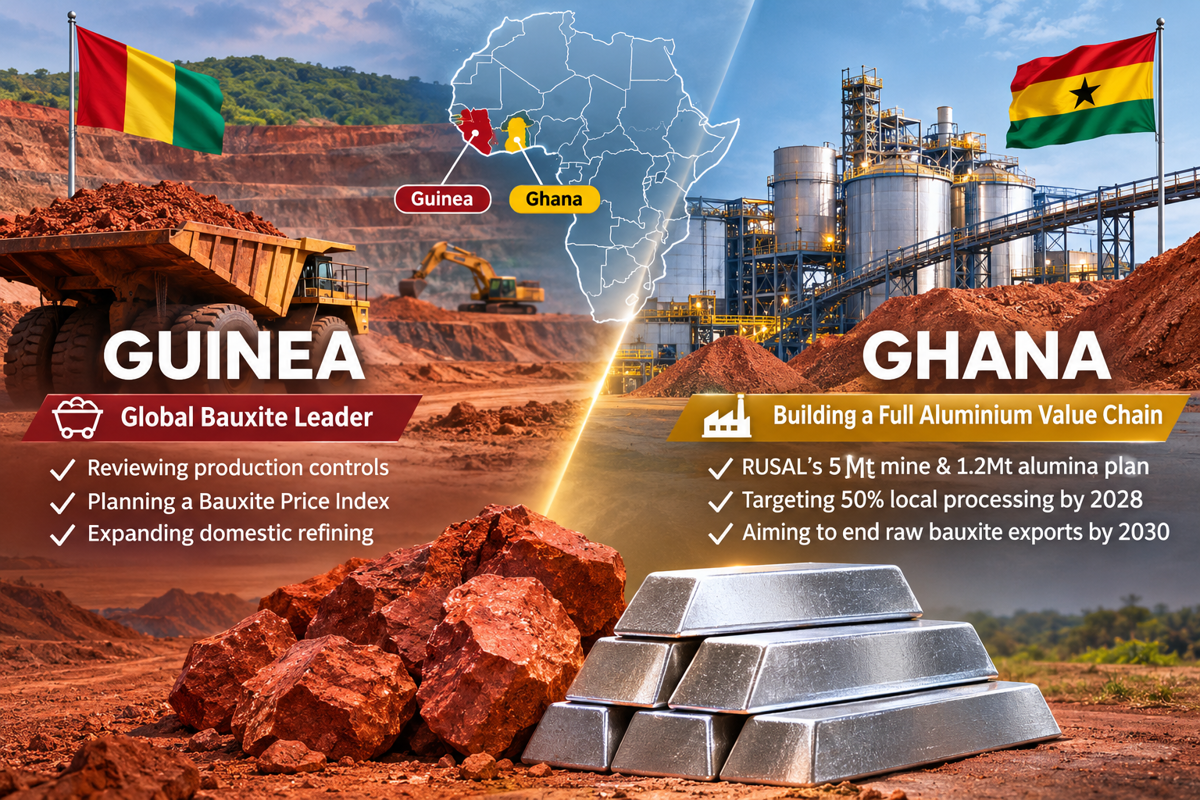
The images used in this article is generated with an AI tool and does not depict any real-time moment
Guinea and Ghana are approaching the global bauxite market from very different positions. While Guinea has established itself as the powerhouse of international bauxite supply, its growing export volumes are creating a new challenge of maintaining prices and protecting the economic returns from its mineral wealth. Ghana, meanwhile, is looking beyond raw ore exports, pursuing foreign investment, domestic alumina refining and stronger integration across its aluminium industry.
The contrast is becoming increasingly momentous, with Guinea considering production controls and a national bauxite pricing mechanism to strengthen its influence over the market. Au contraire, Ghana is attracting international companies, including Russia’s RUSAL, to develop its largely untapped deposits and establish a domestic processing chain.
Both strategies could reshape the West African bauxite landscape, but their priorities and timelines are markedly different.
Explore the production, demand and consumption forecasts of bauxite and alumina in our report: "Global Bauxite & Alumina Market Forecast to 2036: Supply–Demand, Trade Flows & Price Outlook"
Guinea’s bauxite dominance meets the challenge of falling prices
Guinea's position as the world's largest bauxite exporter has been reinforced by years of expanding mining operations, substantial foreign investment and growing Chinese demand. Its exports increased by 25 per cent in 2025, with China receiving 74 per cent of the shipments. The market includes several major operators, notably Chalco, Compagnie des Bauxites de Guinée (CBG), Société Minière de Boké (SMB) and AGB2A/SDM.
The country’s resource advantage is equally imperative. AL Circle’s latest research estimates Guinea's bauxite reserves at 7.4 billion tonnes, compared with Ghana's 0.96 billion tonnes. This extensive difference is the key to why Guinea remains central to global alumina supply, particularly for Chinese refineries seeking imported feedstock.
However, higher export volumes have not translated into stronger pricing power. Guinea shipped 164.9 million tonnes of bauxite during the first three quarters of this year, according to data from the Ministry of Mines and Geology. The supply expansion has coincided with a weaker pricing environment, as oversupply and pressure on downstream alumina markets have weighed on producer margins.
The impact has extended beyond mining companies. Lower ore prices affect government royalty and tax receipts, while smaller producers face increasing pressure on their operating economics. In April, free-on-board Guinea bauxite prices were reported at around USD 32–38 per tonne, their lowest levels in four years.
This has prompted the government to reconsider how the country's mineral resources are marketed and regulated. Mining and Geology Minister Bouna Sylla has indicated that Guinea may introduce production regulations and consider restrictions on raw bauxite exports to prevent excessive supply.
"Maybe before the end of this month, we will publish something on regulation for Guinea bauxite production because the oversupply isn't good for the market," Sylla said.
Guinea Bauxite Index could change pricing dynamics
Beyond production regulation, Guinea is working towards establishing a national pricing benchmark, the proposed Guinea Bauxite Index (GBX), potentially launching in 2027.
Unlike aluminium and copper, bauxite does not have a widely recognised international exchange benchmark. Its commercial value depends on several variables, including alumina content, reactive silica levels, impurities, transportation costs and the destination refinery's processing requirements. Consequently, transactions are largely negotiated through individual contracts, making price transparency difficult.
A national index could give Guinea greater influence over how its ore is valued and potentially strengthen the country’s negotiating position with international buyers. However, its effectiveness will depend on whether mining companies, traders and major importing refineries accept the benchmark as a reliable reference.
The domestic processing question also remains important. Guinea exported 324,400 tonnes of alumina during the first three quarters of this year, with the Friguia refinery accounting for the majority. Although the country’s bauxite industry is considerably more developed than its downstream refining sector, expanding domestic processing remains an important part of its longer-term ambitions.
RUSAL provides an interesting link between Guinea's established mining industry and Ghana's emerging ambitions. The Russian aluminium producer operates bauxite assets in Guinea, including the Compagnie des Bauxites de Kindia, Friguia and Dian-Dian operations. Its first-half results also highlighted increased production following capacity expansion at Dian-Dian.
Its growing interest in Ghana therefore represents an expansion of its West African raw-material strategy rather than an entirely new regional entry.
Looking for alumina refinery raw materials? Compare grades, explore sourcing options, and connect with global suppliers on AL Biz.
Ghana’s bauxite market seeks a breakthrough through downstream integration
Ghana’s position is different. Despite its considerable mineral wealth, the country has struggled to translate its bauxite resources into a fully integrated aluminium industry.
The available US Geological Survey production data put Ghana’s bauxite output at 1.69 million tonnes in 2024. Its mining operations remain comparatively limited, with the Awaso mine representing its established operating base.
More importantly, Ghana does not yet have a domestic alumina refinery. Bauxite from Awaso is transported by road to Takoradi Harbour for export, while alumina is imported to supply the Volta Aluminium Company (VALCO) smelter in Tema.
This gap between domestic mineral resources and downstream industrial requirements has been a major obstacle to Ghana’s ambition of developing an integrated aluminium industry. The government and the Ghana Integrated Aluminium Development Corporation (GIADEC) are consequently looking to secure investment in mining and refining infrastructure rather than relying exclusively on the export of unprocessed ore.
RUSAL’s Nyinahin project puts Ghana on the investment map
One of the most considerable developments is the agreement between RUSAL and GIADEC, signed in Moscow in late October during the Russia-Africa Forum.
The partnership covers the development of a bauxite mine at the Nyinahin deposit in the Ashanti Region, with a planned annual mining capacity of up to 5 million tonnes. The designated development area contains more than 100 million tonnes of estimated bauxite resources.
The second phase involves an alumina refinery with an annual production capacity of 1.2 million tonnes. The facility is expected to use natural gas, creating an opportunity to process the locally mined ore instead of exporting it in its unrefined form.
The project will operate through two joint ventures, Nyinahini Bauxite and Ghana Alumina Company. RUSAL will finance the projects and hold majority stakes, while the Ghanaian side will retain a minority interest, including a 10% non-dilutable stake. GIADEC has estimated the refinery's development cost at more than USD 1.5 billion, with an anticipated construction period of approximately 36 months.
The strategic importance of the agreement extends beyond securing additional mineral resources. It offers RUSAL an opportunity to strengthen its raw-material base while giving Ghana a potential route towards domestic alumina production.
"Our agreement with GIADEC marks an important step in implementing RUSAL’s strategy to strengthen its own raw material base," said Evgeniy Nikitin, General Director of RUSAL.
Under Ghana’s broader integrated aluminium industry plan, bauxite from Nyinahin is expected to support domestic alumina production, with the intention of supplying VALCO's smelter and strengthening the country's downstream aluminium manufacturing capabilities.
However, RUSAL is not the only international investor exploring Ghana's opportunities. GIADEC and UAE-based Metalloid Resources Investment previously signed a USD 60 million financing facility to advance mining activities at parts of the Nyinahin concession. Furthermore, a delegation from Guinea's ORG Technology visited the deposit in early November.
Although the visit indicates interest from another foreign company, no formal investment commitment or specific role has been publicly established.
Unlock key insights from leading companies and experts across the aluminium ecosystem with our e-Magazine - Mine to Market: Aluminium Producers & Manufacturers 2026
Ghana sets a deadline for ending raw bauxite exports
The country's ambitions are also being reinforced through a more decisive mineral-processing policy.
During the presentation of the 2027 Budget Statement and Economic Policy, Finance Minister Dr Cassiel Ato Forson announced a USD 1.5 billion programme to develop domestic processing capacity for manganese, bauxite, lithium and gold.
Ghana aims to process at least 50 per cent of its manganese and bauxite domestically by the end of 2028, moving towards full local processing thereafter. The government's ultimate objective is to prohibit raw manganese and bauxite exports by the end of 2030.
"By the end of 2030, Ghana will process all its manganese and bauxite locally and prohibit raw manganese and bauxite exports," Ato Forson said.
The proposed restrictions represent a noteworthy policy shift for the country's mining industry. Rather than treating bauxite primarily as an export commodity, Ghana wants to retain more of the economic value generated through refining, industrial manufacturing and associated supply-chain activities.
Nevertheless, achieving this objective will require more than securing mining licences and announcing refinery partnerships. Processing capacity, energy availability, transportation infrastructure and the commercial viability of domestic production will determine how quickly the policy can translate into actual output.
Rail connectivity and energy become critical to Ghana’s plans
Transport infrastructure is an important part of this equation. Ghana currently relies on road transportation to move Awaso bauxite to Takoradi, making the proposed Western Corridor Railway particularly relevant to its future mining and refining ambitions.
The government plans to develop a railway connecting Takoradi Harbour through Nsuta and Awaso to Nyinahin, with construction scheduled to begin in 2027. Petroleum revenues and mineral royalties are expected to finance the project during the following two years, without additional government borrowing.
Energy infrastructure is equally important. Ghana's proposed critical-mineral processing enclave in the Western Region is intended to operate with a reliable power supply, while RUSAL's proposed alumina refinery is designed around natural gas.
For Ghana, the objective is not simply to expand extraction. It is to connect mineral deposits, processing facilities, ports and downstream aluminium production into a commercially sustainable industrial ecosystem.
Guinea vs Ghana: Two different strategies for the global bauxite market
The developments in Guinea and Ghana reflect two distinct approaches to gaining greater economic value from bauxite.
Guinea's immediate priority is to manage its position as a major supplier. Its challenge is to prevent excessive production from undermining prices, improve transparency in commercial transactions and encourage more domestic processing without disrupting the export revenues generated by its established mining industry.
Ghana, on the other hand, is still building the foundations of a larger bauxite industry. Its success will depend on whether proposed mining partnerships, alumina refining investments, railway infrastructure and industrial policies can progress from agreements to operational facilities.
While Guinea is attempting to turn its export dominance into stronger market influence, Ghana is seeking to transform its mineral resources into an industrial advantage. Now, how effectively each country executes its strategy will help determine its role in the next phase of the global bauxite and alumina market.
Unlock full access – sign up for FREE.
Key benefits
Grow with
AL Circle












_md.webp)
_md.webp)
_md.webp)