Germany’s aluminium FRP consumption reaches 1.68 Mt as 2025 trade surplus tops $3.1 billion
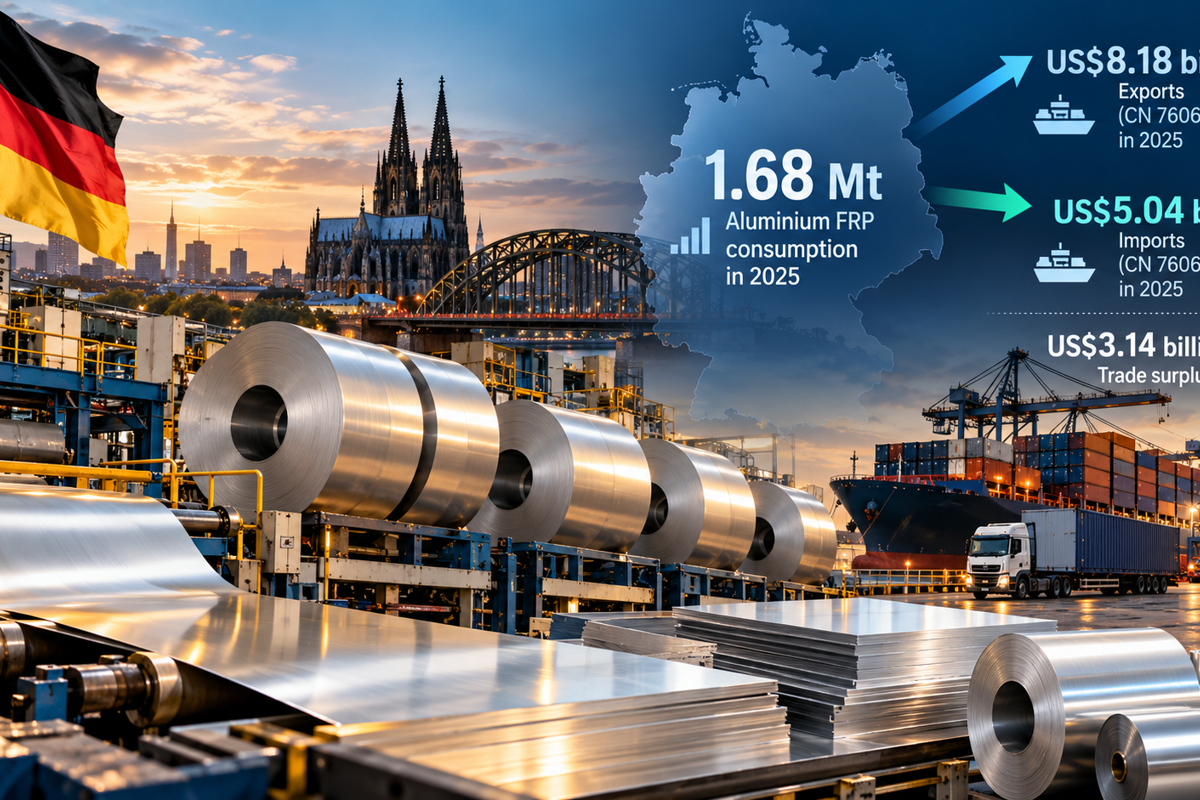
The image used in this article is generated with an AI tool and does not depict any real-time moment
Germany’s aluminium flat-rolled products (FRP) market is revealing a striking disconnect between its shrinking primary aluminium base and its still substantial downstream manufacturing capacity. Estimated German FRP consumption reached 1.68 million tonnes in 2025, up from approximately 1.66 million tonnes in 2024, even as domestic primary aluminium production had fallen sharply in previous years.
The latest trade data add another layer to the picture. Germany’s combined imports of aluminium plates, sheets and strip above 0.2 mm (CN 7606) and aluminium foil of 0.2 mm or less (CN 7607) reached approximately USD 5.04 billion in 2025, while exports climbed to USD 8.18 billion. That left a combined trade surplus of about USD 3.14 billion across the two FRP categories.
Germany remains a net importer of FRP by estimated physical volume, but a major net exporter by trade value. It points to an industrial model in which imported aluminium and recycled metal are transformed into higher-value rolled, finished and specialised products before being supplied to domestic manufacturers and overseas markets.
Germany’s FRP consumption reaches 1.68 million tonnes
For the purposes of this analysis, flat-rolled aluminium covers CN 7606, comprising aluminium plates, sheets and strip above 0.2 mm thickness, and CN 7607, covering aluminium foil of 0.2 mm or less. Extrusions and other aluminium products falling outside these headings are excluded.
On that basis:
| Germany FRP balance | 2024 | 2025 |
| Estimated production | 1.37 Mt | 1.4 Mt |
| Estimated imports | 390 kt | 400 kt |
| Estimated exports | 100 kt | 120 kt |
| Estimated apparent consumption | 1.66 Mt | 1.68 Mt |
| Estimated net imports | 290 kt | 280 kt |
The estimates indicate that Germany’s domestic FRP requirement remained above its domestic rolling output, leaving the country dependent on net imports to close the supply gap.
CN 7606 accounts for the overwhelming majority of that estimated consumption, at approximately 1.65 million tonnes in 2025, while foil under CN 7607 represents only about 30,000 tonnes.
The bigger story is the gap between primary aluminium and downstream rolling
Domestic primary aluminium output fell from 341,212 tonnes in 2022 to 189,471 tonnes in 2023, representing a decline of 44.47 per cent. The contraction reflected the pressure placed on energy-intensive primary electrolysis by high electricity costs and deteriorating production economics.
Yet Germany retained a large downstream aluminium-processing base. German semi-finished aluminium production has remained around the 2.3 million tonnes level, supported by imported primary metal, imported re-melt slabs and domestic scrap. The result is a growing separation between Germany’s upstream smelting footprint and its downstream rolling capabilities.
To know the global production, demand and consumption forecasts of aluminium extrusions, explore our report "The World of Aluminium Extrusions to 2035"
Alunorf and recycling underpin Germany’s rolling strength
Germany’s downstream advantage is supported by some of Europe’s largest aluminium-processing assets.
Aluminium Norf GmbH (Alunorf) in Neuss, operated as a joint venture between Novelis Deutschland and Speira, has approximately 1.5 million tonnes of annual hot- and cold-rolling capacity. The facility forms a major part of the Western European rolled aluminium supply chain.
At Speira’s Grevenbroich operation, the downstream ecosystem extends into finishing and recycling. The facility is described in the research as having recycling infrastructure capable of processing up to 650,000 tonnes of scrap annually, alongside a beverage-can recycling plant with annual capacity of approximately 100,000 tonnes.
This recycling infrastructure is increasingly important because Germany’s industrial model is shifting away from dependence on domestic primary smelting and towards a combination of imported primary metal and circular feedstock.
But Germany’s FRP trade tells a different story
The physical-volume estimates show Germany as a net importer of FRP. The actual trade-value datasets supplied for this analysis show something more nuanced.
For CN 7606 and CN 7607 combined, Germany recorded:
| FRP trade value | 2023 (USD) | 2024 (USD) | 2025 (USD) |
| Imports | 4.39 bn | 4.24 bn | 5.04 bn |
| Exports | 7.38 bn | 7.37 bn | 8.18 bn |
| Trade balance | 2.996 bn | 3.13 bn | 3.14 bn |
The 2025 datasets show that combined FRP imports increased by approximately 18.7 per cent year on year, while exports rose by about 11 per cent.
CN 7606 dominates the German FRP trade
The largest component of Germany’s FRP trade is CN 7606, covering plates, sheets and strip above 0.2 mm.
In 2025, German imports under CN 7606 reached approximately USD 3.88 billion, compared with USD 3.22 billion in 2024. That represents an increase of about 20.6 per cent. Exports increased from approximately USD 5.627 billion in 2024 to USD 6.328 billion in 2025, a rise of about 12.5 per cent.
The resulting 2025 CN 7606 trade balance was therefore approximately USD 2.44 billion in Germany’s favour.
The research identifies key import flows for plates, sheets and strip from European suppliers including Italy, Austria, Poland and France, while German exports feed manufacturing markets across Europe. Specialised automotive and aerospace products form an important part of this downstream value proposition.
Looking for aluminium flat rolled products? Browse through a comprehensive list here at AL Biz
Foil is smaller by volume but significant by value
The CN 7607 story is even more revealing. Germany’s estimated domestic foil consumption is only around 30,000 tonnes in 2025, according to the production-and-consumption reconciliation. Yet its international trade in foil is worth well over USD 1 billion in each direction.
The actual trade datasets show that German imports of CN 7607 increased from approximately USD 1.024 billion in 2024 to USD 1.15 billion in 2025, representing growth of about 12.7 per cent.
Exports increased from approximately USD 1.74 billion to USD 1.85 billion, or about 6.1 per cent.
That produced a 2025 foil trade surplus of approximately USD 697 million. The result reinforces a point already visible in Germany’s wider FRP structure: physical tonnage alone understates the economic importance of specialised aluminium products.
The research previously estimated Germany’s 2024 foil exports at around USD 1.71 billion and imports at approximately USD 922 million, implying a surplus of roughly USD 786 million. The newly supplied dataset extends that picture into 2025 and shows continued growth in both directions.
Germany is therefore simultaneously importing foil for its domestic converting and manufacturing ecosystem while exporting high-value foil products to external markets.
Germany’s FRP industry is built around value addition
The trade numbers make more sense when viewed alongside the country's end-use industries.
Automotive and transportation represent a major value-generating market for flat-rolled aluminium. German manufacturers use 5xxx and 6xxx series alloys for lightweight body structures, crash-management components, EV battery trays, heat exchangers and other applications.
The shift towards electric vehicles is also expanding the role of aluminium beyond traditional body-in-white applications. Battery trays, thermal-management systems and other EV components require products with increasingly demanding specifications.
Packaging is another important pillar. German rolling and foil operations supply can stock, thin-gauge foil and converter products for food, pharmaceutical and other packaging applications. The research highlights recycled-content requirements as an increasingly important factor in this market.
Building and construction use aluminium sheet for façades, roofing, cladding and other architectural applications, while solar infrastructure adds another source of demand for aluminium sheet and plate.
Meanwhile, aerospace and heavy engineering create demand for higher-strength plate, including heat-treatable alloy products used in structural components and precision engineering applications.
Read our latest magazine “ALuminium’s Frontline: OEM Edition 2026” and learn how OEMs are transforming critical aluminium applications across end-use sectors.
Market growth is likely to be moderate, but value opportunities remain
The supplied market research values Germany’s aluminium rolled-products market at approximately USD 5.95 billion in 2025, with the market projected to reach around USD 6.69 billion by 2030, implying a 2.4 per cent CAGR.
A separate market-volume outlook covering the broader aluminium market forecasts total domestic aluminium demand across forms to rise from 3.34 million tonnes in 2026 to 4.48 million tonnes by 2035.
The latest industry landscape assessment is more bullish on the longer-term growth trajectory, pointing to opportunities created by EV lightweighting, circularity, specialised packaging products, low-carbon production and reshoring of critical supply chains.
However, the near-term operating environment remains challenging. High electricity prices, weak industrial demand and pressure on automotive and construction supply chains continue to constrain capacity utilisation. The German aluminium industry’s 2025 assessment indicates that rolled-product production improved by around 2 per cent year-on-year, but remained approximately 12 per cent below 2021 levels, underscoring the gap between current output and pre-crisis production.
Note: This is exclusive coverage by AL Circle and may not be reproduced, republished or shared without prior permission.
South Korea’s aluminium foil imports hit five-year high at 57kt in YTD July 2026 as China drives 96% of new volume
Next articleMEC to invest $26m in New Georgia’s metal fabrication facility, adding 140 jobs
Grow with
AL Circle