South Korea’s aluminium foil imports hit five-year high at 57kt in YTD July 2026 as China drives 96% of new volume
The image used in this article is generated with an AI tool and does not depict any real-time moment
South Korea’s aluminium foil market has entered a stronger phase in 2026, with imports reaching their highest level in five years. But the trade data points to a more specific shift beneath the headline growth: most of the additional aluminium foil entering South Korea is coming from China.
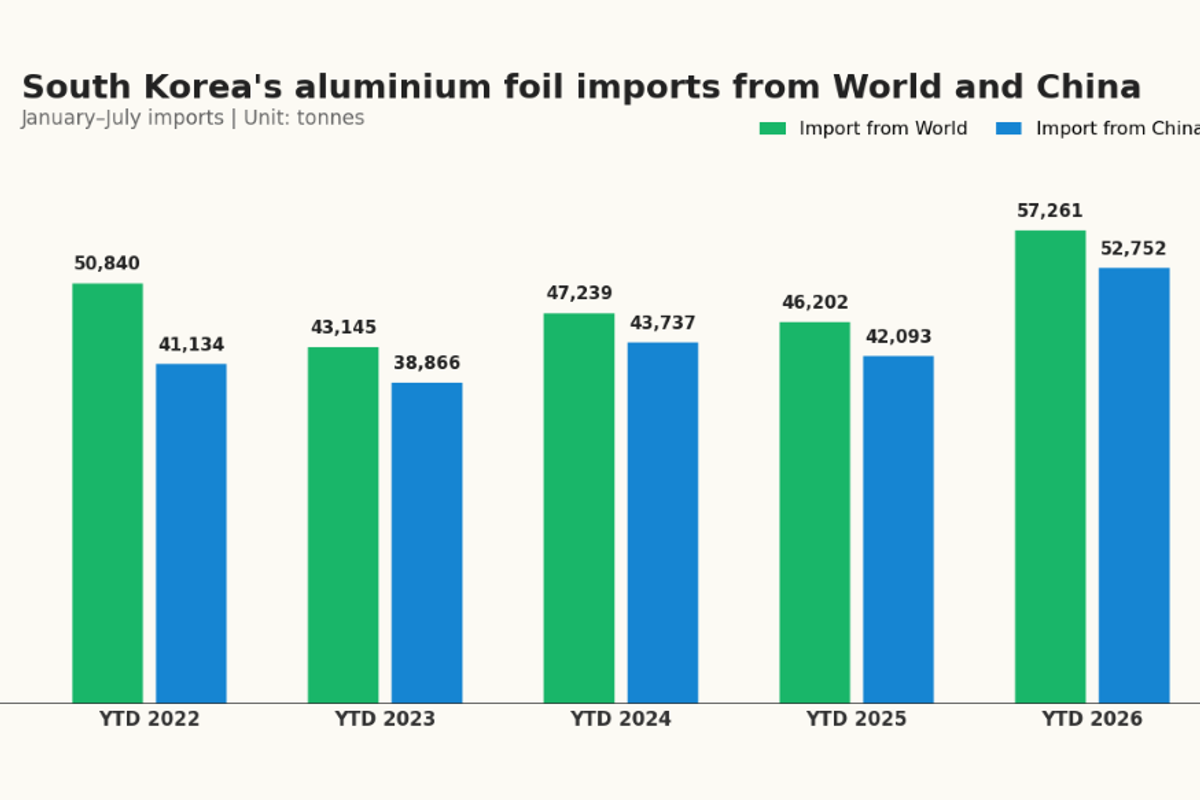
South Korea imported 57,261.18 tonnes of aluminium foil from the world in YTD July 2026, up 23.94 per cent from 46,201.68 tonnes in YTD July 2025. Imports stood at 50,840.22 tonnes in YTD 2022, 43,145.18 tonnes in YTD 2023 and 47,238.94 tonnes in YTD 2024, before slipping to 46,201.68 tonnes in 2025, as per ITA.
The return to growth is clear, but the supplier data reveals where that recovery is coming from.
China supplies 92% of South Korea’s aluminium foil imports
China supplied 52,751.81 tonnes of aluminium foil to South Korea in YTD July 2026, an increase of 25.32 per cent from 42,093.41 tonnes in YTD July 2025.
That lifted China's share of the Korean market from 91.11 per cent to 92.12 per cent in just one year.
The difference becomes clearer when the increase is compared in terms of actual volume. South Korea's total aluminium foil imports increased by 11,059.50 tonnes between YTD July 2025 and YTD July 2026. Chinese supplies alone increased by 10,658.40 tonnes. Explore: The most comprehensive and forward-looking industry-focused report – Aluminum Foil Market Report Forecast Till 2035
China’s dominance has been building since 2022
China's leading position in South Korea is not a new development. The country has been increasing its share of the Korean aluminium foil market for several years.
In YTD 2022, China supplied 41,133.77 tonnes, accounting for 80.91 per cent of South Korea's total imports. Chinese supplies declined 5.51 per cent to 38,866.08 tonnes in YTD 2023, but China's share still increased to 90.08 per cent as overall Korean imports fell to 43,145.18 tonnes.
China then increased its shipments 12.53 per cent to 43,737.44 tonnes in YTD 2024. In YTD 2025, Chinese supplies again fell 3.76 per cent to 42,093.41 tonnes.
Top aluminium foil exporters to South Korea
After China, Thailand remained South Korea’s second-largest supplier in YTD July 2026, but its shipments fell 15.44 per cent to 1,539.94 tonnes from 1,821.2 tonnes in YTD July 2025. Compared with 1,700.11 tonnes in YTD July 2024, Thailand’s supplies were down 9.42 per cent.
Japan moved into third place, with shipments rising 60.84 per cent year on year to 987.76 tonnes from 614.14 tonnes. Over two years, supplies increased 89.71 per cent from 520.67 tonnes in YTD July 2024.
Germany ranked fourth, supplying 510.95 tonnes in YTD July 2026, up 14.79 per cent from 445.1 tonnes a year earlier. Its shipments more than doubled from 231.32 tonnes in YTD July 2024, recording a 120.88 per cent increase over two years.
Slovenia completed the top five in YTD July 2026 with 261.38 tonnes. It replaced Malaysia, which was the fifth-largest supplier in YTD July 2025 with 282.84 tonnes.
Connect with verified aluminium extrusion buyers and suppliers through the AL Biz marketplace
Battery production is adding to aluminium foil demand
South Korea's battery industry is one of the areas generating additional aluminium foil requirements. Aluminium foil is used as the cathode current collector in lithium-ion cells, making it an essential component in battery manufacturing.
LG Energy Solution began production of 46-series cylindrical batteries at its Ochang plant and had secured an order backlog exceeding 300 GWh for the format by the end of 2025. Samsung SDI also began mass production of 46-series cylindrical batteries at its Cheonan plant in March 2025.
The scale of this industry helps explain the potential impact on foil demand. Lotte Aluminium estimates that one GWh of battery capacity requires around 700 tonnes of electric foil. As battery production expands, the associated requirement for foil can therefore increase quickly.
The Korean government and industry are continuing to invest in the sector. In September 2026, the Ministry of Trade, Industry and Energy announced a next-generation battery programme involving approximately KRW 400 billion in government R&D spending over five years. Industry participants have also committed around KRW 8 trillion towards R&D and production-facility expansion from 2026 to 2030, creating further requirements for battery materials, including aluminium foil.
Battery manufacturing is not the only source of demand. In south Korea, aluminium foil is also used in food, pharmaceutical and consumer-goods packaging, including flexible laminates, lidding and blister applications.
Why China is supplying most of South Korea’s additional aluminium foil
China’s lead in South Korea’s aluminium foil market is linked to both product range and supply scale. Korean buyers source several types of foil, including unbacked foil, jumbo rolls, flexible-packaging foil, pharmaceutical foil, capacitor foil and increasingly battery-related material.
Chinese producers can supply these different requirements, from price-sensitive packaging and converter-grade jumbo rolls to thin-gauge and battery-related foil, where tighter thickness control, surface condition and consistent quality are required. China also has a large export base, with aluminium foil exports reaching 802,000 tonnes in January-July 2026.
For Korean buyers, this combination of product variety, manufacturing scale and availability makes China a practical source across multiple end-use sectors, helping explain its continued dominance in the Korean market.
Unlock key insights from leading companies and experts across the aluminium ecosystem with our e-Magazine - Mine to Market: ALuminium Producers & Manufacturers 2026
Worldwide Aluminium shareholders back FY26 accounts and director reappointment with 99.86% support
Next articleGermany’s aluminium FRP consumption reaches 1.68 Mt as 2025 trade surplus tops $3.1 billion
Grow with
AL Circle