South Korea
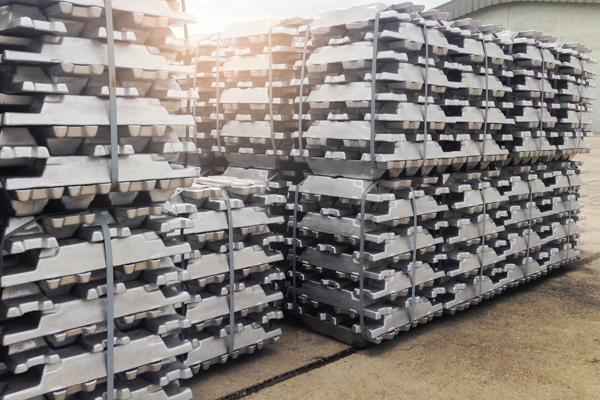
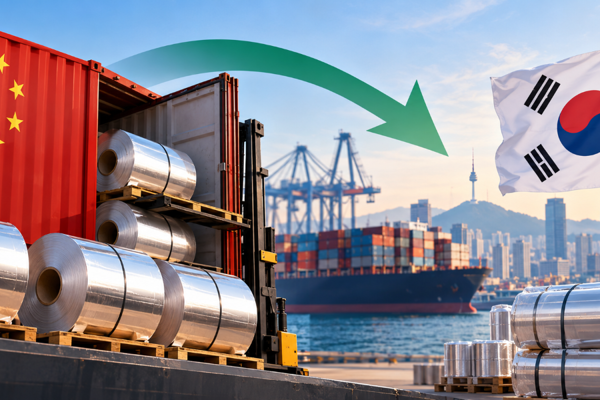
South Korea’s aluminium foil imports hit five-year high at 57kt in YTD July 2026 as China drives 96% of new volume
South Korea’s aluminium foil market has entered a stronger phase in 2026, with imports reaching their highest level in five years. But the trade data points to a more specific shift beneath the headline growth: most of the additional aluminium foil entering South Korea is coming from China. South Korea imported 57,261.18 tonnes of aluminium foil from the world in YTD July 2026, up 23.94 per cent from 46,201.68 tonnes in YTD July 2025. Imports stood at 50,840.22 tonnes in YTD 2022, 43,145.18 tonnes in YTD 2023 and 47,238.94 tonnes in YTD 2024, before slipping to 46,201.68 tonnes in 2025, as per ITA. The return to growth is clear, but the supplier data reveals where that recovery is coming from. China supplies 92% of South Korea’s aluminium foil imports China supplied 52,751.81 tonnes of...
Ex-China aluminium market runs steadily as market awaits Q4 MJP settlement
This week, the overseas aluminium market was generally mediocre, with limited trading activity across major markets. In South Korea, purchases were mainly small-scale restocking, with little change in prices. In Thailand, demand remained weak, and some sellers slightly lowered their offers due to shipment pressure. The market focused on Q4 MJP quarterly pricing, with Rio Tinto's latest offer further reduced, and market expectations suggested there is still room for the final settlement price to move lower. South Korea: Mediocre market, transactions mainly small-scale restocking This week, trading in the South Korean market was very subdued, with purchasing demand limited to small-scale restocking and no concentrated procurement seen. Sellers showed moderate willingness to offer, with...
Grow with
AL Circle
Price
→Events

15th International Bauxite, Alumina & Aluminium Conference & Exhibition - IBAAS–VFMSTA 2026
ICSOBA 2026 - 44th International Conference and Exhibition
SMM AICE 2026 Southeast Asia Aluminum Conference
15th International Bauxite, Alumina & Aluminium Conference & Exhibition - IBAAS–VFMSTA 2026
ICSOBA 2026 - 44th International Conference and Exhibition
SMM AICE 2026 Southeast Asia Aluminum Conference
Business Cards
A report that reveals where the aluminium casting industry is heading and how businesses can act.
LEARN MORE
A report that reveals where the aluminium casting industry is heading and how businesses can act.
LEARN MOREGlobal EV sales to hit 35.4 million by 2030, with aluminium usage forecast to rise 38% in North America & 79% in China
AL Circle analysis: How do Germany’s 32.8% automotive aluminium share, 40% Diet Coke can price rise & 3.54Mt North American extrusion demand matter?
AL Circle Analysis: Guinea’s 150Mt bauxite cap, China’s import swings, US tariffs draw aluminium Q4’26
EU approves Germany’s power relief instrument: Could aluminium producers save €459m annually?
North America’s aluminum extrusion demand set to reach 3.54Mt by 2035: The end-use sectors behind the climb
News
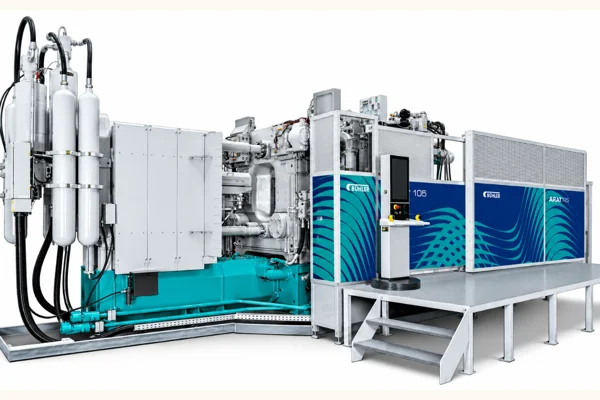
Bühler celebrates 20 years of die-casting collaboration with Hyundai
Swiss technology group Bühler is marking 20 years of collaboration with Hyundai Motor Group. The partnership began with the installation of the first machine, an Evolution 270D, at Hyundai’s Ulsan complex in South Korea two decades ago. Since then, Bühler has delivered 43 die-casting systems to Hyundai production sites, including Carat and Evolution machines, across production sites in South Korea, China, and India. “Strong partners make strong products. For more than 20 years, Bühler has been a trusted partner, providing the solutions and expertise that help us maintain excellence in manufacturing. This collaboration strengthens our ability to innovate and build the future of mobility on a strong foundation,” said Jong Cheol Kim, Production Team Senior Manager at Hyundai. At the centre...

Korea’s 483kt of Russian aluminium imports hit record high as sanctions risks deepen
South Korea’s Russian aluminium imports reached a record high in 2025, making Russia the country’s largest aluminium supplier for the first time. The sharp increase has strengthened Korea’s dependence on Russian metal even as the US and Europe tighten sanctions against Moscow. The exposure is significant for Korea’s defence industry, where aluminium and its alloys are used in missiles and other weapons systems. Korea imported 483,084 tonnes of aluminium from Russia in 2025, according to Korea Customs Service data, representing a 41 per cent increase year on year. The volume exceeded imports from Australia at 408,657 tonnes and China at 394,837 tonnes. The shift has become increasingly pronounced since 2022. Compared with the 120,629 tonnes imported from Russia in 2021, last year’s volume...

Hyundai expands beyond cars as robotics becomes a new growth engine
What happens when an automaker starts building a business beyond cars? For Hyundai Motor Co., robotics is becoming a key part of that shift, with the company moving from using robots in its factories to developing, manufacturing and deploying them at scale. Hyundai is laying the groundwork to become a physical AI and technology company following its takeover of robotics maker Boston Dynamics. The move comes as the company looks to diversify its revenue, with its automotive business currently accounting for nearly 80 per cent of revenue. The next step is already taking shape at Hyundai Motor Group Metaplant America in Savannah, Georgia, where the company manufactures all-electric vehicles. Hyundai opened its Robot Metaplant Application Center there in June. The centre simulates real...

South Korean restocking provides brief support, but Asian primary aluminium spot premiums remain weak
The overseas primary aluminium spot market remained subdued this week. Although limited restocking briefly improved trading activity in South Korea at the beginning of the week, the recovery was not sustained, and transactions weakened again from midweek. Elsewhere in Asia, the traditional downstream off-season continued to restrict purchasing activity. Thailand recorded few inquiries and particularly weak trading, while Japan’s spot MJP moved lower as sellers faced increasing difficulty securing transactions. In the United States, the Midwest DDP premium showed little change from the previous week. Review of spot premiums by region According to SMM data, overseas primary aluminium spot premiums remained under pressure this week as weak seasonal consumption continued to limit downstream...

China June primary aluminium imports slump 13.2 per cent as Russia share tops 90 per cent; exports surge on South Korea demand
In June 2026, China's primary aluminium trade exhibited a pronounced divergence, marked by contracting imports and surging exports. Imports declined sharply in both volume and value, while their origins remained highly concentrated, with Russia retaining its firm lead as the top supplier. On the export front, Asian markets asserted clear dominance, with South Korea and India collectively accounting for nearly 80 per cent of total outbound shipments. Export volumes soared across the board, with dispatches to South Korea registering a month-on-month explosion. Total primary aluminium imports for June reached approximately 167,100 tonnes, reflecting a year-on-year decrease of 13.15 per cent and a month-on-month drop of 19.74 per cent. Cumulatively, imports for the first six months amounted...

Samsung and SK Hynix: How South Korea came to power two-thirds of the world's memory chips
Pick up almost any electronic device made over the past five years—a smartphone, an AI server, a laptop or an autonomous-driving computer. Hidden beneath the casing, the memory chips inside are likely to have been manufactured in just three South Korean cities: Hwaseong, Pyeongtaek or Icheon. Even more remarkable is that those chips were probably made by only two companies—Samsung Electronics and SK Hynix. Together, they produce roughly two-thirds of the world's memory chips and have a combined market capitalisation of more than USD 700 billion. That reality would have been almost impossible to imagine in 1953. South Korea had no semiconductor industry, no precision-manufacturing ecosystem, no advanced engineering workforce and no capital markets capable of supporting such an industry....














Blog
LATEST POSTS





Turn marketplace visibility into more relevant buyer enquiries.
View Priority Plans
Turn marketplace visibility into more relevant buyer enquiries.
View Priority Plans
