Who’s holding up Germany’s aluminium game? Meet EGA, Hydro and Constellium
The image used in this article is generated with an AI tool and does not depict any real-time moment
Germany does cars, machinery and engineering rather well, and all of that needs a lot of aluminium. So, when three international players put serious money and muscle into the country's aluminium industry, it's worth a look.
Together, the three companies offer an interesting snapshot of more recycling, more specialised products, stronger local supply chains and lower-carbon production. Here is who is doing what, and why it matters.
EGA: The Gulf giant moving into Hannover
Emirates Global Aluminium (EGA) is the world's largest "premium aluminium" producer. It already ships over 600,000 tonnes of primary aluminium to Europe every year, with the automotive and construction industries among its key customers. Then it did something it hadn't done in a decade: it bought a company.
That company was Leichtmetall, a Hannover-based speciality foundry. The deal was EGA's first major acquisition since it was formed through the merger of Dubai Aluminium and Emirates Aluminium. Leichtmetall runs on renewable energy and produces up to 30,000 tonnes of billets a year, with secondary aluminium making up 80 per cent of its input. Its hard alloys and billets of up to 1,150 millimetres in diameter end up in high-load extruded profiles and very large forged components.
Then came the bigger news. In December 2025, EGA announced a new facility near Hannover that will lift recycling capacity more than six-fold. It adds 110,000 tonnes a year of scrap-sorting capacity and 153,000 tonnes a year of melting and casting capacity, against the current 30,000 or so. Reports put the investment at around USD 170 million.
The plans include some neat technical touches:
- Smarter sorting: X-ray and laser systems will separate scrap by alloy, grade and impurity level.
- Post-consumer scrap: this will be used to make high-quality aluminium for demanding applications for the first time.
- Less waste: recycling uses salt to bind impurities, which normally creates salt slag as waste. At the new site, the salt will be almost entirely recovered and reused.
Europe is also the third-largest recycled aluminium market in the world, after the USA and China, so the timing is sensible. Recycled aluminium already supplies around 40 per cent of Europe’s aluminium demand, with consumption estimated at about 4.9 million tonnes annually in 2025. That figure is expected to rise to around 7.2 million tonnes by 2033.
To know the global production, demand and consumption forecasts of aluminium extrusions, explore our report "The World of Aluminium Extrusions to 2035"
Hydro: The backbone having a German footprint with a European supply-chain mission
Norway's Norsk Hydro is less a newcomer than a fixture. It calls itself the largest and most versatile aluminium company in Germany, and its presence backs that up, with 17 locations across the country, employing over 1800 people.
Its German extrusion plants in Offenburg, Rackwitz and Uphusen manufacture customised aluminium profiles for industrial customers, while Ulm is a centre of excellence for its WICONA building-systems business.
Neuss is the standout. It is home to the country's largest primary aluminium production. Building-systems activities are spread across several locations, Ulm among them. Hydro's German headquarters sits in Grevenbroich, and its Dormagen office mainly supports the Recycling Technologies division.
A new wire rod casthouse at its Karmøy plant in Norway represents an investment of NOK 1.65 billion and will add 110,000 tonnes per year of capacity for low-carbon aluminium wire rod used in power cables. The company has agreements covering close to 360,000 tonnes of aluminium for European electricity transmission and distribution infrastructure.
At ALUMINIUM 2026 in Düsseldorf, Hydro highlighted investments in renewable energy, recycling, production capacity and partnerships across Europe. The company said it had reached approximately 850,000 tonnes of annual post-consumer aluminium recycling capacity by the end of 2025, while continuing to expand its European recycling network.
Constellium: Foil for the battery age
Constellium's Singen plant has more than 1,300 employees and is one of the company's largest sites. It has an integrated hot and cold rolling line, high-grade cold mills and one of the largest extrusion presses in the world. It serves automotive customers (structural components and auto body sheet), packaging, and special-surface applications. It has also been ASI-certified since 2019.
Its latest chapter is a EUR 30 million (about USD 35 million) investment, made with Lotte Infracell, a subsidiary of Lotte Aluminium. The new finishing lines will supply high-quality aluminium foilstock for battery applications in Europe. The project came in on schedule and on budget, and the first coil rolled off in November 2025. The lines handle coils up to 2,000 mm wide and 1.3 mm thick, and a new solar power system is expected to generate roughly 760,000 kWh a year.
The plant's director described the new capacity as supporting the shift to e-mobility and sustainable energy.
In July 2026, it announced a 10-year power purchase agreement under which its Gottmadingen and Singen plants will receive locally generated solar electricity from the Katzental solar park. The renewable electricity is expected to cover more than 25% of the combined electricity needs of the two facilities and avoid approximately 3,500 tonnes of CO₂ emissions annually. Supply is scheduled to begin in spring 2027.
So, are they really "life-savers"?
"Life-saver" is a big word, so let's keep it honest. These investments don't mean every German smelter's troubles are solved. But the pattern is clear:
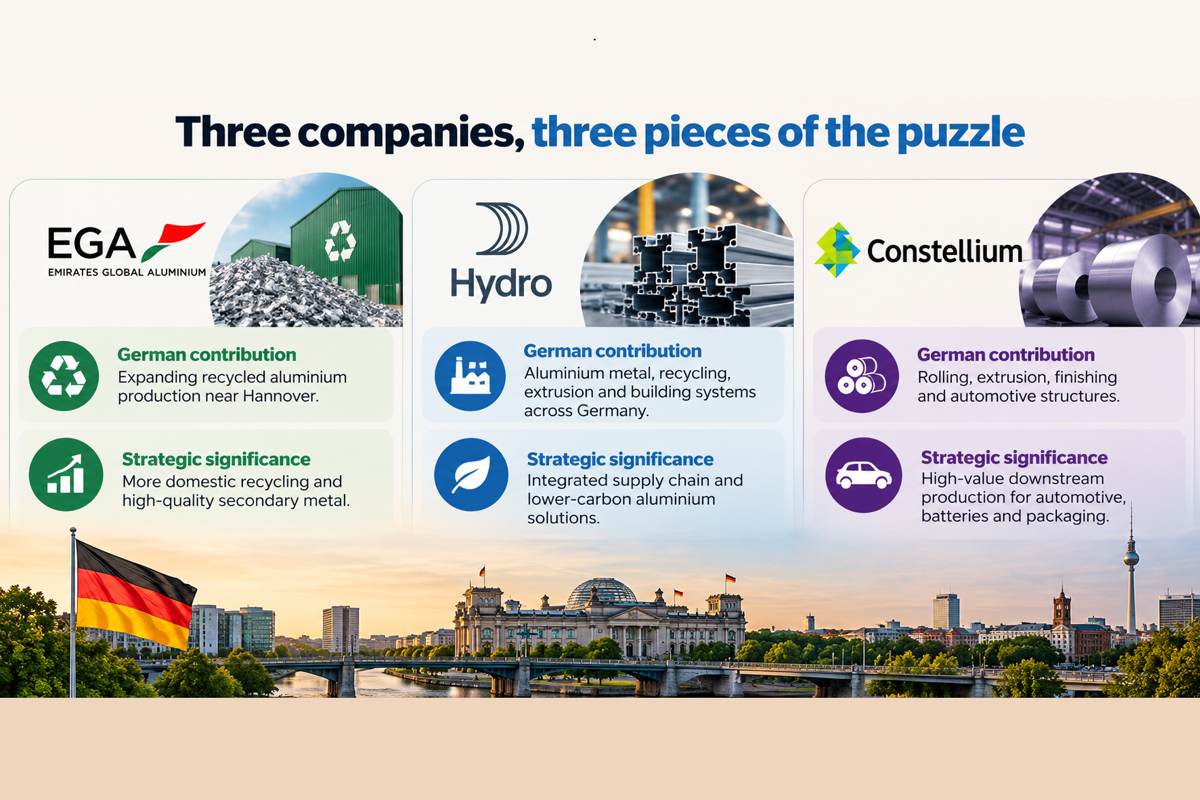
- EGA is betting on recycled and low-carbon aluminium.
- Hydro provides scale and continuity, from primary metal to rolled and extruded products.
- Constellium is betting on batteries and e-mobility.
Together they cover three of the biggest themes in the aluminium industry: aluminium recycling, lower-carbon metal, and the demands of electric vehicles. A country that wants to keep making things needs partners willing to invest in it, and these three are doing exactly that.
Note: This is exclusive coverage by AL Circle and may not be reproduced, republished or shared without prior permission.
Explore downstream aluminium products from our comprehensive list on AL Biz.
Sharvaya Metals adds new aluminium extrusion press, expands precision manufacturing capability
Next articleBrazilian industry grows more cautious as industrial confidence falls to 44.9
Grow with
AL Circle