India’s alumina refinery investment landscape: What does it really cost to build a competitive refinery?
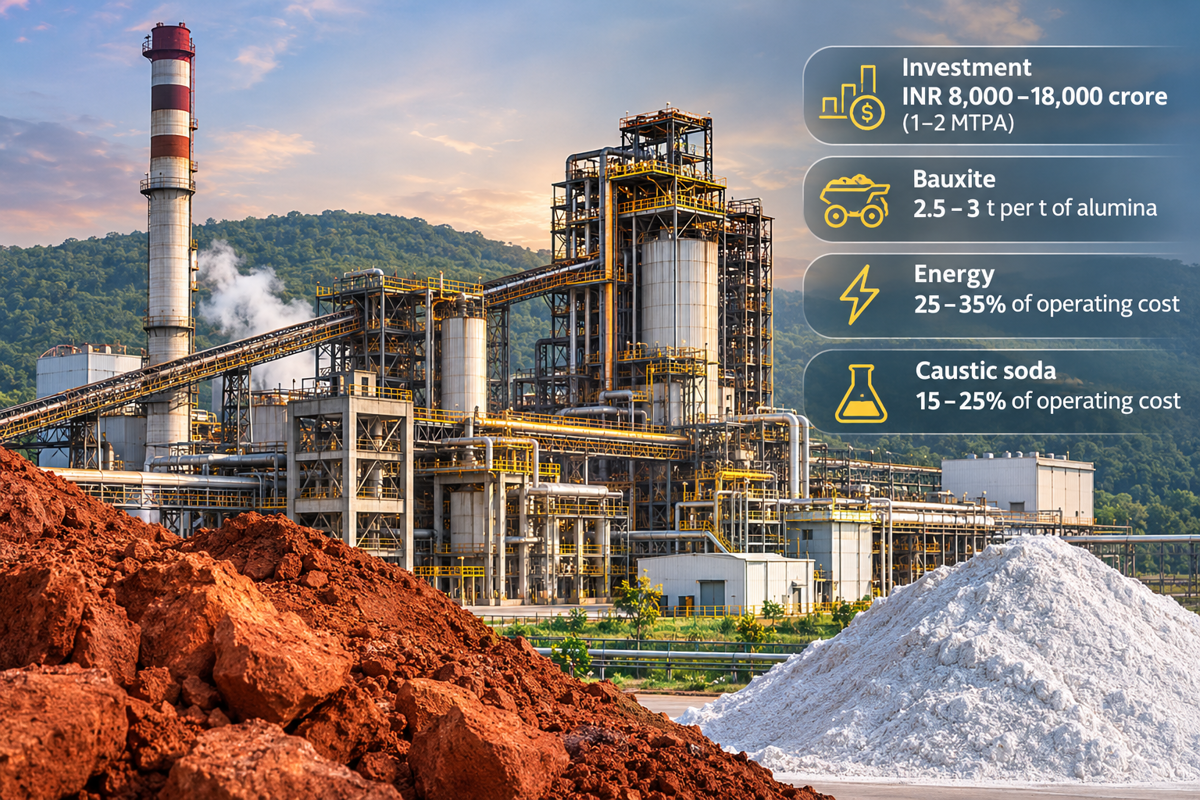
The image used in this article is generated with an AI tool and does not depict any real-time moment
India’s alumina refining industry is expanding, but establishing a commercially competitive refinery involves considerably more than securing bauxite and installing processing equipment. Raw material quality, energy availability, chemical consumption, logistics and environmental compliance all influence the economics of a project.
The scale of the opportunity is evident from India's aluminium production base. The country produced approximately 4.2 million tonnes of primary aluminium in FY 2024-25, alongside 24.7 million tonnes of bauxite, according to the Ministry of Mines.
However, having access to domestic bauxite does not automatically translate into competitively priced alumina. With established producers expanding their refining capacities, the question for prospective investors is whether a new facility can secure its inputs and operate efficiently enough to compete.
To know the futuristic market and value proposition of red mud, explore the report "A Comprehensive Analysis of Bauxite Residue (Red Mud): Sustainability, Resource Recovery and Strategic Recommendations"
What does it cost to establish an alumina refinery in India?
According to IMARC Group's indicative assessment, establishing a smelter-grade alumina refinery with an annual capacity of 1-2 million tonnes could require an investment of INR 8,000 crore to INR 18,000 crore.
Smaller speciality and chemical-grade alumina facilities involve a substantially lower indicative investment of INR 150 crore to INR 1,000 crore.
The difference reflects two distinct business models. Large refineries primarily supply metallurgical alumina to aluminium smelters, making production scale and raw material security central to their economics. Specialty alumina facilities, meanwhile, serve applications such as ceramics, refractories, catalysts and abrasives, where product specifications and customer requirements influence commercial value.
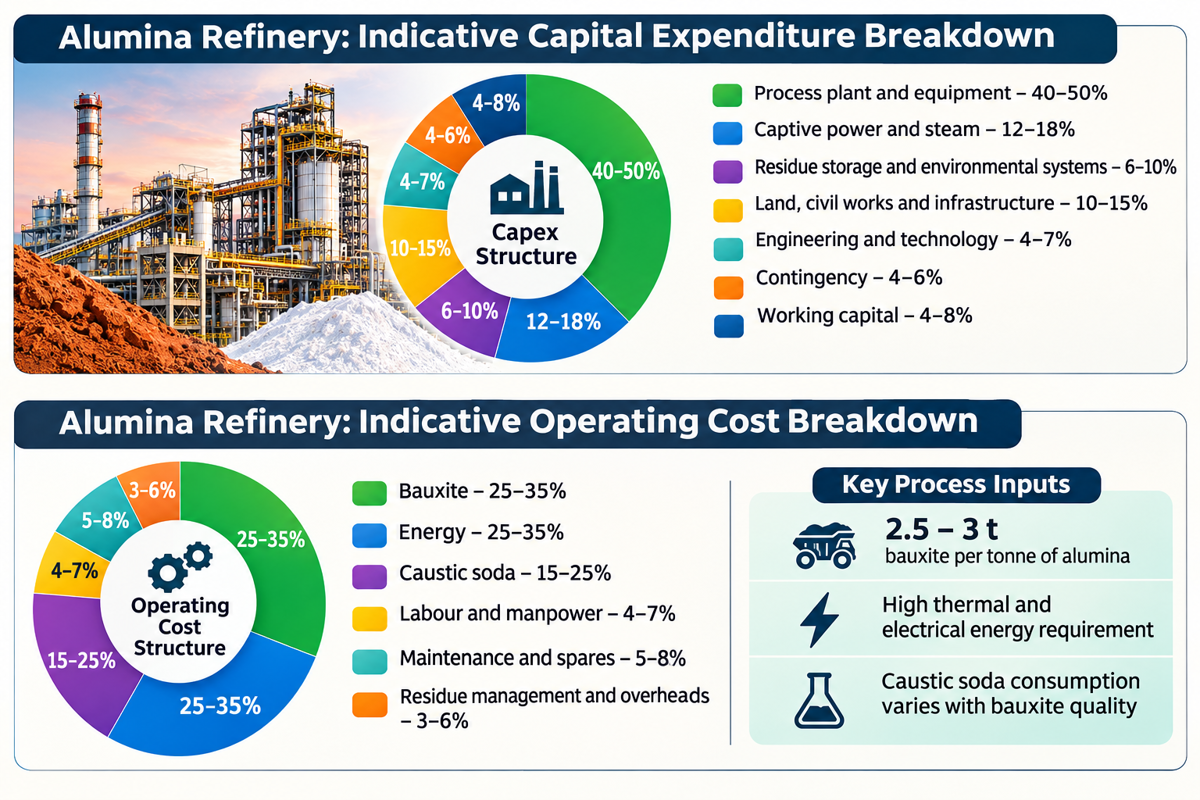
The investment breakdown for a large refinery also extends well beyond the processing plant.
Processing equipment accounts for the largest share, covering digestion, clarification, precipitation, evaporation and calcination. But supporting infrastructure can significantly affect the final investment. A greenfield project may also require captive power and steam facilities, water treatment systems, railway connections and engineered residue storage.
This is where location becomes particularly important. An existing industrial complex may already have access to land, utilities and transport infrastructure, whereas a new entrant could have to finance these facilities independently. Consequently, the cost of expanding an existing refinery may not be directly comparable with that of establishing a greenfield facility.
The INR 8,000–18,000 crore estimate should therefore be treated as an initial reference rather than a universal project cost. Bauxite quality, mine-to-refinery distance, infrastructure requirements, financing costs and construction timelines can all change the final capital requirement.
Bauxite, energy and caustic soda shape refinery economics
The Bayer process is the principal industrial route for producing smelter-grade alumina. It involves digesting crushed bauxite in heated caustic soda, separating insoluble residue, precipitating aluminium hydroxide and calcining it to produce alumina.
Although the technology is well established, the cost of operating a refinery depends heavily on the quality of the ore and the efficiency of its processing.
Bauxite procurement is a major consideration because a typical smelter-grade refinery requires approximately 2.5–3 tonnes of bauxite to produce one tonne of alumina. The actual requirement depends on ore characteristics and recovery efficiency. Alumina content and reactive silica also influence caustic soda consumption and processing requirements.
Operating data from Hindalco's Utkal Alumina illustrate this relationship. In FY 2024-25, the refinery reported bauxite consumption of 2.96 tonnes and caustic soda consumption of 52.96 kg per tonne of calcined alumina. Its reported coal consumption was approximately 417.84 kg per tonne.
Energy is another significant cost consideration. Refining requires thermal energy for digestion, evaporation and calcination, alongside electricity for crushing, grinding and pumping. Reliable supply is essential for continuous operations, while captive power and cogeneration facilities can help manage electricity and steam requirements.
Explore alumina and other essential inputs in the right grades from global suppliers on AL Biz.
Does India's bauxite supply support further refinery expansion?
India has a substantial domestic bauxite resource base, although production is geographically concentrated.
The Ministry of Mines reported bauxite production of 24.7 million tonnes in FY 2024-25, compared with 24 million tonnes in FY 2023-24, with Odisha remaining the leading producing state.
NITI Aayog, drawing on Ministry of Mines data, reported domestic bauxite supply of 24.742 million tonnes against apparent consumption of 27.405 million tonnes in FY 2024-25. This placed India's bauxite self-sufficiency at approximately 90 per cent.
The figures suggest that domestic resources meet most of the country's bauxite requirements, but they also point to a supply gap relevant to future refinery investments.
Odisha offers an established mining and refining ecosystem, with access to mineral resources and east-coast transport infrastructure. However, the presence of bauxite deposits does not automatically guarantee mining rights or economically viable supplies. Mining leases, environmental permissions, ore quality and transportation costs remain important considerations.
How established producers are expanding India's alumina capacity
The expansion plans of existing producers offer a useful indication of where India's refining industry is heading.
Vedanta's Lanjigarh expansion: Vedanta has expanded the designed capacity of its Lanjigarh refinery in Odisha from 2 MTPA to 5 MTPA. Production from Train 1 began in March 2024, followed by Train 2 in October 2025.
In FY 2025-26, the refinery produced 2.916 million tonnes of calcined alumina, compared with 1.975 million tonnes in the previous financial year. It achieved a production run rate of 4 MTPA in March 2026, with full ramp-up targeted during FY 2026-27.
The company is also progressing with its Sijimali bauxite block in Odisha, which has a stated production capacity of 9 MTPA. The development is intended to strengthen raw material security as refining capacity increases.
NALCO's additional refinery stream: National Aluminium Company Limited (NALCO) is pursuing a 1 MTPA capacity addition through a fifth stream at its Damanjodi refinery. Its FY 2025 sustainability report identified 2026 as the scheduled completion and production commencement period.
The project is supported by the planned development of the Pottangi bauxite mine and a crushing and conveying system to provide an alternative ore source.
NALCO also achieved record calcined alumina production of 2.275 million tonnes in FY 2025-26, alongside alumina hydrate production of 2.3 million tonnes.
Hindalco's established refining operations: Hindalco's Utkal Alumina International Limited in Rayagada, Odisha, reported a calcined alumina production capacity of 2.67 MTPA in its FY 2024-25 environmental statement. Its disclosures also provide useful operating data on raw material, chemical and energy consumption.
Together, these developments demonstrate that India's existing producers are approaching capacity expansion alongside investments in mining and supporting infrastructure. For a new entrant, competing with these established operations will require a similarly robust supply-chain strategy.
Alumina trade offers opportunities beyond the domestic market
Despite its established refining base, India remains active in both alumina imports and exports.
The Ministry of Mines' trade analysis for aluminium oxide under HS Code 281820 recorded imports of 2.5 million tonnes and exports of 2.1 million tonnes in 2023. Major import sources included Indonesia, Australia and Vietnam, while Oman, Russia, the UK and the UAE featured among export destinations.
This two-way trade reflects differences in product requirements, supply arrangements, geographical demand and international pricing. Domestic production does not necessarily eliminate the need for imports, just as additional refining capacity does not automatically translate into export competitiveness.
Unlock key insights from leading companies and experts across the aluminium ecosystem with our e-Magazine - Mine to Market: Aluminium Producers & Manufacturers 2026
Red mud management adds to the investment equation
Bauxite residue, commonly known as red mud, is another significant consideration in refinery planning. The highly alkaline residue generated during the Bayer process requires engineered storage and careful environmental management.
The Central Pollution Control Board's guidelines identify dry stacking as an important management approach. They define a dry-stacked filter cake with moisture content below 28 per cent and alkali concentration, expressed as Na₂O, below 3 per cent.
Filtration and dry stacking can improve water recovery and reduce the moisture content of residue, but require investment in equipment, storage infrastructure and monitoring systems.
There is also growing research into recovering iron, titanium and other valuable components from bauxite residue, alongside potential applications in cement and construction materials. However, commercial viability will depend on processing costs, product quality and market acceptance.
Water availability and recycling also need to be considered. Utkal Alumina reported process water consumption of 1.31 kilolitres per tonne of hydrate production expressed as alumina in FY 2024-25, compared with 1.33 kilolitres in the preceding year.
For new projects, residue management, water treatment and environmental compliance must be incorporated into the original plant design rather than treated as additional requirements after construction.
What should investors consider before committing capital?
Beyond the initial investment, the viability of an alumina refinery depends on whether its operating model can withstand changes in raw material prices, energy costs and international alumina markets.
Investors need to establish reliable bauxite supplies, assess the economics of captive power and steam, and account for water, transport and residue management infrastructure. Equally important is identifying the intended customer base, whether captive aluminium smelters, domestic buyers or export markets.
IMARC's assessment presents indicative EBITDA margins of 20-35 per cent, net profit margins of 10-18 per cent, internal rates of return of 12-18 per cent and payback periods of 6–9 years for a large refinery. These are modelled reference assumptions, not guaranteed returns or independently established outcomes for Indian projects.
A project-specific feasibility study would need to test these assumptions against actual input costs, expected capacity utilisation, financing requirements and potential delays.
India's expanding alumina refining base presents opportunities for further investment, but the economics are becoming increasingly dependent on integration across mining, processing and infrastructure. The experience of Vedanta, NALCO and Hindalco shows why securing raw materials and supporting utilities is as important as building processing capacity.
Grow with
AL Circle












_md.webp)
_md.webp)
_md.webp)