Global EV sales to hit 35.4 million by 2030, with aluminium usage forecast to rise 38% in North America & 79% in China
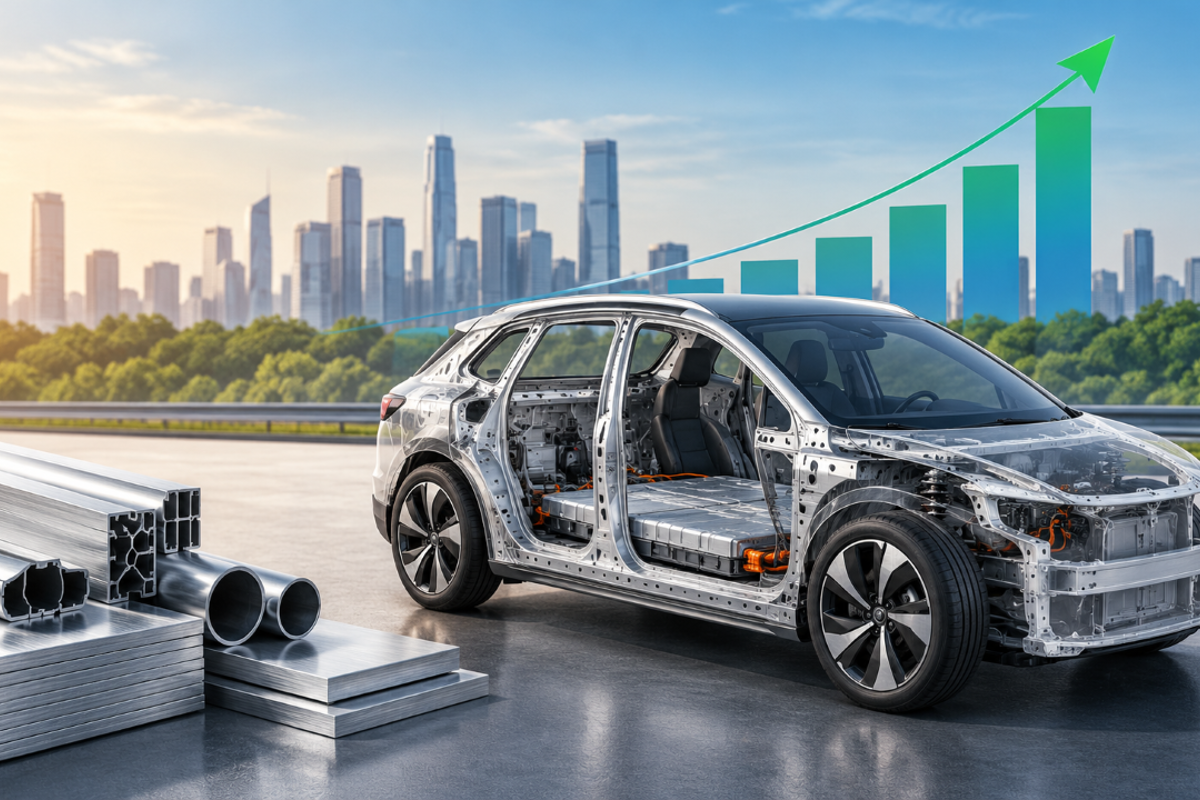
The image used in this article is generated with an AI tool and does not depict any real-time moment
From just 2 million vehicles in 2018 to a projected 35.4 million in 2030, the rise of electric vehicles (EVs) is reshaping the global automotive industry - and changing how much aluminium goes into every car. As automakers expand EV production, aluminium is finding new applications in battery enclosures, electric-drive housings, vehicle bodies and structural components, making the metal an increasingly important part of the industry's transition.
Global sales of battery-electric vehicles (BEVs) and plug-in hybrid electric vehicles (PHEVs) are projected to reach 23.3 million units in 2026, up 11 per cent from 21 million in 2025. Sales are forecast to rise to 26.1 million in 2027, 29.2 million in 2028 and 32.2 million in 2029, before reaching 35.4 million in 2030.
The market has grown rapidly over the past several years. Global EV sales increased from 2.2 million units in 2019 to 3.2 million in 2020 and 6.5 million in 2021. Sales reached 10.4 million in 2022, rose to 13.9 million in 2023 and climbed to 17.6 million in 2024 before reaching 21 million in 2025.
By 2026, EVs are expected to account for 27 per cent of global passenger-vehicle sales, compared with less than 5 per cent six years earlier. Between 2025 and 2030, annual sales are projected to increase by 14.4 million units, representing a compound annual growth rate of 11 per cent.
For the aluminium industry, this expansion raises an important question: as more electric cars enter the market, how much aluminium will they use, and which components will drive the next phase of demand?
How much aluminium goes into an electric car?
The answer depends on the vehicle's design, powertrain and manufacturing location. In Europe, battery electric vehicles (BEVs) contained an average of 283 kg of aluminium per vehicle in 2022. This figure is estimated to have increased to 310 kg in 2025, marking a 9.5 per cent rise over three years. However, aluminium content in BEVs is projected to decline to 275 kg by 2030, an 11.3 per cent decrease from 2025.
Despite this forecast reduction, BEVs used considerably more aluminium than conventional internal combustion engine (ICE)-only cars in 2022. With an average of 283 kg per vehicle compared with 169 kg for ICE-only cars, BEVs contained 67.5 per cent more aluminium.
Plug-in hybrid electric vehicles (PHEVs) are forecast to increase from 277 kg to 281 kg, representing a 1.4 per cent increase over the same period.
By contrast, mild hybrid electric vehicles (MHEVs) are projected to experience a more substantial decline, with aluminium content falling from 259 kg per vehicle in 2022 to 211 kg in 2030, a decrease of 18.5 per cent. Full hybrid electric vehicles (FHEVs) are expected to remain unchanged at 156 kg per vehicle, with no percentage change over the period.
European BEVs contained 283 kg of aluminium per vehicle in 2022, with the figure estimated to have reached 310 kg in 2025 before declining to 275 kg by 2030. Even with this projected decline, BEVs contained 67.5 per cent more aluminium per vehicle than conventional internal combustion engine (ICE)-only cars in 2022.
Plug-in hybrids are forecast to rise from 277 kg to 281 kg over the same period. Mild hybrid electric vehicles (MHEVs), by contrast, are projected to decline from 259 kg to 211 kg, while full hybrid electric vehicles (FHEVs) are expected to remain at 156 kg.
These differences show why the relationship between EV sales and aluminium demand is not always straightforward. Electrification creates new applications, but changes in vehicle architecture, component design and material selection can also influence how much aluminium goes into each car.
To know the aluminium casting demand forecast in the transportation sector, explore our report "Global Aluminium Casting Market 2026-2032: Plant Economics, Alloy Segmentation, Pricing Intelligence, Supply Chain Analysis & Strategic Recommendations"
North America and China show different aluminium trends
The shift towards electric mobility is also changing aluminium use in North America and China, although the projected increases differ.
In North America, aluminium content in BEVs rose from 292 kg per vehicle in 2020 to 365 kg in 2022. It is forecast to reach 404 kg by 2030. For non-BEV light vehicles, aluminium content increased from 206 kg in 2020 to 217 kg in 2022 and is projected to reach 222 kg by 2030.
As a result, the difference between BEVs and non-BEVs is expected to widen from 86 kg per vehicle in 2020 to 148 kg in 2022 and 182 kg by 2030. This projected gap highlights the importance of EV-specific applications in the North American market.
China is also expected to record substantial growth in aluminium content. Average aluminium use across all passenger vehicles rose from 138.6 kg per vehicle in 2020 to 177.4 kg in 2024. The figure is estimated at 187.1 kg in 2025 and forecast to reach 242.2 kg by 2030.
For Chinese BEVs, aluminium content is projected to increase from 157.9 kg per vehicle in 2020 to 283.5 kg in 2030. hybrid passenger vehicles, including HEVs and PHEVs, the figure is expected to increase from 198.1 kg to 265.2 kg over the same period.
The battery pack is creating new opportunities for aluminium
One of the main uses of aluminium in electric vehicles is the battery pack. Typically weighing around 300–400 kg, the pack adds considerable weight to an EV. Automakers therefore look for materials that can make the battery housing strong enough to protect its contents without adding too much weight to the vehicle.
Aluminium is widely used in these applications because it is lightweight, offers good structural strength and conducts heat effectively. Its density is about one-third that of steel. Depending on the component and design, replacing 1 kg of steel may require around 600 grams of aluminium, according to industry sources.
Reducing vehicle weight can also help improve driving range. Industry estimates cited by Vedanta suggest that cutting an EV's weight by 100 kg could increase its driving range by approximately 10–15 per cent. This makes lightweight materials an important consideration for automakers seeking to improve vehicle efficiency.
Different forms of aluminium perform different functions in and around the battery system. Extrusions are used for frames, rails and cross-members, while rolled sheet is used in covers, side panels, cooling plates and protective structures. Castings provide mounting points and structural interfaces, and aluminium foil serves as the cathode current collector inside lithium-ion battery cells.
Browse through top global suppliers for automobile components on AL Biz.
As EV production expands, these applications are creating demand for aluminium products that were not required at the same scale in conventional vehicles.
Five EV components set to drive additional aluminium demand
Ducker Carlisle projects an additional 53.7 kg of EV-specific aluminium per vehicle between 2022 and 2030. Several components are expected to contribute to this increase:
- Electric-drive housings: projected to add 22.7 kg of aluminium per vehicle.
- Battery enclosures: forecast to add 11.8 kg.
- Large and mega castings: expected to add 8.4 kg.
- Battery penetration protectors: projected to add 7 kg.
- Battery cooling plates: forecast to add 5.1 kg.
Electric-drive housings account for the largest projected increase among these applications. They enclose and support components associated with the electric motor and drivetrain, while battery enclosures and protective structures help house and safeguard the battery system.
Battery cooling plates are also important because battery temperature management is a key part of battery-system design. Together, battery enclosures, cooling plates and penetration protectors are projected to contribute 23.9 kg of additional aluminium per vehicle by 2030.
Electric motors are changing demand for aluminium castings
The battery is only part of the story. An electric drivetrain also needs housings for electric motors, reduction gears, inverters and other power-electronics equipment. Aluminium castings are used in many of these applications because they can accommodate complex shapes while providing structural support and heat dissipation.
Large and mega castings are part of the changing manufacturing landscape. Ducker Carlisle projects an additional 8.4 kg of aluminium per vehicle from these applications between 2022 and 2030.
Rolled sheet and extrusions extend aluminium use across the vehicle
Aluminium's role in EV manufacturing extends beyond batteries and electric drivetrains. It is also used in body panels, doors, closures, sills, cross-members and crash-management systems.
Rolled aluminium sheet supports applications such as body panels, battery covers and protective plates. Extrusions provide structural profiles designed to meet requirements for stiffness, packaging and crash performance. These products help automakers balance vehicle weight, safety and structural performance.
In Europe, rolled aluminium sheet consumption is projected to increase from 45 kg per vehicle in 2022 to 59 kg by 2030. Extrusion consumption is forecast to rise from 27 kg to 42 kg per vehicle over the same period, while forged aluminium is projected to contribute around 10 kg per vehicle by 2030.
The body-in-white structure - the main vehicle body before components such as doors, trim and the powertrain are fitted - is expected to gain 15.5 kg of aluminium per vehicle by 2030.
Forged aluminium is used primarily in suspension knuckles, two-point links, steering parts and wheels. The source material also projects a further 0.5 kg per vehicle in forging applications by 2030.
These applications demonstrate how electrification is influencing the wider automotive supply chain. However, aluminium competes with steel, composites and other materials, and its use depends on the performance, cost and manufacturing requirements of each vehicle platform.
Battery costs influence the pace of EV adoption
The growth of electric vehicles also depends on battery manufacturing costs and vehicle affordability. Battery packs are a major component of an EV's cost, and regional differences in battery production economics influence how competitively manufacturers can price their vehicles.
Average battery-pack prices in 2025 were estimated at USD 77 per kilowatt-hour in China, compared with USD 111 per kWh in the United States and USD 120 per kWh in Europe. China benefits from manufacturing scale, an established battery supply chain, input costs and financing conditions. Europe and North America are expanding domestic battery production, but regional cost differences remain an important factor in EV manufacturing and pricing.
For aluminium suppliers, the location of battery-cell and pack manufacturing matters because it influences demand for associated products, including foil, enclosures, structural profiles and cooling systems. However, battery-pack prices alone do not determine how much aluminium an individual vehicle contains.
Unlock key insights from industry experts on aluminum's applications in end-use with our magazine - End-user Revolution: Aluminium’s Impact on Modern Living
EV price premiums are narrowing in several markets
The cost of buying an electric car also affects adoption. Price comparisons show that the premium for BEVs over conventional ICE cars narrowed across most vehicle segments in Germany, the UK and the US between 2024 and 2025.
In Germany, the premium for small BEVs declined from approximately 63 per cent in 2024 to 35 per cent in 2025. For medium-sized cars, it fell from 32 per cent to 21 per cent, while the premium for large cars dropped from 33 per cent to 7 per cent. The premium for SUVs narrowed from 29 per cent to 9 per cent.
The UK recorded a decline in the premium for small BEVs from around 55 per cent to 21 per cent. The gap for medium-sized cars narrowed from 26 per cent to 23 per cent, while the premium for large cars fell from 22 per cent to 19 per cent. For SUVs, it decreased from 35 per cent to 25 per cent.
In the US, the premium for small BEVs fell from 38 per cent to 26 per cent, while that for medium-sized cars declined from 49 per cent to 34 per cent. The gap for large cars narrowed sharply from 32 per cent to 2 per cent. SUVs followed a different trend, with the premium increasing from 29 per cent to 31 per cent.
China showed a contrasting pattern, with BEVs remaining cheaper than comparable ICE vehicles across all four segments in 2025.
As EV sales continue to rise, aluminium demand will depend not only on how many electric cars are produced, but also on how automakers design their vehicles, select materials and develop battery and drivetrain technologies.
Note: This is exclusive coverage by AL Circle and may not be reproduced, republished or shared without prior permission.
Grow with
AL Circle