Europe’s 9M 2026 aluminium production jumps to 5.56Mt as smelter restarts gain ground
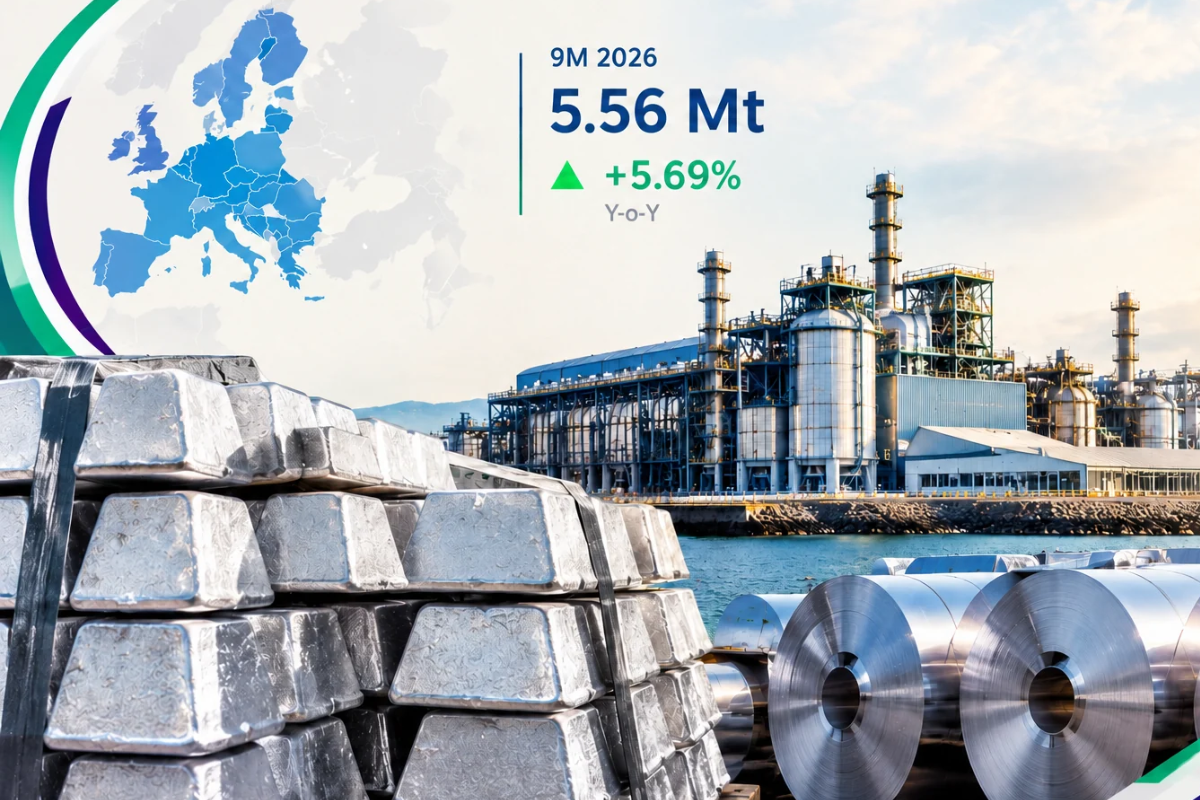
The image used in this article is generated with an AI tool and does not depict any real-time moment.
As the global aluminium supply chain continues to swing between shifts and crunches, how has Europe fared on the production front in the 2026 year-to-date calendar? Substantially well, going by the output figures. Between January and September 2026, the European continent, including Russia, has produced a total of 5.56 million tonnes of primary aluminium, building a significant year-on-year growth chart.
The nine-month growth chart
Set against the same period of 2025, the first nine months of 2026 show a clear lift in output.
From January to September 2026, Europe, including Russia, produced 5.56 million tonnes of primary aluminium, raising the annual growth rate by 5.69 per cent year-on-year (Y-o-Y) over the 5.26 million tonnes produced in 2025.
Explore the production, demand and consumption forecasts of bauxite and alumina in our report: “Global Bauxite & Alumina Market Forecast to 2036: Supply–Demand, Trade Flows & Price Outlook”
The quarterly Y-o-Y comparison tells the story:
- Q3 2026 vs Q3 2025: 1.91 million tonnes vs 1.78 million tonnes, up 7.18 per cent Y-o-Y
- Q2 2026 vs Q2 2025: 1.85 million tonnes vs 1.75 million tonnes, up 5.95 per cent Y-o-Y
- Q1 2026 vs Q1 2025: 1.8 million tonnes vs 1.73 million tonnes, up 3.88 per cent Y-o-Y
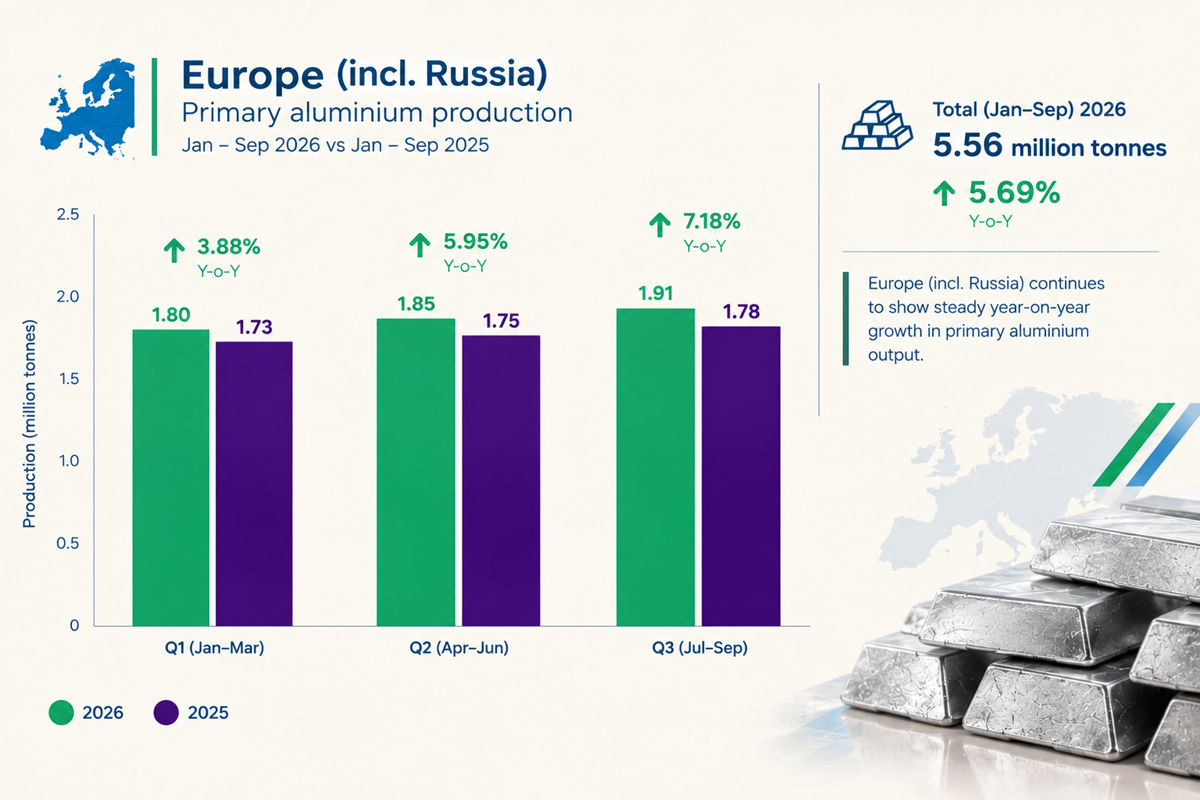
Production has not just grown. The pace of growth has quickened each quarter in this year, from 3.88 per cent in Q1 to 7.18 per cent in Q3.
The sequential study points the same way:
Q3 2026: 1.91 million tonnes, up 3.08 per cent Q-o-Q from 1.85 million tonnes in Q2
Q2 2026: 1.85 million tonnes, up 3.23 per cent Q-o-Q from 1.8 million tonnes in Q1
The quarterly gains, although, are steady rather than spectacular.
Who is supporting the rise in European primary aluminium production?
Europe’s primary aluminium recovery is being led by the restoration of curtailed capacity and higher Russian production. Several developments through YTD 2026 are likely to have provided a boost to the European aluminium production bucket.
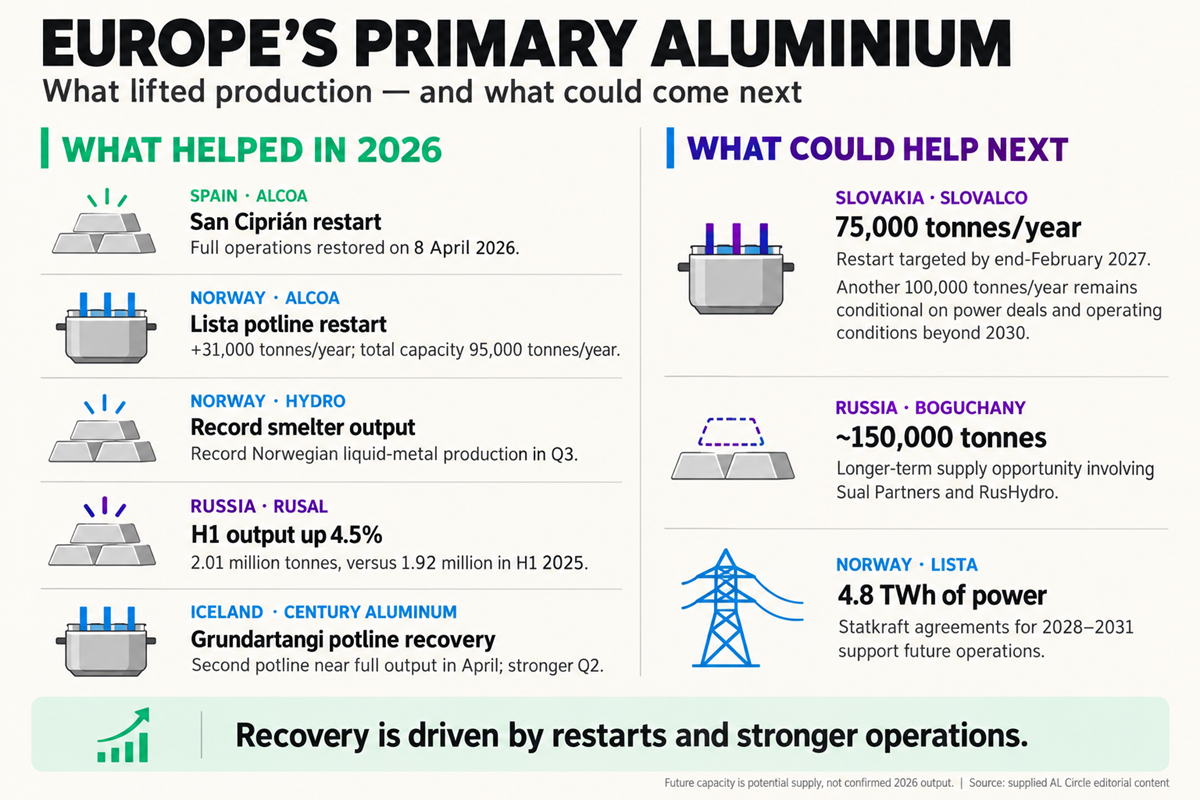
In Spain, after a pause due to a power outage in 2025, Alcoa completed a safe restart of its San Ciprián aluminium smelter on April 8, 2026, restoring full operations, thereby likely contributing to the increased production.
Alcoa also secured 4.8 TWh of electricity from Statkraft for 2028–2031 under two long-term agreements supporting Norway’s Lista aluminium plant, following a potline restart that added 31,000 tonnes of annual capacity and lifted the plant’s total to 95,000 tonnes. These developments further reinforced Alcoa’s Q2 output.
Explore primary aluminium suppliers, product listings and trade opportunities on AL Biz
In Norway, Hydro added to the picture, reporting a record-high liquid-metal production milestone across its Norwegian aluminium smelter system in Q3, another source of operational strength.
Russia also contributed through higher RUSAL output. The company’s attributable primary aluminium production rose by 4.5 per cent, from 1.92 million tonnes in the first half of 2025 to 2.01 million tonnes in the corresponding H1 2026 period.
Meanwhile, in Iceland, Century Aluminum’s Norðurál smelter in Grundartangi saw its second potline return to near-full production in April, helping offset deficits recorded in previous quarters and report a robust Q2 production.
Much of the lift, in other words, comes from restarts and stronger running of existing smelters rather than brand-new capacity.
What the pipeline holds
The near-term pipeline includes a potential contribution from Slovalco in Slovakia. After remaining offline for over three years, Hydro’s latest Q3 update reiterates the target of restarting the 75,000 tonnes of annual primary production capacity by the end of February 2027.
Slovalco’s remaining 100,000 tonnes of annual capacity remains a conditional opportunity. Its realisation would depend on additional electricity agreements and suitable operating conditions beyond 2030.
Moreover, Russia also has a longer-term development opportunity through the collaboration between Sual Partners and RusHydro at the Boguchany smelter in Siberia, adding about 150,000 tonnes of primary aluminium to the production chart.
For more in-depth insights and exclusive analysis on the global aluminum industry, explore the e-Magazine - Mine to Market: ALuminium Producers & Manufacturers 2026
These projects represent potential additions to future supply rather than confirmed production increases in 2026. For now, Europe’s nine-month performance reflects a combination of completed restarts, improved operating output and higher Russian production. With growth accelerating through three consecutive quarters, the next test is whether the pipeline can sustain it once the easier restart gains are banked.
Note: This is exclusive coverage by AL Circle and may not be reproduced, republished or shared without prior permission.
Vietnam aluminium firms seek zero export duty to counter cheaper imports
Next article$4b Oklahoma aluminum smelter’s civil works penciled in for Q2 2027 as Inola ballot looms
Grow with
AL Circle