AL Circle Analysis: Aluminium’s recycling economics, trade walls and carbon rules converge

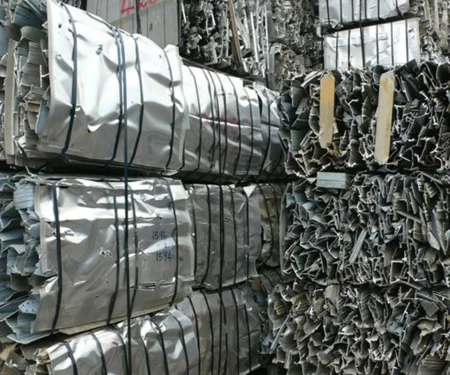
The image used in this article is generated with an AI tool and does not depict any real-time moment
The story of the aluminium industry is starting a chapter wherein scrap availability, recycling technology, trade policy, carbon costs and demand growth are becoming increasingly interconnected. From the US and Canada to Europe, India, New Zealand and China, recent developments show that the global aluminium supply chain is being reshaped on several fronts at once.
These developments point to a changing aluminium business model: access to metal alone may no longer be enough. Quality of recycled feedstock, domestic processing capacity, carbon intensity, trade exposure and the ability to meet increasingly specific customer requirements could become equally important competitive factors.
Join the fourth edition of the webinar “Hedging for recyclers - Become an expert in 6 hours” by Jorge Dyszel.
The economics of recycling: Sorting technology isn’t enough
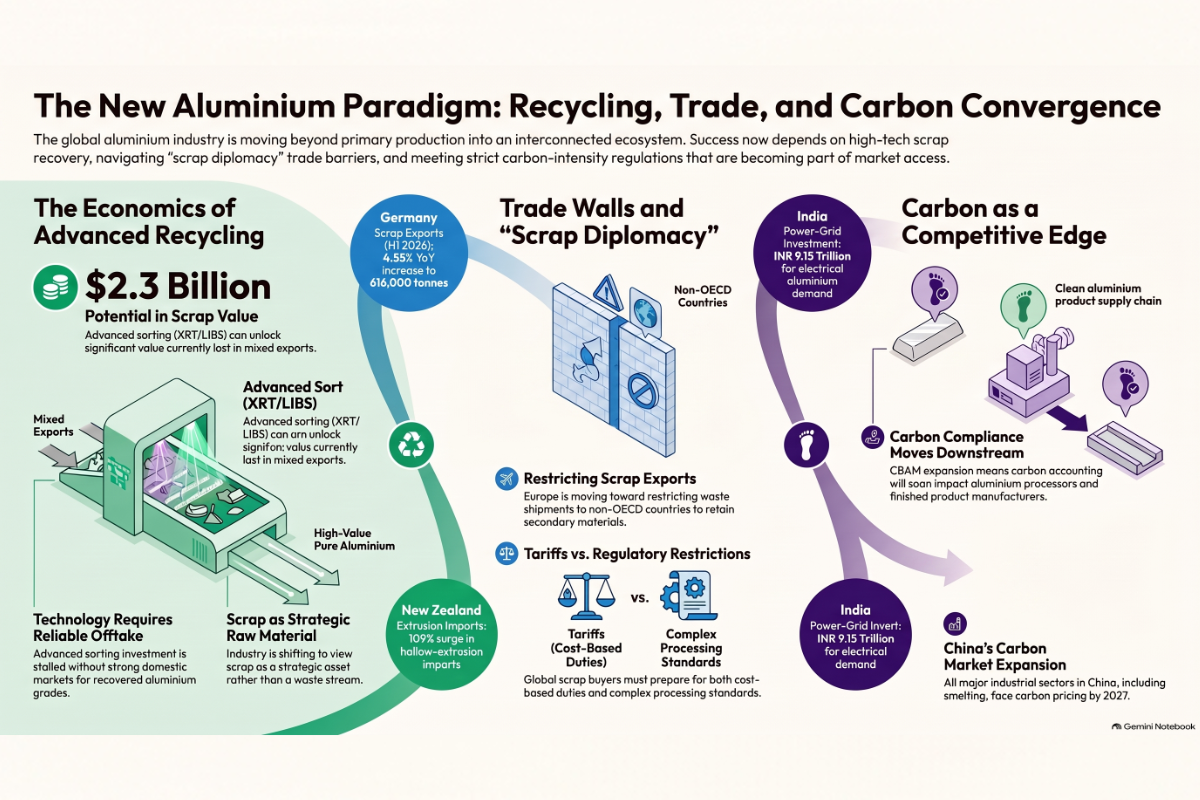
The shift begins with the growing economic value of aluminium scrap. A WBCSD study found that advanced sorting technologies such as XRT and LIBS could unlock an additional USD 1.9–2.3 billion (approx.) in annual value from US aluminium scrap by upgrading material that is currently exported as mixed Zorba. The opportunity could require around 35 additional processing facilities and approximately USD 150 million in investment.
Yet WBCSD’s follow-up study identified a major constraint, i.e., technology is not the only bottleneck. Weak domestic markets for certain recovered aluminium grades are holding back investment in advanced sorting. Recyclers may be able to produce higher-quality material, but without sufficient domestic buyers, the economics of installing sophisticated sorting systems remain difficult.
Canada is taking a broader approach. Since 2021, the country has advanced producer-responsibility programmes, collection improvements, recycling technology and domestic remelting capacity. Planned investments such as RevoCast’s 80,000-TPA recycled billet facility in British Columbia add to that infrastructure, while low-carbon aluminium initiatives strengthen the connection between recycling and decarbonisation.
The challenge is also reaching the consumer end of the chain. BAMA has called for industry-wide improvements in aerosol recycling messaging, highlighting how confusion over what and how to recycle can weaken material recovery even where recyclable packaging and processing infrastructure exist.
Germany’s H1 2026 trade data provide another indication of how valuable scrap has become. Its aluminium scrap exports rose 4.58 per cent year-on-year to around 616,000 tonnes, with Italy remaining the largest destination. The movement of material towards established recycling markets shows that scrap continues to respond to regional processing capacity and industrial demand.
Key takeaways
- For recyclers and investors: Sorting infrastructure is necessary but not sufficient. Before committing capital, secure demand-side coordination across alloy grades, not just feedstock access.
- For manufacturers: Regional scrap flows are increasingly carbon-policy-driven (CBAM, EV transition) rather than purely price-driven — factor decarbonisation timelines into sourcing strategy.
- For downstream operators: Domestic recycling capacity can retain more value, but only if downstream demand supports it.
- For policymakers: Consumer-facing recycling messaging is as critical a bottleneck as processing technology; infrastructure investment without public understanding underdelivers.
Trade defences and scrap diplomacy collide
Europe is taking the strategic value of scrap a step further. Brussels has been examining measures to retain more aluminium scrap within the bloc, arguing that secondary aluminium can support lower-carbon production and reduce dependence on primary metal.
The European Commission's original plan to restrict aluminium scrap exports to non-OECD countries, eyeing major buyers China (28.14 per cent of H1 2026 EU exports) and India (24.68 per cent), aimed to keep recyclable material within the bloc, but risked disrupting established trade routes central to Asian recycling economies.
The Commission then shelved its scrap export duty entirely, pivoting instead to non-OECD shipment restrictions under the Waste Shipment Regulation, effective 2027, marking a shift that “frustrated” European Aluminium, given the scale and urgency of scrap leakage, even as recyclers welcomed the move away from tariffs.
That reversal, it later emerged, has now spilled into EU-India trade negotiations. India, one of 91 countries exempted from the original levy, objected at a sensitive stage of FTA talks, illustrating how a purely industrial policy decision on scrap became entangled with broader trade diplomacy.
An initial proposal focused on restricting aluminium scrap exports to non-OECD destinations, putting major buyers such as China and India in the spotlight. The approach subsequently shifted, with the European Commission delaying the original aluminium-specific measure and moving towards broader restrictions governing waste shipments to non-OECD countries.
New Zealand provides an example of how changing trade flows can affect downstream industries. Aluminium extrusion imports surged 38 per cent over the past year, while hollow-extrusion imports rose 109 per cent and domestic output remained well below its 2022 peak. Domestic extruders have therefore sought safeguard action, although emergency provisional protection was rejected while the wider investigation continues.
To explore trade opportunities of secondary aluminium, visit AL Biz
Key takeaways
- For exporters: A trade-defence measure containing country exemptions signals weak enforcement. Proposed restrictions might be provisional until a final legal instrument is adopted.
- For importers: Countries without trade protection (like New Zealand) are exposed to safeguard action. Diversifying supplier bases is of essence.
- For policymakers and trade negotiators: Industrial and trade policy are no longer separable. Scoping restrictions with foreign-policy consequences in mind from the outset is essential.
- For scrap buyers: Trade negotiations, now more than ever, need to account for access to secondary raw materials. Preparing for both tariff-based and regulatory restrictions may be helpful.
Demand is growing, but carbon is becoming part of the product
While scrap and trade policy are reshaping supply, new demand centres are emerging. India’s planned INR 9.15 trillion power-grid investment could provide a significant long-term boost to aluminium consumption. Demand for aluminium in electrical applications is projected to rise as transmission infrastructure expands alongside renewable-energy integration and new electricity demand centres.
North America is simultaneously responding to supply-security concerns. The US is pursuing the planned 750,000 TPA Oklahoma aluminium smelter, while Canada is progressing with new AP60 capacity in Quebec alongside recycling and low-carbon technology initiatives. The two approaches differ, but both demonstrate the growing importance of strengthening regional aluminium supply chains.
The next layer is carbon.
The European Parliament has backed a wider CBAM scope covering additional aluminium and steel downstream products, potentially taking carbon-related compliance deeper into the value chain. For aluminium processors and manufacturers, this means carbon accounting could become relevant well beyond primary metal production.
The automotive sector is already pushing for greater recognition of low-carbon aluminium. European Aluminium and ACEA have called for low-carbon aluminium to be included in vehicle CO₂-credit mechanisms, arguing that harmonised carbon thresholds and verification could encourage automakers to use lower-emission materials.
China is moving in a similar direction through a different mechanism. Its national carbon market recorded 235 million tonnes of CO₂-equivalent in trading volume in 2025, while aluminium smelting has now entered the carbon-market framework alongside other major industrial sectors. Beijing intends to extend carbon-market coverage to all major industrial sectors by 2027.
Showcase your brand, aluminium recycling initiatives and sustainability vision in our upcoming magazine: Sustainability & Recycling: Aluminium’s Commitment 2026.
Key takeaways
- For aluminium producers: Demand growth is increasingly concentrated in electrification and grid infrastructure (India, broader T&D markets) rather than construction alone. Product mix are to be aligned accordingly.
- For automakers and OEMs: Material-selection flexibility under emerging carbon-credit frameworks is not guaranteed. Defining low-carbon aluminium methodology would be beneficial.
- For investors and capacity planners: Carbon-market inclusion (China) and CBAM expansion (EU) mean production economics increasingly hinge on verified emissions data, not just tonnes produced.
- For policymakers: Regional supply security is increasingly being built through primary metal, recycling and technology together.

Grow with
AL Circle