China’s aluminium extrusion industry is going through a real transition, and I do not think the West has fully absorbed what it means

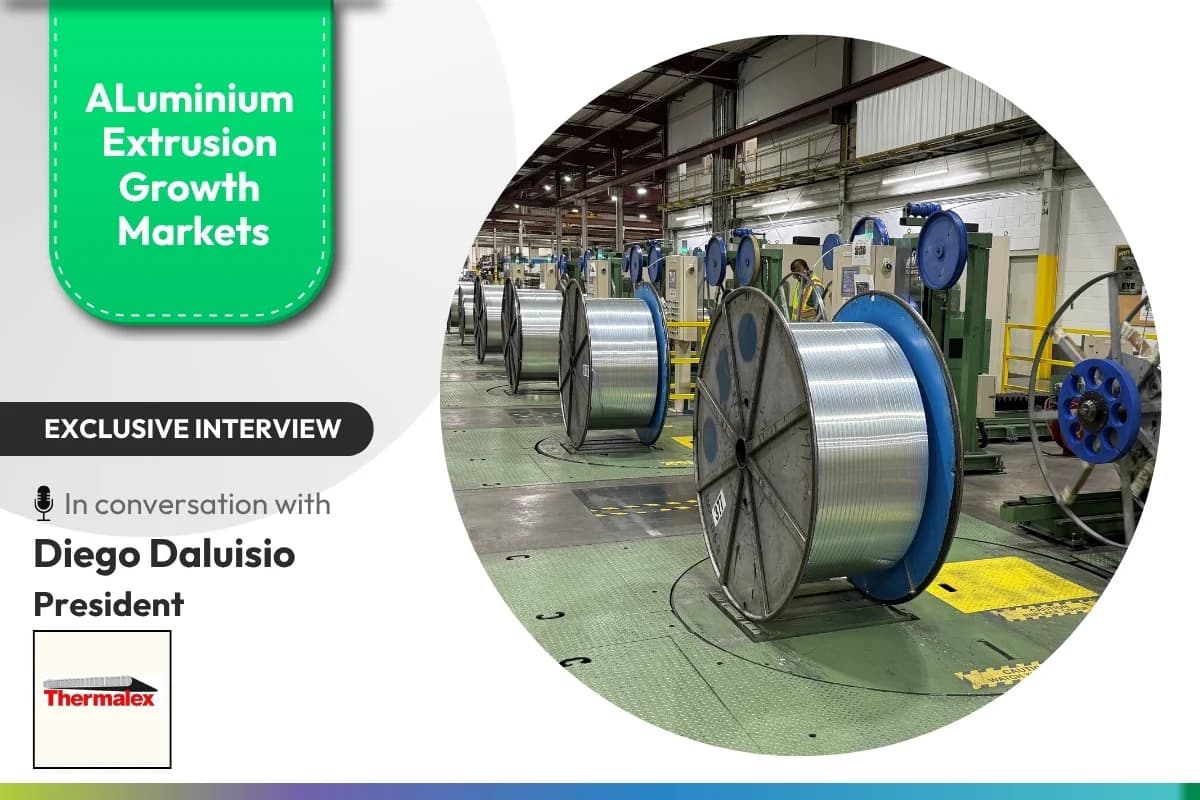
Diego Daluisio, President of Thermalex, Inc., when approached for his key insights into the changing global aluminium extrusion landscape as a part of AL Circle’s ongoing campaign on “Aluminium Extrusion Growth Markets”, drew particular attention to China’s rapidly evolving industry. He explained that the country’s extrusion sector is moving beyond high-volume commodity products and increasingly targeting advanced applications in solar energy, electric vehicles, energy storage and heat dissipation.
Throughout the interview, Daluisio also discussed how steady advances in presses, extrusion dies, alloy chemistry and precision process control are enabling lighter and more efficient microchannel tubes for automotive cooling, EV batteries, HVAC systems, heat pumps and data centres. He highlighted the growing thermal-management requirements of hybrid vehicles, the importance of zinc arc spray in extending tube life and the increasing role of engineering collaboration in developing complex solutions for robotics and AI applications.
Connect with verified aluminium extrusion buyers and suppliers through the AL Biz marketplace.
AL Circle: Thermalex specialises in microchannel aluminium extrusions for heat-transfer applications. How have advancements in extrusion technology, alloy development and precision manufacturing expanded the performance and applications of these products across automotive, EV battery cooling and HVAC systems?
Diego Daluisio: This is a business where dramatic breakthroughs are rare, and the small improvements add up to something dramatic. Presses and extrusion dies have got better; we understand the metal flow far better than we used to, and the upshot is that we can hold a shape today that would have been a curiosity twenty-five years ago. That lets us keep making the tube walls thinner and the ports smaller, which is really the whole game — more surface area is doing the work, with less aluminium carrying it around.
The alloys have moved right along with it. Today’s chemistries handle much higher internal tube pressure, which matters as the industry moves to CO₂ and the new lower-GWP refrigerants, and they still braze cleanly and hold their shape in the furnace.
Then it is a matter of doing it the same way every time — checking dimensions and leaks in line, controlling the zinc coverage, and watching the process rather than sorting the output.
What the customer gets is the same in every market, even though they each want it for a different reason: a smaller, lighter coil that moves the same heat with fewer refrigerants. In a car, it is weight and package space. In a battery pack, it is making sure every cell sees the same temperature. In an air conditioner, it is efficiency and less refrigerant in the system to begin with.
AL Circle: As electrification, reshoring and supply chain localisation redraw North America’s industrial landscape, where is demand for specialised aluminium extrusions accelerating fastest, and how should manufacturers position themselves to capture the next phase of growth?
Diego Daluisio: I would gently push back on the premise, because "electrification" and "EV sales" are not the same thing. Pure battery-electric sales in the US have been soft since the federal credit went away. Hybrids, on the other hand, are the fastest-growing thing on the lot – and a hybrid needs a conventional condenser plus cooling for the battery and the electronics. So, the amount of heat-transfer content in the average vehicle keeps going up even in a year when the EV headlines are gloomy. That distinction gets missed a lot.
Away from cars, the pull is steadier. Heat pumps are the one part of the HVAC market that keeps growing year after year. Data centres are adding cooling load faster than anything else we look at. Behind those are grid storage and transport refrigeration.
As for how to position yourself – be close to your customer, be genuinely easy to work with, and be able to prove where your metal came from, because that now drives real money at the border. Beyond that, I would take the long view. The first new primary aluminium smelter in this country in more than forty years is being built in Oklahoma by EGA. Even though just one new smelter will not suffice to fulfil the US billet needs, it is excellent news that domestic prime metal production is starting to be rebuilt.
AL Circle: The Chinese aluminium extrusion industry has traditionally been a major supplier to global markets. Recent industry analysis highlights changing export dynamics and increasing focus on higher-value applications. How do you see China’s evolving role influencing the global extrusion market?
Diego Daluisio: China is going through a real transition, and I do not think the West has fully absorbed what it means. Exports dropped by roughly a fifth last year once Beijing took away the export tax rebate, and the domestic market has been tough on top of that – construction is weak, aluminium extrusion presses are running well under half capacity, and the summer numbers were about as soft as I have seen them.
But the interesting change is not the volume; it is the mix. The product going out the door is moving up the value chain – solar, electric vehicles, energy storage, and heat dissipation – and away from commodity extrusion like building profiles. The destinations are shifting too, toward Southeast Asia, Australia and South America, as the US door narrows. And to be accurate about why it narrowed: it is the Section 232 structure that did it, not a wave of new dumping cases.
So, what does that mean for us? Less cheap commodity metal is washing into our market, but tougher, smarter competition is exactly the specialised work we do – and increasingly from Chinese-owned plants built outside China. You do not win that on price per kilo. You win it on engineering, on how fast you can get a part qualified, on being nearby, and on the customer knowing their design is safe with you.
To know the global production, demand and consumption forecasts of aluminium extrusions, explore our report "The World of Aluminium Extrusions to 2035"
AL Circle: How do zinc arc spray and controlled zinc concentration improve the corrosion resistance, brazing performance and service life of Thermalex’s microchannel tubes, and what benefits do they offer customers?
Diego Daluisio: The idea is simpler than it sounds. Right after the tube is extruded, we melt zinc wire in an electric arc and spray a very light, very evenly controlled layer onto the tube’s surface. The coating itself is not what protects the tube — what matters is what happens later, in the brazing furnace, when that zinc diffuses from the tube’s surface into the aluminium alloy.
What you end up with is a diffusion layer that is deliberately the weakest link. Corrosion goes after that layer first and spreads sideways along the surface instead of going straight through the tube’s wall. That is the whole trick: you are not stopping corrosion; you are giving it somewhere harmless to go. Instead of a pinhole leak early in the heat exchanger service life, you get slow surface wear over many years.
How much zinc you put down is the craft. Too little and the protection is patchy. Too much and you cause problems of your own — it attacks the grain boundaries and interferes with the braze joints. Getting it right, all the way around the tube and all the way down its length, every day, is the hard part.
For the customer, it is straightforward: a coil that survives salt air and road salt and the confidence to use a thinner wall for weight and cost without giving up life. That is a warranty conversation, and it is usually the reason people come to us.
AL Circle: Over the past few years, the aluminium industry has faced several geopolitical disruptions, including trade tensions, conflicts and supply chain uncertainties. How have these factors impacted the global aluminium extrusion market, particularly in terms of raw material availability, production costs and customer demand?
Diego Daluisio: The honest answer is that raw material has generally been available—it is what it costs to land it here that has changed. Between the tariffs and the premium you pay for metal delivered in the US, billet has been expensive, and it has been unpredictable, which is arguably worse.
The rules have also moved a great deal. Section 232 became the main instrument this year and was restructured twice, and duty is now calculated on the full value of a part rather than just the metal inside it. That is a very different calculation. Meanwhile, negotiations with Canada could bring the rate on some Canadian metal down, and the market moved the moment that was hinted at. When a headline can swing your input cost, planning gets difficult for everyone in the chain.
What I find most telling is how customers have changed. Nobody buys on unit price alone anymore. They want to know where the metal was smelted, what the landed cost really is with duty in it, whether there is a second source, and how much inventory sits between them and the next surprise. Our job is to take that worry off their desk—be clear about what is metal, what duty is, and what our work is; document the origin properly; and have enough capacity here that the next announcement is an inconvenience rather than a crisis.
AL Circle: Could you share a case study where Thermalex worked closely with a customer to develop a customised aluminium extrusion solution for a challenging application?
Diego Daluisio: I must be careful here, and I hope your readers will understand why. The development work we do with customers is theirs, not ours to talk about – the geometry, the performance targets, and the problems we solved together. Confidentiality is a big part of why people bring us their hard problems in the first place, and I am not going to spend that.
What I can say is where the interesting work is heading. Some of the most exciting projects on our floor right now are with companies at the leading edge of robotics and AI. These are demanding applications. The packages are tight, the power densities are high, and the thermal requirements are unlike anything in a traditional automotive or HVAC programme. Those customers come to us early, while the design is still moving, and we work on the problem alongside their engineers.
That is really the pattern, whoever the customer is. The good outcomes come from being brought in early, when we can still influence the design, rather than being handed a finished drawing and asked to quote it. That is the part I would want people to take away.
AL Circle: Every manufacturing company faces challenges during its growth journey. What have been some of the biggest obstacles Thermalex has encountered, and how did the company overcome them?
Diego Daluisio: The honest one, and the one every extruder in this country will recognise, is the cost of the billet. Tariffs and the premium on domestic metal pushed our single largest input cost up sharply, and it did not move gradually; it moved in steps on announcements. When your biggest cost line does that, you cannot simply pass it along and hope the market absorbs it. You must earn it back somewhere.
That's what we set out to do. We invested in the operation and streamlined it—better equipment, tighter processes, less waste, more output from the same footprint and the same hours. The goal was simple to state and hard to do: take real cost out of the product without touching the quality our customers count on, because the quality is the reason they are with us in the first place.
If there is a lesson in it, it is that outside pressure is a decent forcing function. Some of the improvements we made under that pressure are ones we should probably have made anyway, and they will still be paying off long after the tariff situation settles.
AL Circle is coming up with a new Magazine "ALuminium’s Frontline: OEM Edition 2026." Feature your brand and opinion in the edition

