AL Circle Analysis: H1’26 bauxite export, softer alumina, new aluminium supply risks
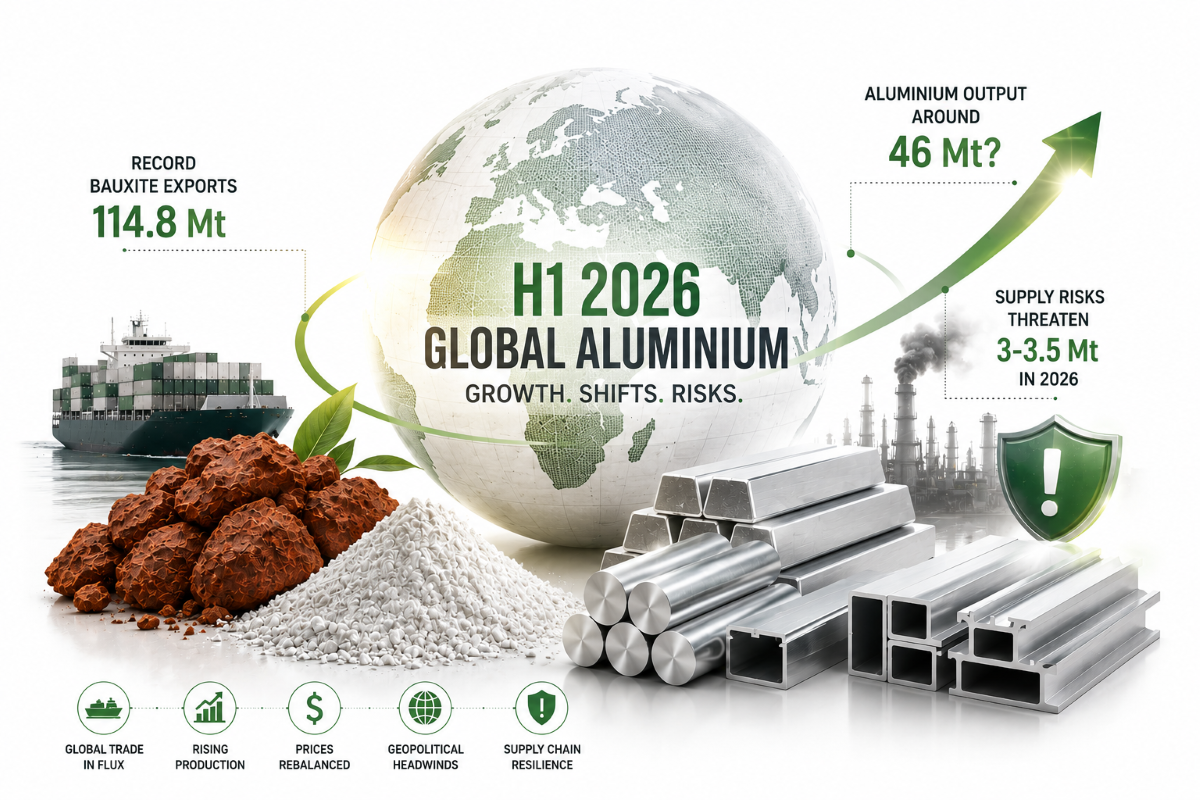
The image used in this article is generated with an AI tool and does not depict any real-time moment
The global aluminium value chain faced mixed signals in the first half (H1) of 2026, with production growth in key regions, evolving trade flows and emerging supply risks shaping the market. From Guinea’s record bauxite exports and China’s growing alumina and aluminium output to disruptions in Indonesia and the Middle East, offer important insights for producers, traders, suppliers and buyers.
Guinea’s exports rise, miners under pressure, Africa seeks value addition
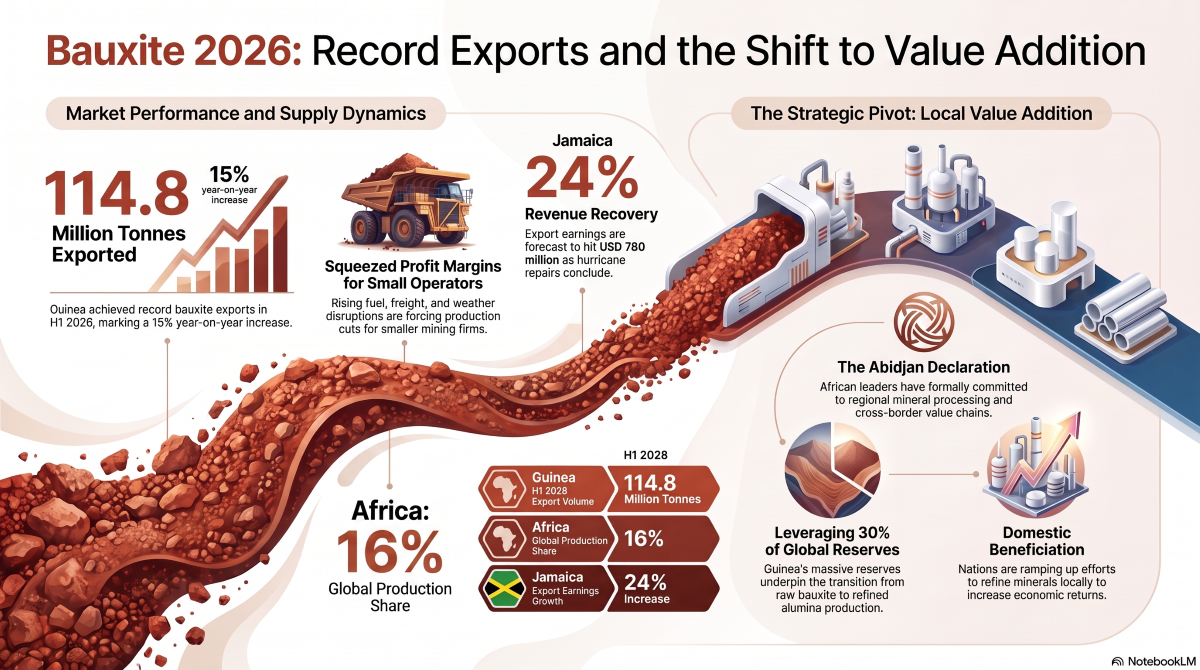
During H1 2026, Guinea exported a record 114.8 million tonnes of bauxite, up 15 per cent year-on-year. Strong Chinese demand reinforced shipments despite rising operating costs for smaller mines.
However, weak global bauxite prices, higher fuel and freight prices owing to the Middle East conflict and heavy rains have squeezed smaller operators, forcing some to reduce or suspend production. Despite these challenges, expanding output from major producers and new mining projects are expected to keep Guinea’s bauxite sector on track through 2026.
To know the futuristic market and value proposition of red mud, explore the report A Comprehensive Analysis of Bauxite Residue (Red Mud): Sustainability, Resource Recovery and Strategic Recommendations
Instead of exporting raw materials, African countries are ramping up efforts to process their mineral resources domestically at greater amounts. Leaders at the African Development Bank's Ministerial Forum adopted the Abidjan Declaration to back regional mineral processing, local beneficiation and cross-border value chains.
Africa accounts for about 16 per cent of global bauxite production, with Guinea holding around 30 per cent of the world's reserves. Africa is seeking to develop alumina refining and aluminium production to add greater value from its resources and enhance its standing in the global platform.
Jamaica’s bauxite and alumina export earnings are forecast to recover by 24 per cent to USD 760 million in 2026 as mining and refining operations recover from disruptions caused by Hurricane Melissa. Although production and exports declined sharply in Q1, the government forecasts bauxite output would rise about 14 per cent to 6.4 million tonnes by year-end as repair work progresses.
Key takeaway:
Guinea’s bauxite exports of 114.8 million tonnes would provide buyers and traders with a better understanding of near-term raw material availability.
However, heavy dependence on a few supply hubs, i.e., Africa’s 16 per cent share in global bauxite production and Guinea’s nearly 30 per cent of the world's reserves, means any policy change, weather disruption or geopolitical event can quickly tighten markets and trigger price volatility.
For suppliers, maintaining operational efficiency and logistics flexibility would be critical to securing long-term contracts.
Explore buying and selling leads of alumina and trade opportunities on the AL Biz platform.
Global alumina trend: production and pricing
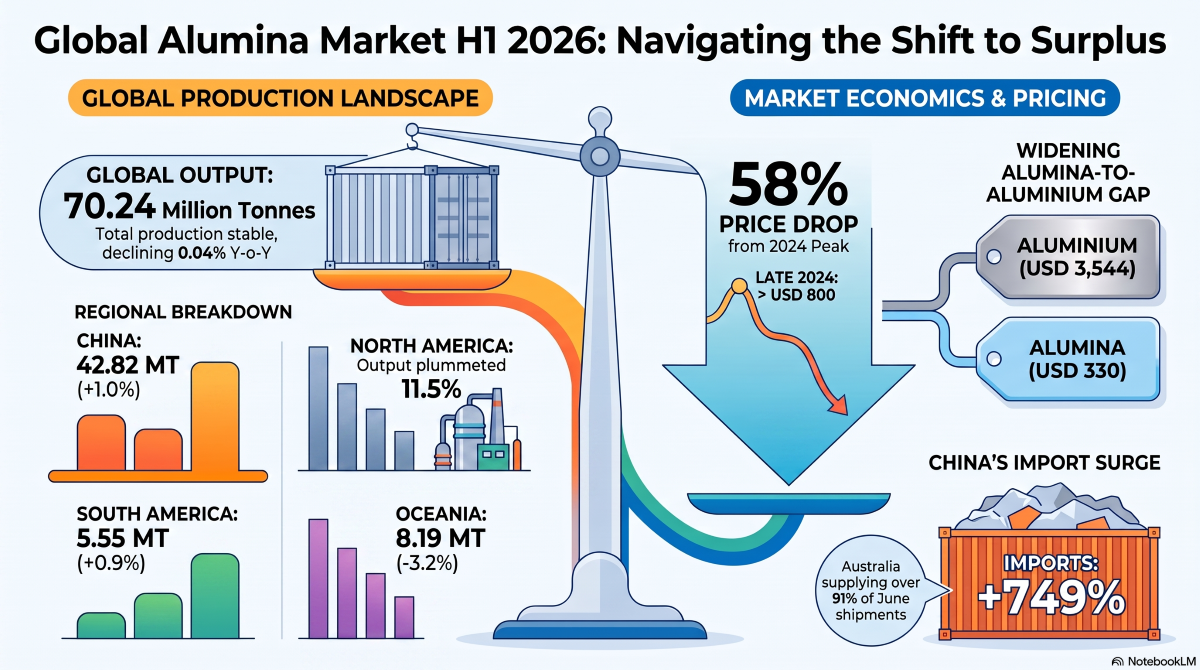
Global metallurgical-grade alumina output was broadly stable at 70.24 million tonnes in H1 2026, down just 0.04 per cent from 70.27 million tonnes a year earlier, despite regional disruptions. China offset global weakness by increasing output 1 per cent to 42.82 million tonnes, although oversupply pushed domestic alumina prices down 21.69 per cent Y-o-Y to RMB 2,697 (USD 399.25) per tonne.
Africa and Asia (excluding China) saw production fall 0.9 per cent to 6.93 million tonnes amid tighter bauxite supply from Guinea and weaker refinery margins. In comparison, North America recorded the steepest decline of 11.5 per cent to 747,000 tonnes due to reduced operations at the Gramercy refinery.
Europe's output slipped 1.8 per cent to 2.85 million tonnes as high energy costs continued to weigh on production, and Oceania declined 3.2 per cent to 8.19 million tonnes following Alcoa's Kwinana refinery closure.
South America was the only major region to post growth, with production rising 0.9 per cent to 5.55 million tonnes, supported by expanded output at Hydro's Alunorte refinery in Brazil.
China’s alumina imports surged in H1 2026, rising nearly 749 per cent Y-o-Y to 2.28 million tonnes, largely driven by Australian shipments, which accounted for 91.7 per cent of June imports. The increase was supported by favourable import economics, low comparison volumes from the previous year and shipping adjustments linked to Middle East tensions.
However, strong domestic production combined with higher imports has increased port inventories, keeping China’s alumina market under pressure. Meanwhile, China maintained steady alumina output through new capacity additions despite weaker refinery margins.
Indonesia is working to resolve regulatory uncertainty that has disrupted alumina and nickel exports after authorities raised concerns over trace rare earth elements found in some shipments. The absence of clear limits on permissible rare earth content has affected exporters, particularly alumina producers.
The LME alumina market has moved in the opposite direction to aluminium over the past three years. Alumina prices surged above USD 800 per tonne in late 2024 following refinery disruptions and bauxite supply constraints but declined towards USD 330 per tonne by mid-2026 as new refining capacity in China and Indonesia pushed the market into surplus.
The price correction has improved smelter economics by lowering raw material costs, even as aluminium prices remain firm. However, refiners are facing increasing margin pressure. Guinea’s bauxite policies, Middle East shipping risks and Chinese refinery decisions remain the major factors influencing the future alumina balance.
Key takeaway:
Expanding alumina capacities in China (42.82 million tonnes) and South America (5.55 million tonnes) would help identify the raw material markets to build a strong supply chain.
For traders, the gap in the alumina-to-aluminium price ratio of rising aluminium prices around USD 3,544 per tonne and softer alumina prices around USD 330 per tonne creates opportunities in market trading and inventory planning. At the same time, buyers can use the current oversupply to secure better raw material deals.
Unlock key insights from leading companies and experts across the aluminium ecosystem with our e-Magazine - Mine to Market: ALuminium Producers & Manufacturers 2026
Aluminium supply watch: Australia, China, Middle East
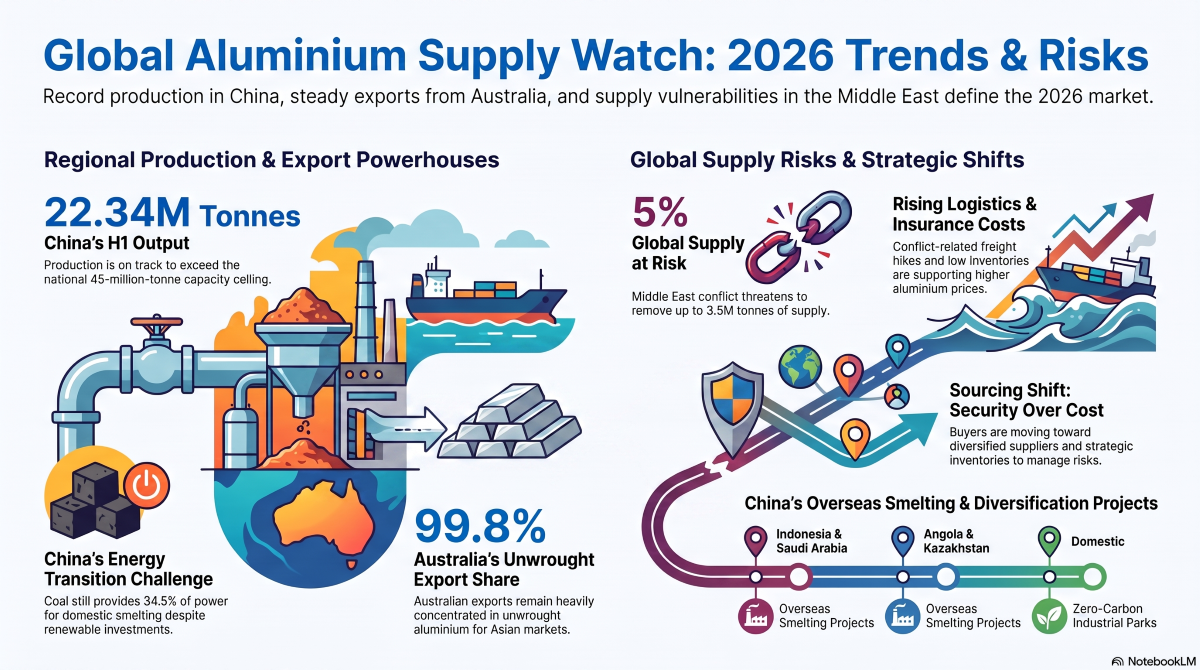
Australia’s aluminium exports remained heavily concentrated in unwrought aluminium during January-May 2026. Total aluminium exports reached 566,386 tonnes, up 1.98 per cent year-on-year, with unwrought aluminium accounting for 565,180 tonnes or 99.79 per cent of shipments.
In 2025, Australia exported 1.45 million tonnes of aluminium products, with unwrought aluminium representing 99.4 per cent of total exports. South Korea, Japan, Vietnam, Taiwan and Malaysia remained its largest export markets.
China produced 22.34 million tonnes of primary aluminium in H1 2026, up 2.24 per cent year-on-year. If production follows seasonal trends in the second half, annual output could approach 46 million tonnes, exceeding the country’s 45-million-tonne capacity ceiling.
China continues investing in renewable energy, zero-carbon industrial parks and overseas smelting projects in Indonesia, Saudi Arabia, Angola and Kazakhstan. However, coal still supplies around 34.5 per cent of domestic aluminium smelting power, creating challenges for balancing production growth with decarbonisation goals.
The renewed Middle East conflict has highlighted the aluminium industry’s exposure to geopolitical risks. Disruptions at Emirates Global Aluminium (EGA) and Aluminium Bahrain (Alba) could potentially remove 3-3.5 million tonnes of aluminium supply in 2026, equivalent to around 5 per cent of global output.
Beyond production losses, higher war-risk insurance premiums, increased freight costs, Strait of Hormuz disruptions and declining LME inventories have supported aluminium prices. The crisis is also pushing buyers away from purely cost-driven sourcing towards diversified suppliers, strategic inventories and greater supply security.
Key takeaway:
China’s rising aluminium output (22.34 million tonnes in H1) continues to influence global pricing, trade flows and supplier strategies, while the Middle East conflict resulted in about a 5 per cent or 3-3.5 million tonnes of global aluminium supply deficit.
Producers and buyers need to closely track China’s capacity utilisation, import trends, energy transition policies and geopolitical developments to manage future supply risks.

TRUNNANO highlights advanced ceramic crucibles for aluminium and high-temperature industries
Next articleWEEKLY: China alumina slides toward ¥2,600-2,750/t range as capacity use dips to 79.77%, stocks hit 6.4Mt
Grow with
AL Circle