Aluminium grabs the headlines, but the LME alumina price trend quietly rewrites margins, economics and supply risk
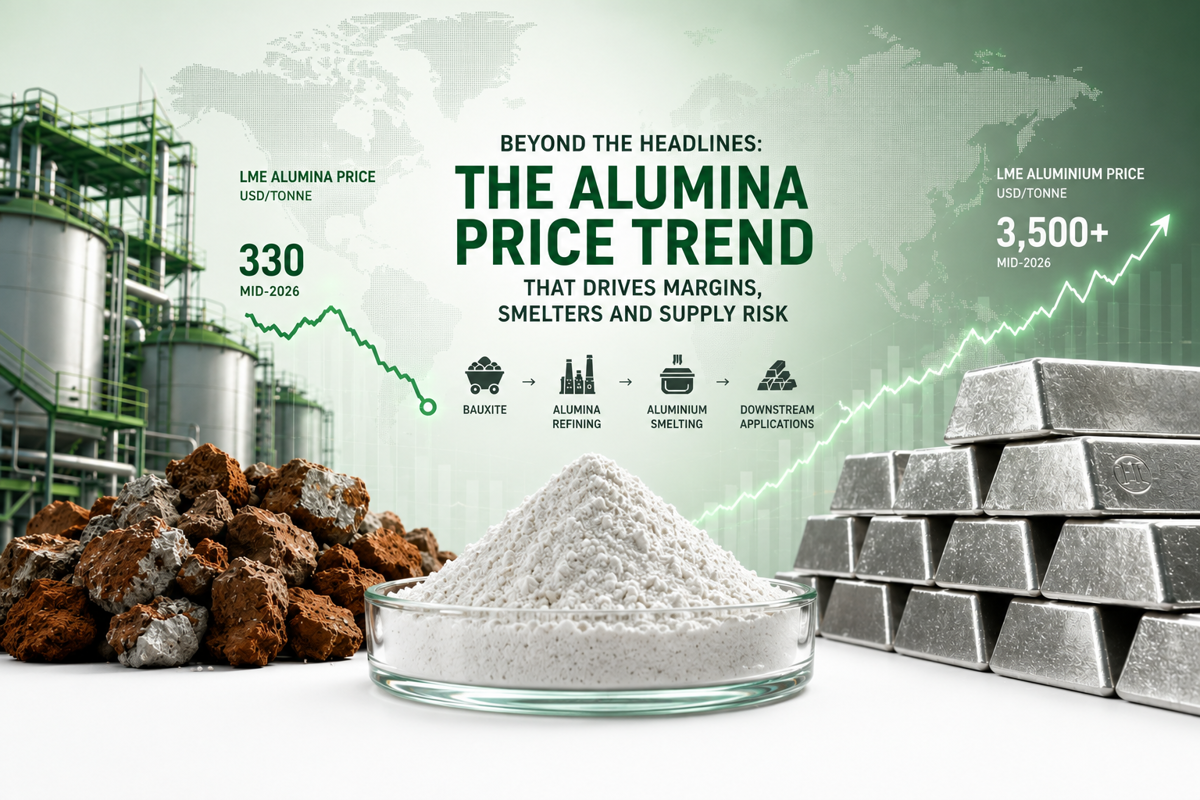
The images used in this article is generated with an AI tool and does not depict any real-time moment
Aluminium prices command the market's attention because they determine the value of the finished metal that carmakers, packaging manufacturers and construction firms ultimately buy. Yet one step up the supply chain, a quieter benchmark has spent the past three years doing something aluminium rarely does: moving on its own terms.
Alumina, the intermediate product refined from bauxite and smelted into primary aluminium, surged past USD 800 per tonne in late 2024, lost more than half its value within months and, by mid-2026, was trading near USD 330 per tonne even as aluminium climbed towards multi-year highs. Traders focused solely on the LME aluminium price would have missed much of that story. The LME alumina price trend is where it began.
Reading the LME alumina price trend through its major turning points
The alumina market has always been volatile, but the magnitude of recent price swings has been exceptional.
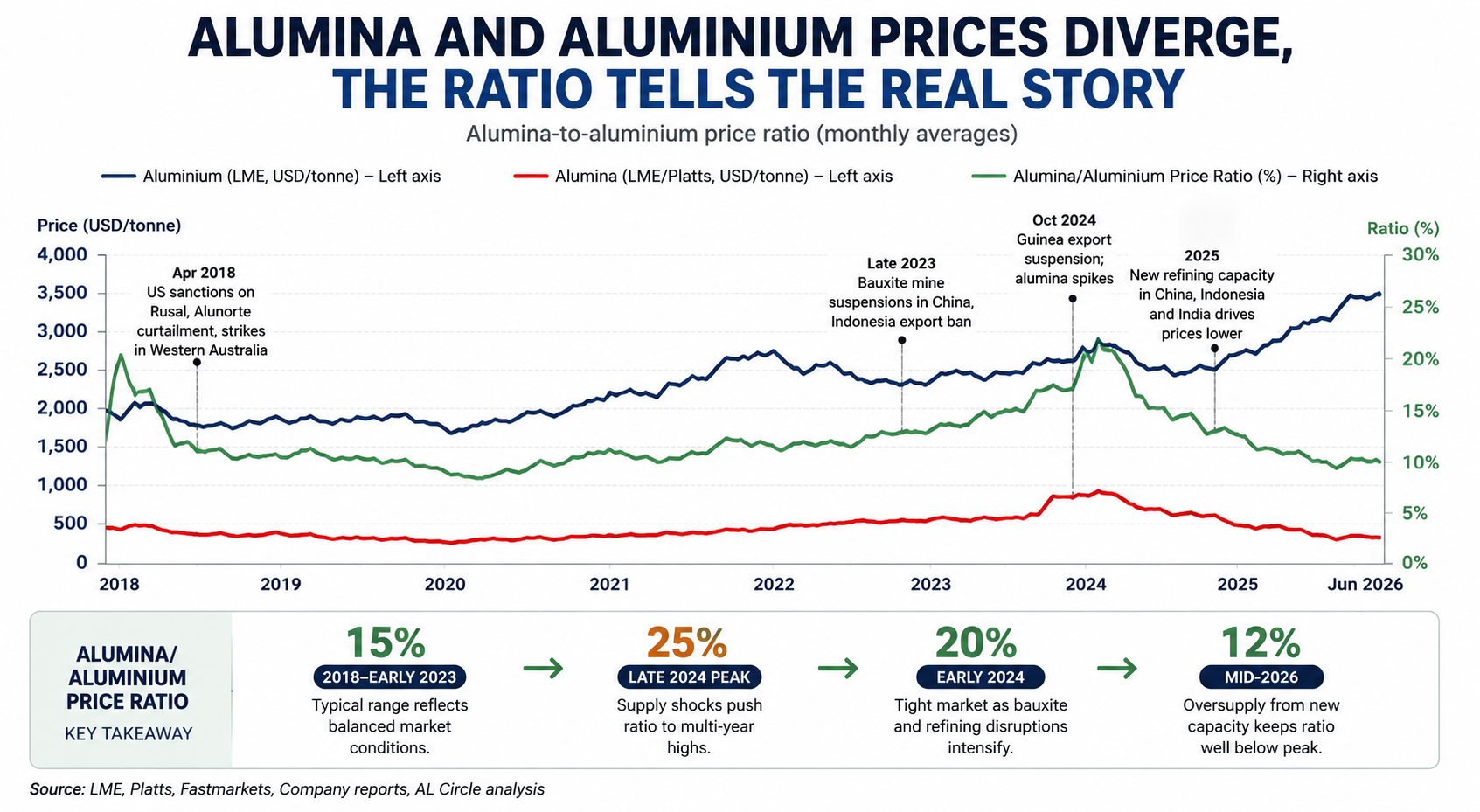
In April 2018, alumina surged towards USD 700 per tonne after US sanctions disrupted Rusal's ownership structure and Brazilian regulators forced Norsk Hydro's Alunorte refinery, then the world's largest, to halve production following environmental concerns. At the same time, strikes at Alcoa's Western Australian refineries further tightened supply. The alumina-to-aluminium price ratio briefly approached 30 per cent, redefining what the industry considered a "high" alumina market for years afterwards.
That record stood until 2024. A tightening cycle began in late 2023 when bauxite mine suspensions in China's Shanxi and Henan provinces, combined with Indonesia's bauxite export ban, left Chinese refiners facing ore shortages heading into the new year. Alumina entered 2024 at roughly USD 350 per tonne, representing around 15 per cent of the aluminium price—a ratio widely regarded as normal.
Supply disruptions then intensified.
Alcoa permanently closed its loss-making Kwinana refinery, removing approximately 2.2 million tonnes of annual refining capacity. A gas pipeline fire cut around 1.2 million tonnes of output at Rio Tinto's Gladstone refinery. Then, in October, Guinean customs suspended bauxite exports from an Emirates Global Aluminium subsidiary. That single event pushed alumina prices to USD 633.35 per tonne within days, lifting the alumina-to-aluminium ratio to nearly 25 per cent.
Speculative trading on the Shanghai Futures Exchange added further momentum, with trading volumes approaching one-fifth of annual global production in a single session. By early December, Australian alumina assessments had climbed to approximately USD 805-819 per tonne, surpassing the 2018 record and establishing a new all-time high.
The correction proved far more rapid than the rally.
More than 13 million tonnes of new Chinese refining capacity commissioned across 2024 and 2025, together with expanding production in Indonesia and India and easing concerns over bauxite availability, shifted the market from deficit to surplus. Alumina prices fell below USD 600 per tonne within weeks before continuing their decline throughout 2025. Quarterly benchmark prices dropped by between 20 and 29 per cent in successive periods before stabilising around USD 310-320 per tonne by year-end.
Throughout the first half of 2026, alumina largely traded within a comparatively narrow USD 310-340 per tonne range. That stability stands in stark contrast to the volatility of the previous two years and reflects an oversupplied refining market rather than a fundamentally balanced one.
Explore the relevance of red mud in the sustainable aluminium industry in A Comprehensive Analysis of Bauxite Residue (Red Mud): Sustainability, Resource Recovery and Strategic Recommendations
When alumina and aluminium move in opposite directions
The clearest divergence occurs when aluminium prices rise while alumina prices fall, precisely the pattern seen through much of 2026.
Aluminium has drawn support from tightening LME warehouse stocks, resilient demand and, since late February, disruption to Gulf shipping caused by conflict involving Iran. Those factors briefly pushed aluminium to USD 3,544 per tonne, its highest level since March 2022.
Alumina, meanwhile, has remained anchored near USD 330 per tonne as refining capacity additions in China and Indonesia continue to outpace demand. The result is two interconnected industries following distinctly different pricing trajectories.
The reverse scenario, with falling aluminium prices alongside rising alumina prices, typically emerges when refinery-specific disruptions hit an already tight bauxite market while aluminium demand remains subdued. That pattern appeared during isolated trading sessions in 2024 and resurfaced briefly in mid-2026, when aluminium eased even as the Platts alumina assessment continued climbing.
Inventory strategies also play a role. Smelters that accumulated alumina ahead of anticipated shortages can suppress spot buying even as benchmark prices rise on relatively thin trading volumes. At the same time, arbitrage between Chinese domestic pricing and international benchmarks can cause the two markets to diverge for weeks before eventually converging.
Margin squeeze: who wins, who loses?
Refiners and smelters experience the same aluminium price in fundamentally different ways.
For refiners, revenue is determined by the alumina price, while costs are largely driven by bauxite, caustic soda and energy. Smelters, by contrast, earn revenue from aluminium sales, with alumina representing their single largest raw material cost.
When the alumina-to-aluminium ratio widens, refiners generally benefit while merchant smelters face margin compression. When the ratio narrows, the opposite occurs.
A simplified example illustrates the impact. Assume aluminium is priced at USD 2,600 per tonne, while electricity and other conversion costs total approximately USD 1,180 per tonne. With alumina consumption averaging 1.93 tonnes per tonne of aluminium, an alumina price of USD 330 per tonne, close to mid-2026 levels, results in feedstock costs of around USD 637 per tonne, leaving an operating margin of roughly USD 783 per tonne, or around 30 per cent.
Repeat the calculation using the late-2024 alumina peak of approximately USD 800 per tonne. Feedstock costs rise to around USD 1,544 per tonne, reducing the operating margin to just USD 76 per tonne, effectively breakeven.
Notably, aluminium prices did not have to decline for margins to collapse; the surge in alumina alone was sufficient.
The opposite also holds true. Even if aluminium falls to USD 2,400 per tonne, a simultaneous decline in alumina to USD 310 per tonne still leaves a smelter margin of around USD 622 per tonne—substantially healthier than during the high-alumina environment despite weaker metal prices.
Alcoa's second-quarter 2026 results reflected this divergence in real-world performance. Its aluminium segment delivered a record 32.3 per cent margin on stronger LME prices, while its alumina business lowered guidance following gas supply disruptions at the Pinjarra refinery in Western Australia.
Integrated producers are increasingly seeking to capture value across both refining and smelting rather than remaining exposed to only one segment of the value chain. Alcoa's pending acquisition of South32's bauxite, alumina and aluminium interests is one example of that broader strategic shift.
Explore: The most comprehensive and forward-looking industry-focused report — Global Bauxite & Alumina Market Forecast to 2036: Supply–Demand, Trade Flows & Price Report
China's influence over the alumina market
China now produces and consumes close to 80 million tonnes of alumina annually, accounting for more than half of global output. The country has metallurgical alumina refining capacity of nearly 110 million tonnes, operating at around 80 per cent utilisation.
A government-imposed cap on primary aluminium smelting capacity, currently around 45.5 million tonnes, limits how much of that alumina can be absorbed domestically. As a result, China became a net exporter of alumina in 2024 and continues to ship surplus material into Asian and Middle Eastern markets.
That production cap means Chinese refinery decisions increasingly determine the marginal price of alumina for the rest of the world. Yet China remains heavily dependent on imported bauxite, with Guinea supplying around 70-74 per cent of its imports. Any disruption to that supply chain therefore has the potential to ripple quickly through global alumina markets.
Domestic yuan-denominated prices on the Shanghai Futures Exchange and international Platts-linked assessments do not always move in tandem. The spread between the two markets has become an increasingly valuable indicator for arbitrage opportunities and shifting regional supply-demand dynamics.
Global supply-side risks across the value chain
Guinea remains the pivotal player in the global bauxite market. The country exported a record 183 million tonnes of bauxite in 2025, with shipments continuing to rise through the first half of 2026. However, higher export volumes have pushed bauxite prices down by roughly 50 per cent from their early-2025 peak, prompting the government in Conakry to raise export tariffs, revoke inactive mining permits and consider (though not yet implement) an export quota linked to domestic refining investment.
Should such a quota materialise, Chinese refiners would face tighter ore supplies within weeks, given the concentration of global bauxite exports.
Australia presents a different risk profile. Its mature, relatively high-cost refining sector remains vulnerable to energy disruptions, as demonstrated by Rio Tinto's Gladstone gas outage. At least one major producer is reportedly evaluating a shift away from conventional refining capacity towards higher-value production.
Brazil's Alunorte refinery, the world's largest, continues to represent a recurring source of environmental and regulatory risk.
Indonesia, meanwhile, has transitioned from being a source of disruption to one of relief. With alumina refining capacity expanding from around 10 million tonnes at the end of 2025 towards an estimated 25 million tonnes over the medium term, the country has become one of the principal contributors to today's oversupplied market.
The Middle East presents the greatest geopolitical risk. Most Gulf smelters rely on imported alumina shipped through the Strait of Hormuz, and the conflict that began in late February 2026 forced shipping companies to impose war-risk surcharges and reroute vessels, despite refining infrastructure remaining unaffected.
India is also emerging as an increasingly important swing supplier. Supported by abundant bauxite reserves and capacity expansions by Nalco, Vedanta and Hindalco, the country is expected to play a larger role in shaping the next phase of the global alumina balance.

Market outlook: next 6-12 months
Current market signals suggest continued stability rather than another period of upstream tightness, even as aluminium prices may continue to receive support from geopolitical risks in the Middle East and tightening LME warehouse inventories.
Approximately 17 million tonnes of new global alumina refining capacity is expected to come online during 2026, primarily in China's Guangxi region and Indonesia. Nalco's guidance also points to alumina prices remaining within the USD 320-330 per tonne range for much of the year.
Together, these factors should keep the alumina-to-aluminium ratio well below the extremes seen in 2024, supporting smelter profitability while placing greater pressure on refinery margins.
The principal upside risk remains Guinea. An export quota, should it eventually be formalised, could tighten bauxite supplies to China within a matter of weeks because of the country's overwhelming dependence on Guinean ore. Likewise, a prolonged disruption to Middle East shipping routes would increase freight and energy costs across the supply chain, even without directly affecting physical alumina production.
Absent either of those shocks, the most probable scenario is a relatively low-volatility alumina market continuing to support healthy smelter margins into 2027, while refiners bear the greater share of margin risk.
Note: This is exclusive coverage by AL Circle and may not be reproduced, republished or shared without prior permission.
Ireland’s Aughinish Alumina probe finds no Russia defence link; EU review continues
Next articleIndonesia's alumina exports hit by regulatory gap over rare earth content
Grow with
AL Circle