70.24Mt, six regions, one production story: Global alumina output stays steady in H1 2026 even after declines in Africa and Europe
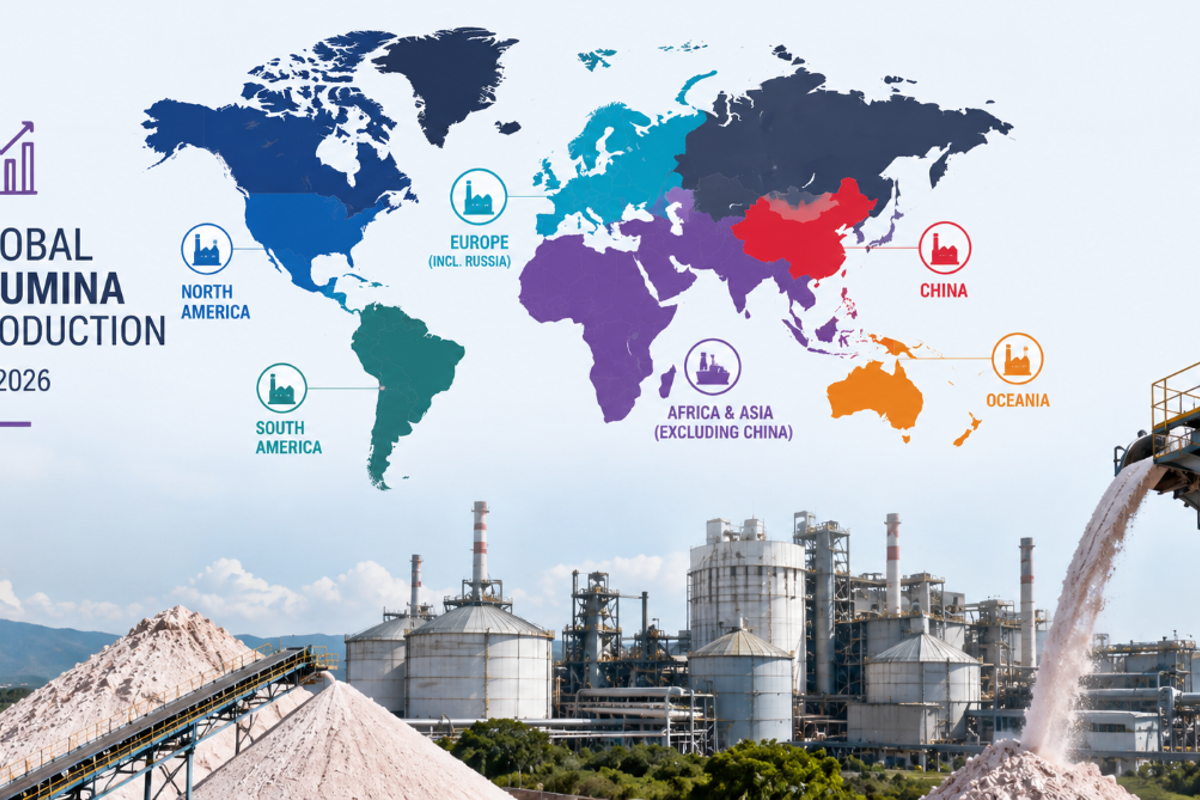
The image used in this article is generated with an AI tool and does not depict any real-time moment
Global metallurgical-grade alumina production remained almost unchanged in the first half of 2026, totalling 70.24 million tonnes, compared with 70.27 million tonnes in H1 2025-a marginal decline of just 0.04 per cent year on year. But that near-flat headline conceals one of the most eventful six-month periods the alumina industry has witnessed in recent years.
While China's expanding refining capacity helped cushion the global output, Africa and Asia (excluding China) struggled with tightening bauxite availability and weakening refinery margins. North America remained constrained by operational changes at its only operating refinery, Europe continued to battle elevated energy costs, Oceania adjusted to the permanent loss of refining capacity, and South America stood out as one of the few regions to register year-on-year growth, supported by earlier infrastructure investments.
If we look at the quarterly trend, we can see how those pressures gradually unfolded.
Global alumina production slipped to 34.93 million tonnes in Q2 2026, marking a 1.7 per cent decline from 35.33 million tonnes in Q1, after output had already dropped 6 per cent from 37.7 million tonnes in Q4 2025.
Daily average production mirrored this trend, easing to 382,600 tonnes in Q2 2026 from 393,700 tonnes in Q1 2026, after falling from 409,800 tonnes in Q4 2025.
China: Stable annual output despite changing market dynamics
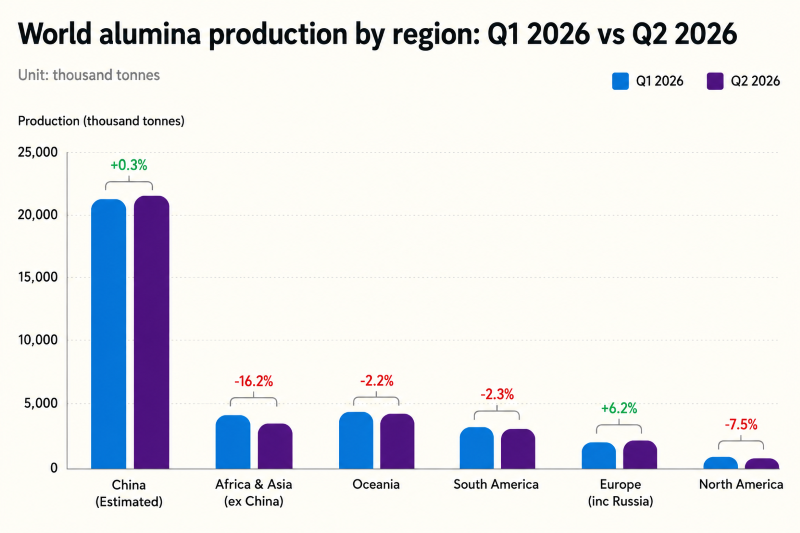
China retained its position as the world's largest alumina producer, with estimated output rising from 42.42 million tonnes in H1 2025 to 42.82 million tonnes in H1 2026, an increase of 1.0 per cent year on year. Quarterly production reached 21.4 million tonnes in Q2 2026, up 0.3 per cent from 21.3 million tonnes in Q1, although Q1 production had earlier fallen 7.5 per cent from 23 million tonnes in Q4 2025.
Although China's H1 production remained virtually unchanged year on year, the quarterly movements reflected operational and policy-led adjustments rather than weak demand. Refineries underwent scheduled maintenance in northern China, while a plant in Henan halted production for environmental compliance. Additional maintenance at facilities in Guangxi and Guizhou further reduced output during Q1.
At the same time, rapid refining capacity expansion created a supply surplus. Domestic alumina prices declined by around 17 per cent quarter on quarter in Q1, compressing refinery margins. A brief recovery in smelter procurement during March offered temporary price support, but oversupply persisted. As margins weakened further in April and May, several refiners prolonged maintenance or reduced operating rates instead of producing into an oversupplied market. During H1 2026, China's domestic spot alumina price averaged RMB 2,697 per tonne, down 21.69 per cent year on year.
To know the futuristic market and value proposition of red mud, explore the report "A Comprehensive Analysis of Bauxite Residue (Red Mud): Sustainability, Resource Recovery and Strategic Recommendations"
Africa & Asia (excluding China): Feedstock shortages and weaker margins weigh on production
Africa & Asia (excluding China) produced 6.93 million tonnes of alumina in H1 2026, compared with 6.99 million tonnes in H1 2025, reflecting a decline of 0.9 per cent year on year. The slowdown became more pronounced over the quarters, with production easing from 3.8 million tonnes in Q4 2025 to 3.7 million tonnes in Q1 2026 before dropping sharply to 3.1 million tonnes in Q2, a 16.2 per cent decline from the previous quarter.
While the marginal decline in Q1 largely reflected a normalisation following the strong production levels recorded in Q4 2025, the much steeper contraction in Q2 2026 highlighted deeper structural challenges.
A key factor was tightening bauxite availability. Guinea, the world's largest bauxite producer and a major feedstock supplier to regional refineries, including Guinea Alumina Corporation, began tightening bauxite exports by June 2026. At the same time, logistics disruptions linked to the Middle East conflict, including the diversion of more than 1 million tonnes of Guinea bauxite to Indian ports, created additional delays and feedstock imbalances, reducing raw material availability for some refiners.
Refinery economics also deteriorated during the period. The international FOB Australia alumina benchmark, the key pricing reference for seaborne alumina trade, declined from around USD 321 per tonne in October 2025 to approximately USD 306.8 per tonne by the end of Q1 2026. Softer alumina prices squeezed refinery margins, reducing the incentive for refiners to operate at full capacity even where feedstock remained available.
North America: Operational restructuring keeps output under pressure
North America recorded the sharpest regional decline in H1 2026. Production fell from 844,000 tonnes in H1 2025 to 747,000 tonnes, representing an 11.5 per cent year-on-year decline. Quarterly output slipped from 387,000 tonnes in Q4 2025 to 388,000 tonnes in Q1 2026 before falling to 359,000 tonnes in Q2.
The slowdown was driven primarily by operational changes at Atlantic Alumina's (Atalco) Gramercy refinery in Louisiana. It is the only operating alumina refinery in the United States and is currently producing only around one-third of its capacity, with annual output estimated at 500,000 to 600,000 tonnes.
Also, optimisation measures, including improvements to bauxite blending and other operational adjustments, moderated production.
South America: Infrastructure investments sustain annual growth
South America was one of the few regions to register growth during the first half of the year. Alumina production increased from 5.50 million tonnes in H1 2025 to 5.55 million tonnes in H1 2026, a gain of 0.9 per cent. On a quarterly basis, production eased from 2.84 million tonnes in Q4 2025 to 2.8 million tonnes in Q1 2026 and then to 2.7 million tonnes in Q2.
The year-on-year increase was largely supported by Hydro's Alunorte refinery in Brazil, the world's largest alumina refinery with an annual capacity of 6.3 million tonnes. Infrastructure upgrades completed in 2024, including bauxite slurry pipeline systems, enabled higher annual production.
The Q2 slowdown, however, was not linked to operational performance. Hydro reported improved productivity, but softer market conditions outside China weighed on production incentives. The Platts alumina index traded between USD 303 and USD 330 per tonne during Q2, while the ex-China alumina market remained oversupplied despite lower production at some Indonesian and Australian refineries due to raw material constraints. With prices remaining subdued, producers focused on protecting margins rather than maximising output.
Explore buying & selling leads of alumina and trade opportunities on AL Biz
Europe (including Russia): High energy costs continue to erode competitiveness
Europe, including Russia, produced 2.85 million tonnes of alumina in H1 2026, down from 2.90 million tonnes in H1 2025, a decline of 1.8 per cent. Quarterly production fell from 1.45 million tonnes in Q4 2025 to 1.38 million tonnes in Q1 before recovering to 1.46 million tonnes in Q2.
The region's longer-term decline continued to reflect elevated energy costs. Several smelters and refineries had already reduced output or suspended operations in recent years, including Aldel in the Netherlands and Speira's Rheinwerk facility in Germany.
Although some operations continued, persistently high power prices and squeezed margins kept production below previous levels. Gas prices also remained higher than a year earlier, averaging around EUR 40–45 per MWh in H1 2026 compared with roughly EUR 34–36 per MWh in H1 2025. EU wholesale electricity prices for energy-intensive industries averaged around USD 95 per MWh in 2025- more than twice US levels and roughly 50 per cent above Chinese competitors.
Adding to this, Hydro also reported lower hydropower generation during Q1 due to maintenance activities at its power plants.

Oceania: From weather disruptions to lasting capacity loss
Oceania remained the world's second-largest alumina-producing region in H1 2026, although output declined from 8.47 million tonnes in H1 2025 to 8.19 million tonnes in H1 2026, marking a 3.2 per cent year-on-year decrease. The slowdown unfolded over consecutive quarters, with production easing from 4.4 million tonnes in Q4 2025 to 4.1 million tonnes in Q1 before falling further to 4 million tonnes in Q2.
The region's year-on-year decline was primarily driven by the permanent closure of Alcoa's Kwinana refinery in Western Australia, which permanently removed refining capacity from Oceania's production base.
However, the fall in Q1 was largely the result of temporary upstream disruptions rather than weaker refinery performance. Heavy rainfall at Weipa and Tropical Cyclone Narelle disrupted bauxite supplies to Pacific refineries, creating short-term feedstock constraints. In addition, Q1 comprised 90 calendar days compared with 92 days in Q4. Daily alumina production remained broadly unchanged at around 5,200 tonnes per day in both quarters, confirming that the lower quarterly output reflected supply disruptions and the shorter calendar quarter rather than a decline in operating rates.
Beneath the steady global production figure, the first half of 2026 told a story of an industry adapting to very different challenges across regions.
Unlock key insights from leading companies and experts across the aluminium ecosystem with our e-Magazine - Mine to Market: Aluminium Producers & Manufacturers 2026
Indonesia's alumina exports hit by regulatory gap over rare earth content
Next articleEuropean Commission examines Ireland's Aughinish Alumina refinery over Russia-linked export flows
Grow with
AL Circle